
Badminton is going to 15 points. How much time does An Se-young have to come back?
From Jan. 4, 2027, each game is first to 15. An Se-young’s Korea Open final against Akane Yamaguchi shows who was ahead the first time each game hit that number — and how much less room a comeback still has.
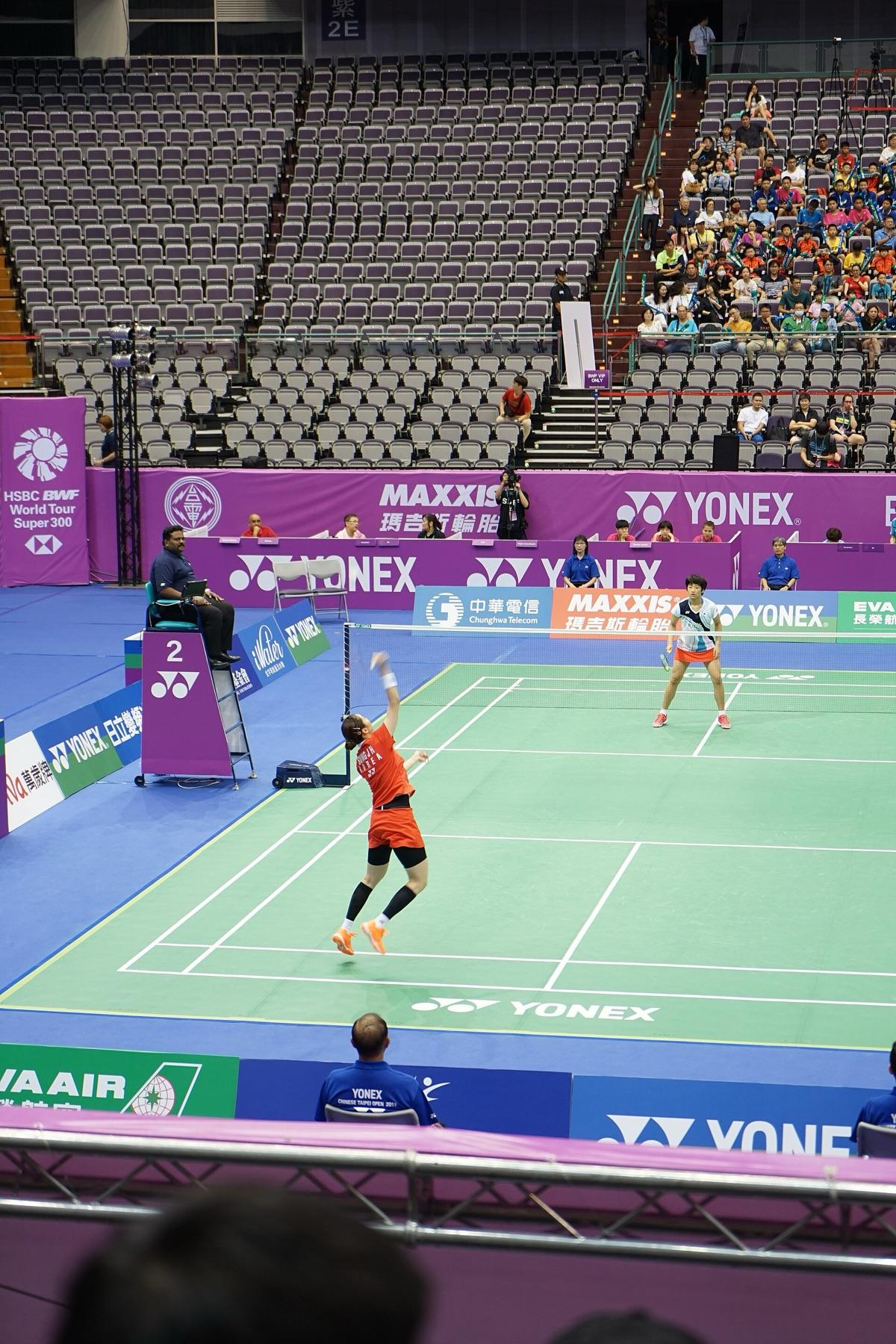
An Se-young, near side in Korea kit, at the 2019 Chinese Taipei Open. From January 2027 her matches will be first to 15, not 21.
Photo: De-Shao Liu
Starting the week of Jan. 4, 2027, badminton’s standard match is still best of three — but each game stops at 15. The Badminton World Federation voted the change through in April. Rally scoring stays. At 14-all you need a two-point lead; at 20-all the next point ends it. The mid-game break and the change of ends in a deciding game both move to eight points instead of eleven. If you are watching An Se-young, the practical question is how much runway she still has when a game starts to slip.
Last Sunday’s Korea Open final in Yeosu is a clean tape for that. An beat Akane Yamaguchi 21–12, 15–21, 21–16 for her 11th title of 2026. Stop each game the first time either player reaches 15 and note who is ahead. That is the score the new law will treat as late, every week.
Game one opened even at 9–9. An took three straight to 12–9, then, from 13–10, ran seven in a row through 19–10 before closing 21–12. The first 15 on the board was An’s, at 15–10. Under 3×15 that game is already finished. The points she still scored after 15, and the ones Yamaguchi scraped late, never get played. Yamaguchi never found a way back after 9–9; under the new ceiling she would have had even less time to look.
Game two is where the comeback question bites. Yamaguchi opened 4–0. At the mid-game interval An trailed 8–12. She climbed to 14–16, then watched it stretch to 14–19 before the game finished 15–21. Yamaguchi was first to 15, and An was still behind. An only reached 15 herself while Yamaguchi was closing. On a 15-point sheet, a Yamaguchi lead at 15 with a two-point cushion ends the game before that 14–16 chase fully forms. The long defensive exchanges An uses to force errors have fewer rallies left once she is already looking up at double digits.
Game three flipped back. After 1–1, An took five straight to 6–1. Yamaguchi got back to within one at 10–9 for An, then An stretched again and won 21–16. She led 11–9 at the old mid-game break and first hit 15 while still in front. Under the new rules that break would already have come at eight, and the game would have ended around her 15 instead of running into the low 20s. An still wins the set. Both players simply get less of it to work with.
The finish is not the only thing that moves. The choice to raise the pace — to stop floating clears and start hunting the lines — has to come earlier than the old stretch around 15–15 under 21. The mid-game drink at eight means the first tactical reset arrives while today’s eye still thinks the game is young. Serving after that break carries more weight. And the time a player can spend testing an opponent’s defense shrinks. An’s strength is winning the long exchange and the late error; a shorter game still rewards that, and it punishes a slow start more sharply. In Yeosu she could lose the second game and still have 21 points of runway in a third. In 2027 a lost game to 15 leaves the same best-of-three shape with less room inside each set.
An has said she was surprised when the vote landed, then that she can adjust — and that the early matches under 15 might feel awkward before the body learns the new clock. The Korea Open final only shows where 15 already sat on a real scoreboard against her closest rival: ahead in two games, behind in the one she dropped, with Yamaguchi holding that first 15 while An was still climbing. Watch the next meeting with that mark in mind. Eighteen is no longer where the game gets late.