
Calling all Asian women athletes
Asian Americans are about 7% of the country. AANHPI athletes are about 2.5% of the NCAA. The women who break through keep getting treated like exceptions instead of evidence.
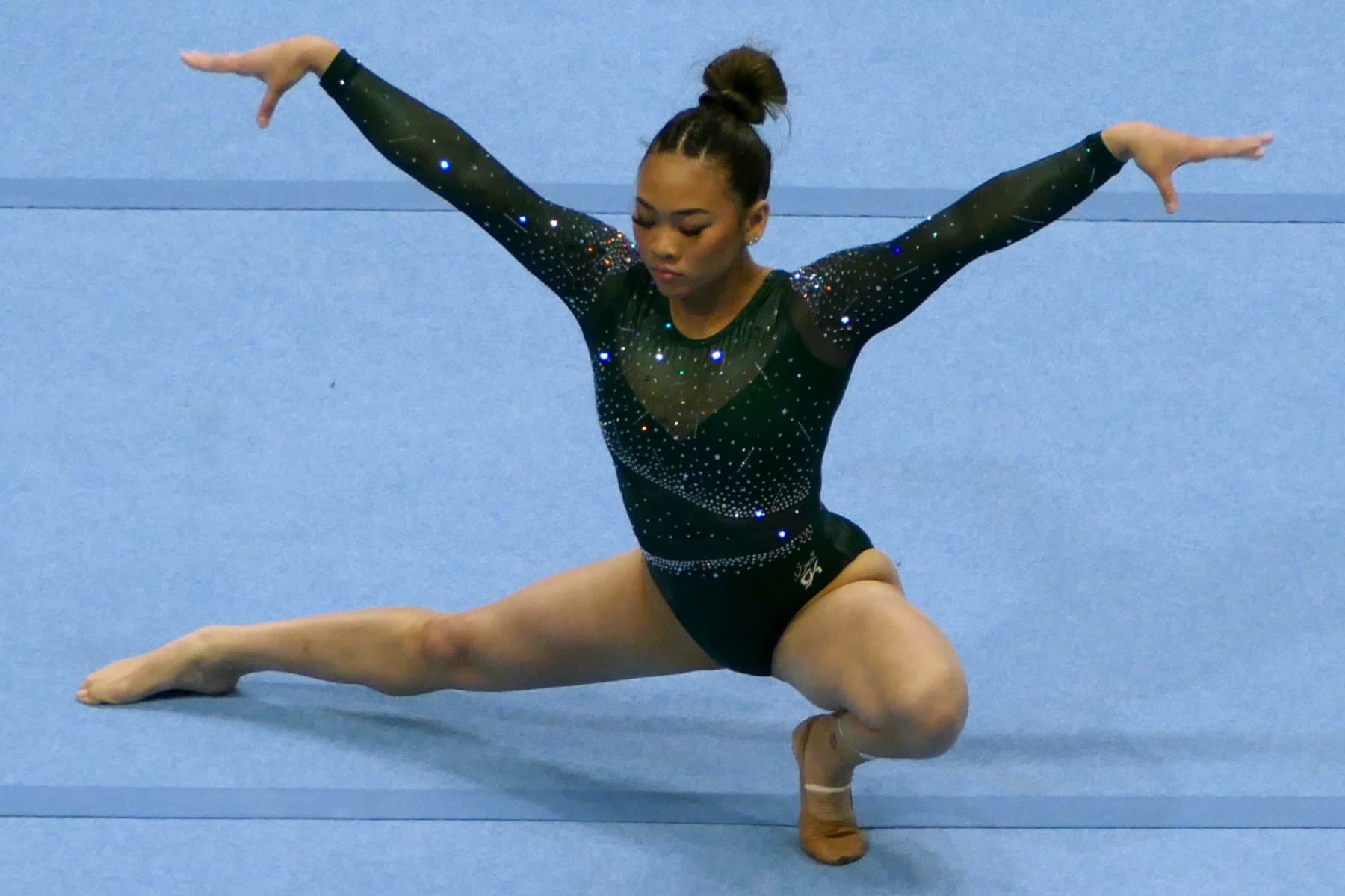
Suni Lee on floor at the 2024 U.S. Classic.
Photo: FloweringDagwood / CC BY 4.0
Suni Lee can hold a floor routine and six Olympic medals and still feel, to American sports, like a pleasant surprise. Asian American and Asian Canadian women keep arriving at the top of the sport. The systems underneath them keep acting shocked.
You can watch a lot of Division I women’s basketball, WNBA nights, and Power Five contact-sport recruiting cycles before you see one. College is the honest place to start, because that is still where most American pro women come from. Asian Americans are about 7% of the U.S. population, according to Pew’s reading of Census numbers. In 2024-25 the NCAA counted 13,844 AANHPI student-athletes — Asian plus Native Hawaiian and Pacific Islander — among 554,298 championship-sport athletes, or about 2.5%. The buckets blur a few groups together. The undercount still holds.
The hole opens earlier. Aspen Institute’s Project Play had Asian youth sports participation at 56.8% in 2024, behind white youth at 65.5%. A Minnesota Student Survey analysis of more than 4,000 Asian American girls put sport participation around 37% overall, and closer to 27% for Southeast Asian girls. Statistics Canada’s 2023 survey found Filipino women at 29.3% sport participation, against 51.4% for women who are not racialized; South Asian women were at 34.5%. The word “Asian” is a filing convenience. The childhoods inside it are not the same.
None of this requires a conspiracy. After 1965, a lot of immigrant families treated school as the ladder and sport as something you did if the homework was finished — historians and athletes describe that bargain over and over, then beg you not to flatten it into a joke about tiger parents. Coaches absorb a second script: smart, small, delicate, not for the collision sports. Studies of Asian American women in college athletics and powerlifting keep landing on the same bind. Race reads as non-athletic. Gender reads as a warning against taking up space. Girls get pointed at the sports that already look acceptable, then locked out of the ones that pay and broadcast.
The numbers are moving anyway. NCAA AANHPI participation is up 48% in a decade. Women’s basketball is up 58% in that window; golf 59%; gymnastics 62%; lacrosse 94%. AANHPI women are now 10% of NCAA women’s golf and 8% of women’s tennis and gymnastics — a real foothold in a few sports, and still thin everywhere else.
The names at the top are harder to ignore: Lee, the first Hmong American Olympian; Chloe Kim, who will not perform gratitude on demand; Rose Zhang’s Stanford-to-LPGA path; a U.S. Solheim Cup team stacked with Asian American golfers; Natalie Nakase, the WNBA’s first Asian American head coach, with the Golden State Valkyries. The Institute for Diversity and Ethics in Sport still had Asian players at about 1.4% of the WNBA in 2023. One hire does not fill a league.
What people call representation usually comes down to ordinary choices. A 12-year-old decides whether another year of club fees is worth it. A college coach builds a watch list from the camps she already trusts. A front office tries to picture a head coach who is 5-foot-2 and Japanese American. Lose the girls early and you lose the scholarships, the assistants, and the sponsors who finally learned women’s leagues can sell. That Minnesota study also tied sport participation to lower odds of anxiety and depression among Asian American girls. Pull the team, and you pull more than a jersey.
Women’s sports are having a boom. Asian American and Asian Canadian women are still treated like a specialty item — fine for skating and golf, rare on Tuesday night TV. The work is dull and specific. Recruit past the same suburbs. Put money into club access where Southeast Asian and Filipino kids actually live. Hire people who do not need a workshop to believe an Asian American point guard belongs. Keep the women who already made it on camera long enough that the next one does not feel like a glitch.
Lee’s floor exercise was always evidence. The talent was in the building. College and pro sports are still arranged as if it were hiding. Call the athletes. Then call the rooms that keep failing to see them.