
Korea loaded the Asian Games with World Cup wildcards. Japan brought a U-21 team.
Same U-23 tournament, opposite squad philosophies — military-gold urgency meets an LA28 development window on home soil in Aichi–Nagoya.
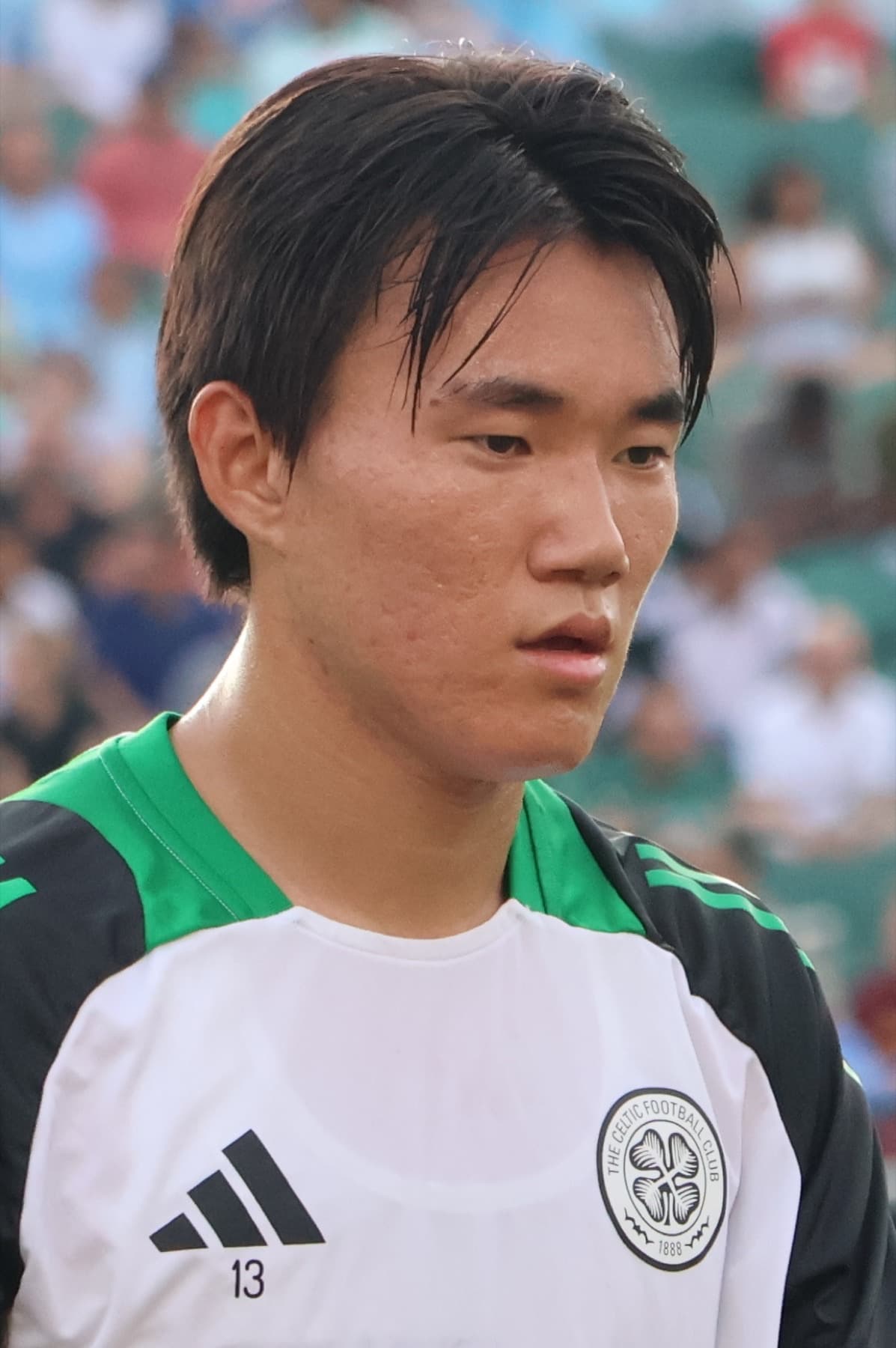
Yang Hyun-jun in Celtic’s white training kit during a July 2024 open practice in Cary, North Carolina — Korea’s World Cup wildcard and Europe-based face of the Asian Games gold chase.
Photo: Hameltion / CC BY-SA 4.0
On Friday in Tokyo, Go Oiwa read out twenty-three names for Japan’s home Asian Games and left three overage slots blank. The tournament is built for under-23 sides with up to three wildcards. Japan answered with a pure under-21 roster aimed at Los Angeles 2028 — captain Rion Ichihara of AZ Alkmaar, Frankfurt’s Keita Kosugi, Sint-Truiden’s Nelson Ishiwatari, Aalborg’s Uche Brian Nwadike, and nineteen other players still inside the Olympic age band. South Korea had already chosen the other door: three World Cup overagers, nine Europe-based professionals, and a gold medal that still doubles as a military-service exemption.
The contrast is the story. Asian Games men’s football has been a Korea–Japan final factory for two cycles. In Jakarta–Palembang 2018 and Hangzhou 2022, Korea won both golds 2–1 over Japan — three straight titles counting Incheon 2014, six overall. Japan’s only men’s gold remains Guangzhou 2010. Aichi–Nagoya, the first Japanese hosting since 1994, opens football on September 15 with the final at Toyota Stadium on October 3. The squad sheets published weeks apart now tell you how each federation intends to walk into that rematch.
Korea’s list, confirmed by the Korea Football Association on July 9, treats the Games as a finished product. Coach Lee Min-sung filled the overage slots with Celtic’s Yang Hyun-jun, Swansea’s Eom Ji-sung, and Gangwon’s Lee Gi-hyuk — all three World Cup squad members still short of completed military service. Stoke City’s Bae Jun-ho, under the age limit, makes four World Cup names on a 23-man sheet that also includes Tottenham’s Yang Min-hyeok and Brentford’s Kim Ji-soo. Lee has said aloud that gold is the goal; for the wildcards, gold is also career continuity. Asian Games champions and Olympic medallists earn exemption under Korean law, the same path Son Heung-min took in 2018.
Japan’s list treats the Games as a laboratory with home crowds attached. Oiwa’s U-21s include three university players and leave out senior-capped attackers who might have stiffened a win-now XI. The Europe quartet is younger than Korea’s: development minutes at Alkmaar, Frankfurt, Sint-Truiden, and Aalborg rather than Celtic and Swansea. Oiwa will take the senior Samurai Blue job in March 2027 after Hajime Moriyasu finishes the Asian Cup; for now the Asian Games are the first public exam of the dual track the Japan Football Association just approved — grow the Olympic generation, then fold that language into the A team.
The groups sharpen the philosophies. Host Japan opens Group A against Hong Kong China, Kyrgyzstan, and Thailand — four teams, three matches, a home runway. Defending champion Korea sits in three-team Group D with Saudi Arabia and Qatar after Iraq’s withdrawal left a fifteen-team field. Korea plays one fewer group match and still faces two World Cup-qualified West Asian sides before the quarter-finals. Neither draw is decorative. Both are readable only against the squad choices already made.
Read the sheets as two answers to the same question: what is an Asian Games gold worth in 2026? For Korea it is still a career-altering certificate — four-peat pressure, World Cup experience on the grass, Europe clubs watching whether exemption arrives before another conscription clock. For Japan it is a September stress test for the LA28 core on Japanese pitches, even if that means walking into Korea’s loaded U-23 without overage armour. September will score the argument. The squad lists already published the theses.