
How Nadeshiko Japan built a World Cup system
From Frankfurt 2011 to a third Asian Cup in Sydney — Beleza depth, a professional WE League, and a WSL generation turned a miracle title into a durable machine.
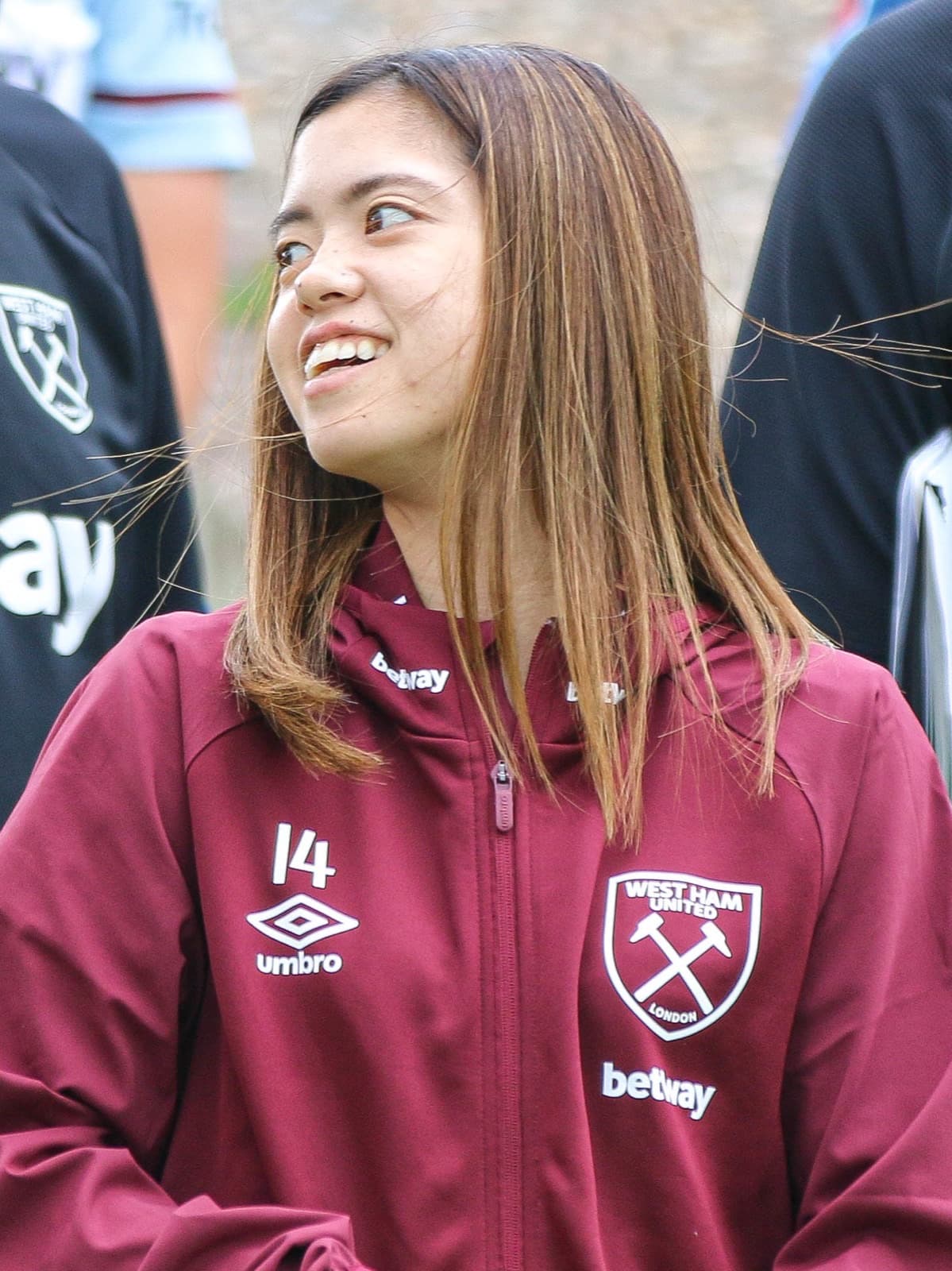
Yui Hasegawa in West Ham United colours during an August 2021 preseason match at Lewes — the midfield face of Nadeshiko’s Europe pipeline before her Manchester City years and Japan captaincy.
Photo: jamesboyes / CC BY 2.0
On a March night in Sydney, Maika Hamano curled Japan ahead in the seventeenth minute and a Stadium Australia crowd of 74,397 — an Asian Cup record — spent the rest of the evening trying to drag Australia level. The Matildas never did. The Nadeshiko left with a third continental title, the tournament’s Golden Boot on West Ham’s Riko Ueki, and a Brazil 2027 World Cup berth already locked from the quarter-finals. The useful story is not that Japan can still win Asia. It is how a side that once needed a miracle in Frankfurt rebuilt itself into a system that keeps producing those nights.
The nickname came first as branding, then as identity. In July 2004 the Japan Football Association asked the public for a team name; from roughly 2,700 entries it chose Nadeshiko Japan — after the dianthus flower and the older phrase Yamato nadeshiko, the ideal of quiet strength. For years it sat lightly on a competitive side that still trailed China’s Steel Roses in Asia’s hierarchy. Then Frankfurt changed the word’s meaning. After the 2011 World Cup final, Nadeshiko stopped sounding like a marketing contest and started sounding like a football culture.
That final remains the founding proof. Japan twice cancelled United States leads — Aya Miyama in the eighty-first minute, Homare Sawa with a near-post heel flick in the 117th — before winning 3–1 on penalties in front of 48,817 in Frankfurt. Captain Sawa took the Golden Ball and Golden Boot; Saki Kumagai scored the decisive kick. Japan became the first Asian side to win a Women’s World Cup, months after the Tohoku earthquake and tsunami had made the team’s presence in Germany feel like national oxygen. Silver medals followed at London 2012 and Canada 2015. The miracle had a sequel. What it did not yet have was a professional domestic ladder that matched the ambition.
The factory that fed those squads was already old. Nippon TV Beleza — now Tokyo Verdy Beleza — had been minting national-team midfielders and forwards since the L.League era: Sawa, then Yui Hasegawa, Riko Ueki, Aoba Fujino, and a long list of caps in between. INAC Kobe Leonessa supplied a second hub, including the 2011 domestic double season that overlapped the World Cup year. Club football in Japan was serious. It was not yet fully professional in the way Europe’s top women’s leagues were becoming. Players still left for Germany or Scandinavia in ones and twos. The national team’s ceiling depended on how many of those careers stayed sharp enough to matter in July.
The WE League answered that gap. Announced in June 2020 and launched in autumn 2021 as Japan’s first fully professional women’s top flight, it pushed the semi-professional Nadeshiko League down a tier and asked clubs to pay wages that could keep talent home longer. Average crowds are still climbing toward the league’s early five-thousand target — about 2,138 a match in 2024–25 — and the product remains uneven between Hiroshima sellouts and quieter midweek nights. The developmental return is clearer. A twelve-club professional calendar gives teenagers a domestic stage that looks like a career, not a hobby with a national-team bonus attached.
Europe then became the finishing school. Hasegawa’s path — Beleza, a West Ham landing, then Manchester City from 2022, with a deal that now runs to 2029 — is the template for Japan’s midfield generation. Fujino and goalkeeper Ayaka Yamashita joined her at City; Ueki leads the line at West Ham; Hamano’s Chelsea-to-Tottenham loan arc produced the Asian Cup final winner. Hinata Miyazawa at Manchester United and Fuka Nagano at Liverpool filled out a WSL core so thick that Japan’s Asian Cup final XI read like an English matchday programme with a few WE League surnames mixed in. The men’s Samurai Blue story is volume export. The women’s story is concentration: enough starters in one league that international weeks feel like club reunions with higher stakes.
The hard nights still arrive. Sweden ended Japan’s 2023 World Cup in the quarter-finals. The United States, via Trinity Rodman’s extra-time strike, ended the Paris 2024 Olympic run at the same stage. Those exits are real data, not footnotes. They also sit beside a ranking that has Japan fifth in the world as of June 2026 — behind Spain, the United States, Germany, and England — and beside a continental record that now includes Asian Cups in 2014, 2018, and 2026, each time past Australia in the final. The system does not guarantee July. It keeps Japan in the conversation when July arrives.
What travels from the Nadeshiko story is a three-layer lesson that mirrors Japan’s men’s Europe pipeline and its baseball export, told for a different market. Club academies and Beleza-style factories create the base. A professional domestic league makes staying home viable. Europe’s biggest women’s clubs — especially the WSL — turn that base into weekly tempo against the sides Japan must eventually beat. Brazil 2027 will test whether Hamano’s Sydney strike was a peak or a floor. For now, the machine’s output is visible every international window: a Japan captain in City colours, a Golden Boot at West Ham, a goalkeeper collecting continental awards, and a national team that no longer needs the world to be surprised when it wins.