
Volleyball systems: how national teams build depth
Olympic volleyball rosters are finished in club leagues — Italy and Poland as weekly labs, Brazil’s Superliga density, France’s export model, Japan’s school-to-SV.League funnel.
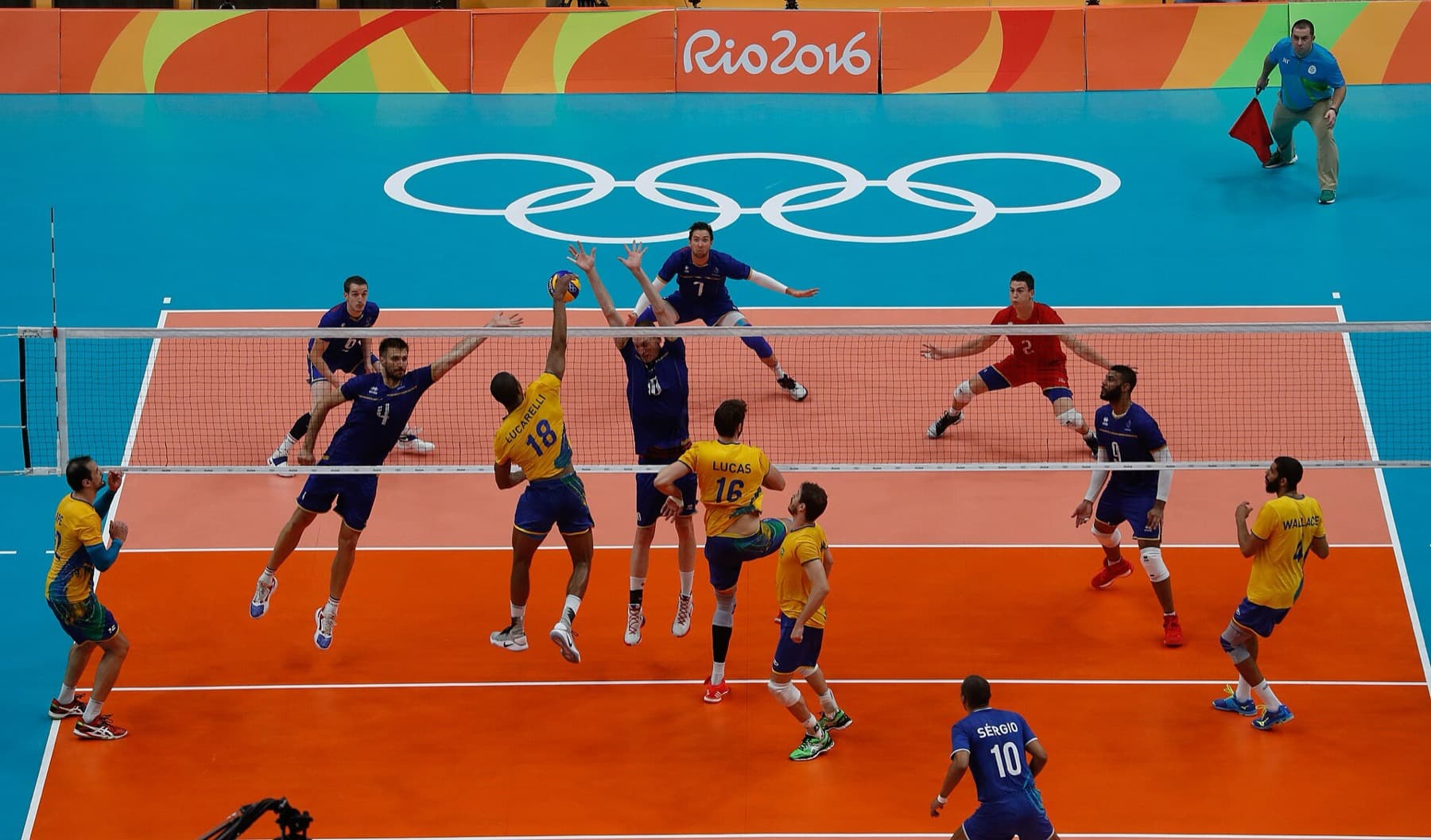
Brazil vs France in men’s volleyball at Rio 2016 — two club-fed programs on the same court; France later turned that European seasoning into back-to-back Olympic gold.
Photo: Fernando Frazão / Agência Brasil / CC BY 3.0 BR
Twelve names on an Olympic scoresheet look like a camp project. They are usually a club-league product. Federations that stay in medal conversations across cycles share a boring advantage: a domestic or destination league that pays for weekly high-level reps, develops scarce positions — setters, opposites, liberos — and still has bodies left when someone gets hurt in March. Paris 2024 made the pattern loud. France’s men defended Tokyo gold by sweeping world No. 1 Poland in the final, with Earvin Ngapeth named MVP again after seasons spent in Italy and elsewhere. Italy’s women, led by opposite Paola Egonu, took the country’s first Olympic volleyball gold of either gender — then most of that gold-medal core went straight back into Serie A1 clubs such as Vero Volley Milano and Imoco Conegliano.
Italy is the clearest weekly laboratory. Men’s SuperLega clubs — Trentino, Perugia, Lube Civitanova, Modena — and women’s Serie A1 sides treat October-to-May as the real season; Nations League and Olympic windows are the exam. The league imports world-class foreigners and still produces Italian starters who have already played Champions League tempo at club. That is why an Italian national-team call-up often feels like a reunion of rivals rather than a crash course. Depth here means positional redundancy: if one opposite is unavailable, another has already been closing SuperLega finals.
Poland’s PlusLiga runs a parallel European hub. Ahead of Paris, Polish media counted thirty-five Olympians on PlusLiga rosters — eleven Poles plus a colony of French, American, German, and other imports — across twelve clubs. ZAKSA, Jastrzębski Węgiel, Resovia, and Skra have been the domestic names; the league’s export value is that other countries’ Olympians sharpen there too. When Poland reached the Olympic final as FIVB world No. 1, it was not a two-week peak. It was a national program drawing from a league that already hosts Olympic-level minutes every weekend.
Brazil’s model keeps more of that density at home. Superliga clubs such as Sada Cruzeiro, Minas, Osasco, Praia Clube, and Flamengo feed the national teams that report to the CBV high-performance hub in Saquarema. Men’s Olympic gold in Rio 2016 and women’s golds in 2008 and 2012 grew out of that weekly domestic ladder more than from a European finishing school — though Brazilians still circulate abroad. Recent women’s Nations League call-ups still skew Superliga-heavy: the national team borrows from club density instead of inventing a roster every summer. Beach volleyball runs a separate pairs economy under the same federation brand; indoor depth is still the Superliga story.
France shows the export-then-assemble version of the same idea. A thinner domestic ceiling pushed stars into SuperLega and PlusLiga seasoning; Ngapeth’s Italian chapter is the public face of a wider pattern. Then the federation pulls them home for European Championships, Nations League, and Olympic windows. Back-to-back Olympic golds in Tokyo and Paris — only the third country to repeat in men’s volleyball after the Soviet Union and the United States — are the proof that club weeks abroad can still stock a national finishing school, provided the positions keep getting filled underneath the stars.
Japan’s funnel is the Asia-shaped cousin: school and corporate volleyball first, then the professional SV.League (the rebranded top flight that followed the old V.League). High-school powerhouses and university programs still mint teenagers into under-age national teams; corporate clubs and licensed SV.League sides turn that into a paid career. The national team travels with a wider bench than a single golden class can invent, even when Japan’s Olympic ceiling has been quarterfinals rather than gold. Indoor and beach remain related but not identical markets — height and six-rotation specialization indoors, all-around pairs outdoors — and Japan’s Paris beach breakthrough sat beside an indoor program still built on that school-to-club ladder.
The spectator test for depth is fairly simple. Watch which countries keep loading Italy and Poland with players and still fill competitive home leagues — and which lean on one age band that ages out together. Programs that last treat the national team as a finishing school on top of club weeks. Programs that spike treat the Olympic window as the place where the system is supposed to appear. Paris already showed the difference. LA28 will ask whether those same leagues still have the next setters and liberos ready when the current ones need rest.