
Diving mechanics: what separates podium finishes
How World Aquatics scoring actually works — execution marks, degree of difficulty, synchro matching — and why the last optional dive decides medals.
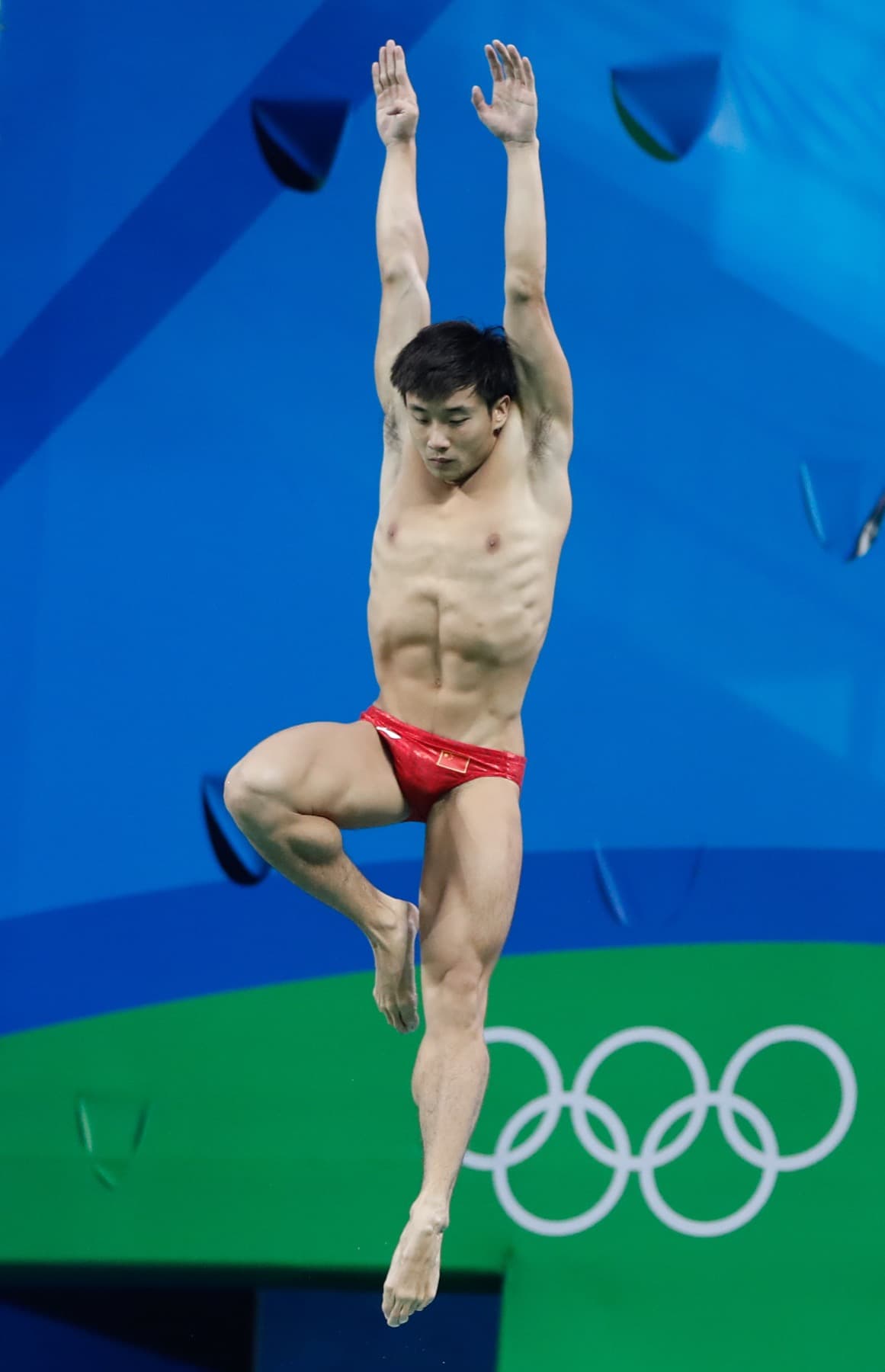
Cao Yuan competing for China at the Rio Olympics — the mid-air tightness and vertical entry that still define China’s scoring standard.
Photo: Fernando Frazão / Agência Brasil / CC BY 2.0
A diving score is an execution mark multiplied by a published degree of difficulty. Miss either half and the board looks mysterious; understand both and Olympic finals become readable. What separates podium finishes is almost always the same tradeoff: how much difficulty a diver can put on the sheet without giving the judges a reason to drop into the sixes.
In individual Olympic events, seven judges each award 0 to 10 in half-point increments. The two highest and two lowest marks are discarded; the three that remain are added, then multiplied by the dive’s degree of difficulty (DD). Judges are not scoring difficulty — World Aquatics rules tell them to ignore it — and they are not scoring splash alone. They collapse five phases into one mark: starting position, approach, takeoff, flight, and entry. The verbal scale runs from excellent (10) through very good, good, and satisfactory, down to deficient and failed (0). A dive performed clearly in the wrong body position — tuck announced, pike shown — is capped at 2. Perform the wrong dive number entirely and the referee can call it failed.
Degree of difficulty is the fixed half of the equation. Every listed dive carries a DD built from World Aquatics components — roughly somersaults, flight position, twists, approach/group, and unnatural-entry factors — published before the meet. Positions matter: A straight, B pike, C tuck, D free. More rotation and twist raise the tariff; so does a harder approach group. Elite optional lists often live in the high threes. That number does not move with the splash. It multiplies whatever the judges give you.
That is why the risk math is ruthless. Three counting marks averaging 6.0 on a 3.5 DD dive yield 63.0. The same three marks averaging 8.5 on a safer 2.5 DD dive yield 63.75. A high-tariff dive can survive a modest splash if the judges stay in the sevens; a safer dive dies if the entry opens or the body leaves vertical. China’s program still sets the execution baseline the field is measured against — takeoff balance, somersault tightness, and a vertical entry that disappears. Cao Yuan’s career is that standard made human: Olympic gold on 3 m springboard at Rio, then consecutive 10 m platform titles in Tokyo and Paris, including the dive that completed China’s eight-gold sweep in 2024. When rivals from Japan, Britain, Mexico, or Australia steal a night, they usually do it by matching that cleanliness on a DD China already put on the list.
Synchronized diving adds a second scoreboard. Eleven judges work in three panels: three on diver A’s execution, three on diver B’s, five on matching. After highs and lows are dropped in each panel, five marks remain — one execution per diver, three synchro — then the total is multiplied by 0.6 before DD, so synchro totals sit in a similar range to individual scores. Synchro judges watch height at takeoff, timing through the air, distance from the board, entry angles, and whether the pair hits the water together. Two excellent solo divers can lose if their shapes diverge by a frame. That is why Olympic synchro finals often feel stricter than the highlight reel: the matching panel can punish what a casual eye still calls clean.
For a spectator, the readable exam is the last optional. Early rounds establish whether a list is honest; the final dive is where a leader protects a lead with a high-percentage entry or chases with a tariff that needs sevens. Watch the last half-metre into the water — arms by the ears on a headfirst entry, toes pointed, body straight, splash collapsing — because that is where execution marks move fastest. Then glance at the DD next to the name. The podium is usually the diver who kept both numbers working on the same dive.