
How Olympic qualification works
International federations allocate a limited field; national bodies decide who fills it. Here is how standards, rankings, quotas, and selection fit together.
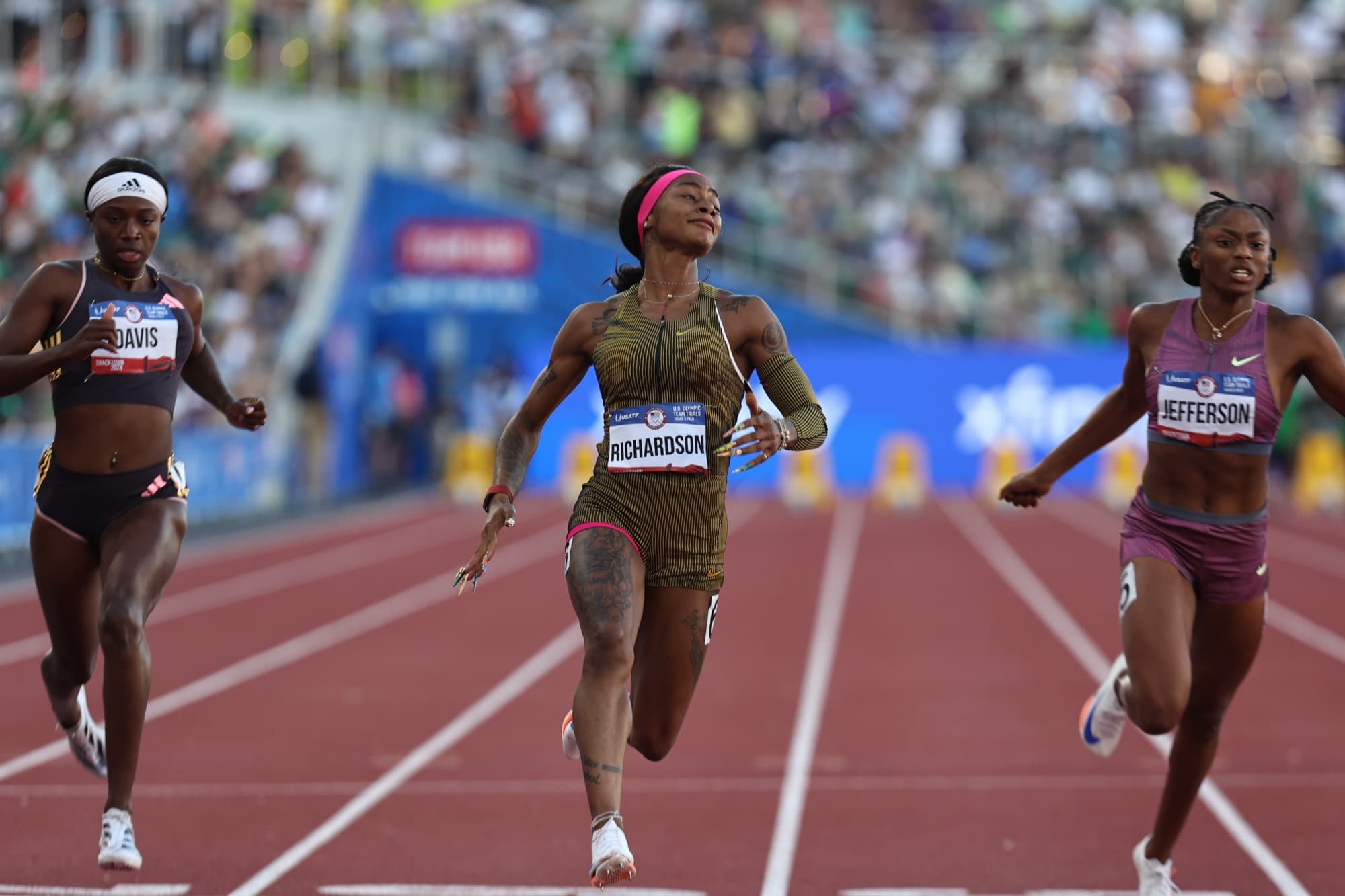
Sha’Carri Richardson, center, races Tamari Davis and Melissa Jefferson at the 2024 U.S. Olympic Team Trials — a national selection event layered over international qualification standards.
Photo: jenaragon94 / CC BY 2.0
There is no universal Olympic qualifying meet. The IOC sets principles for the Games, but each international federation writes the system for its sport and submits it for IOC approval. Those documents cover eligibility, pathways, national limits, deadlines, and what happens when a place is declined. For LA28, the systems are meant to offer more than one chance inside qualification windows of no more than two years.
Who owns the place: NOC or named athlete?
Every sport states whether its places go to a National Olympic Committee or to an athlete by name. Even a named place still needs the NOC’s confirmation before the entry is final.
| Allocation | What it means | Examples |
|---|---|---|
| NOC place | The country earns the slot and later names the athlete or crew under its own procedures | Canoe sprint boat quotas; swimming relays |
| Named athlete | A ranking or event result attaches the place to a specific person | Badminton and golf ranking pathways; many surfing Tour places |
The main pathway types
Individual sports usually lean on standards, rankings, or both. Championship chains and team-sport tournaments work on a different calendar logic.
- Standards: hit a published mark at an approved meet inside a fixed window.
- Rankings: accumulate results across events, often with weighting for level, opponents, or finish.
- Championships: Worlds can hand out early places; continental events protect geography; a final qualifier fills what remains.
- Team tournaments: continental rounds feed global qualifiers because the Olympic field is far smaller than a world championship field.
The calendar matters as much as the headline number. A personal best outside the window, or at an unapproved meet, may carry no Olympic value. National limits add another filter: if one country has more ranking-eligible athletes than it is allowed to enter, the next eligible athlete or NOC inherits the place. In a deep program, surviving domestic selection can be harder than hitting the international mark.
Case study: LA28 swimming
Swimming stacks several mechanisms inside one overall quota of 830 athletes. Individual entry standards sit on a clear clock: approved meets only, from March 1, 2027 through June 18, 2028.
| Standard | What it unlocks | Limits |
|---|---|---|
| A | Direct qualification path, subject to entry rules | Maximum two swimmers per NOC per event |
| B | Invitation only after higher-priority categories are filled | Same NOC caps; unused places first |
- New 50m backstroke, breaststroke, and butterfly: top six in designated 2027 World Cup finals earn direct places.
- Relays: national quotas, not named athletes — the 12 fastest NOCs in each relay heat at the 2027 World Aquatics Championships in Budapest qualify, then each country builds its Olympic relay roster from eligible swimmers.
Case study: surfing’s mixed allocation
Surfing is why readers should check the allocation column instead of assuming one rule applies to every sport. Some LA28 places attach to athletes by name — through the World Surf League Championship Tour and continental competitions — while certain World Surfing Games places go to an NOC. The pathway is hierarchical: athletes already qualified earlier are skipped when later places are handed out.
Host places, universality, and late reallocations
- Host places are sport-specific, not a blanket invitation for the United States across every event, and many still require minimum participation or performance.
- Universality places help traditionally underrepresented NOCs in selected individual sports; the Tripartite Commission handles many allocations, while athletics and swimming are run by their federations.
- After the last qualifier, federations notify NOCs, which accept or decline by deadline. Declined places move down a written hierarchy — next ranking, team, or continental finisher — so provisional lists can change without another competition.
What else has to be true
A ranking position cannot fix a missed citizenship rule, an ineligible performance, or a failure to meet the sport’s participation conditions. Athletes still need Olympic Charter compliance, nationality clearance, World Anti-Doping Code adherence, and federation technical requirements. Age rules vary by sport.
National selection is a second rulebook. In the United States, each national governing body may use trials, rankings, discretionary criteria, or a mix; the USOPC reviews nominations. Other countries weigh medal potential, consistency, team composition, or head-to-head results. Disputes usually turn on whether published criteria were followed.