
The Asian Games athletes most likely to become global stars this fall
Aichi–Nagoya opens in six weeks. These are the names who can turn a continental medal into an LA28 résumé — or a bigger pro market.
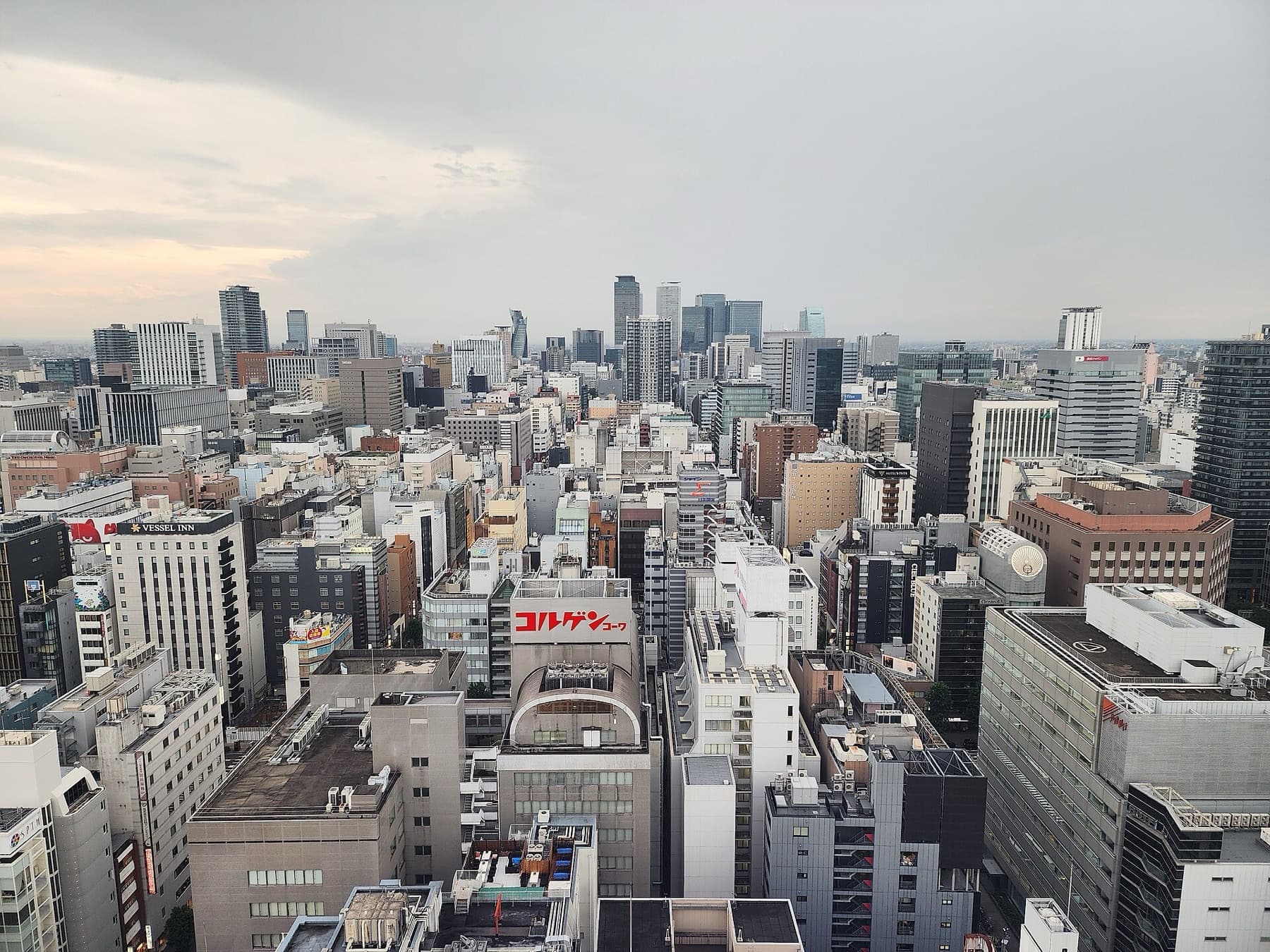
Nagoya’s Sakae skyline from Mirai Tower, looking west toward the station towers — the host-city backdrop for the 20th Asian Games in September 2026.
Photo: LMP 2001 / CC BY-SA 4.0
The 20th Asian Games open in Aichi Prefecture and Nagoya on September 19. For two weeks after that, Asia’s best compete under one roof — swimming at the Tokyo Aquatics Centre, athletics at Paloma Mizuho Stadium, tennis in Higashiyama, badminton in Ichinomiya, climbing at Portmesse Nagoya. The medals matter. What matters more for the next Olympic cycle is who leaves Japan looking bigger than a continental champion.
Think of this as a shorter autumn list: athletes who can use Aichi–Nagoya as a launchpad into Los Angeles 2028 or into a louder professional market. Some are already household names at home. A gold, a breakthrough race, or a home-crowd week can make them familiar elsewhere.
Start with the tours. Alexandra Eala has confirmed to Philippine officials that she will play the Games after Hangzhou bronzes and a first WTA Tour singles title in Washington. Tennis runs September 27 to October 3, overlapping the China Open, so the calendar is still a live problem — but she arrives as a gold favorite and the face of a country suddenly packing its tennis courts.
Golf carries a different kind of pressure. Korea is sending Kim Joo-hyung, Kim Sung-hyun, and Moon Do-yeop, and for the first two, Asian Games gold still comes with a military exemption that can keep a PGA Tour career intact.
Japan answers by fielding pros for the first time — Keita Nakajima and Kazuki Higa, with amateur Daishi Moto — on a home course that rewards a bigger circuit. The women’s Korean team is worth watching for the opposite reason: several LPGA stars declined, so amateurs such as Yang Yunseo get the continental spotlight early.
In the pool, China’s published roster is the cleanest preview of who will own September evenings. Olympic champion Pan Zhanle headlines the freestyle, Qin Haiyang the breaststroke lane, and Zhang Yufei the veteran women’s side.
The name to write down twice is Yu Zidi: thirteen years old, already a world championship medalist, and named to China’s swimming roster for these Games. A multi-gold week would turn a phenom story into a global one while she is still in junior high. Watch also for Hong Kong’s Siobhan Haughey if she is selected, and for Japan’s Rikako Ikee on home water if she makes the cut.
On the track, Thailand’s Puripol Boonson brings sprint speed that already travels on the Diamond League circuit; an Asian Games title would make him harder to miss ahead of LA28. Singapore’s Shanti Pereira remains the regional face of women’s sprinting when she is healthy enough to race. Japan’s confirmed middle-distance breakout is Rin Kubo in the women’s 800 — a host name who can spill beyond the stadium if she turns home pressure into a medal.
The sports that already sell well in Asia deserve the same early look. Sport climbing runs late in the Games at Portmesse Nagoya, where Japan’s Miho Nonaka, Korea’s Seo Chae-hyun, and China’s Zhang Yuetong are the women’s names most likely to turn a final into viral clips, with Lee Dohyun on the men’s Korean side.
Badminton’s An Se-young is the clearest women’s star if she arrives healthy, while Malaysia’s Lee Zii Jia and Singapore’s Loh Kean Yew still own the men’s highlight reels. In table tennis, China’s Sun Yingsha and Wang Chuqin will treat Nagoya as Olympic-cycle practice for LA28 doubles and mixed pairs — though Korea’s Shin Yu-bin and Lim Jong-hoon have already shown on the World Table Tennis circuit that they can beat them.
Gymnastics sits between those lanes and the Olympic podium. Carlos Yulo is still the Philippine standard after Paris; younger brother Eldrew joins a Team PH men’s group that also includes Fil-Am recruit Zachary Nunez. China’s Zhang Boheng arrives as the continental all-around standard after winning the Asian Championships in June. On the Philippine women’s side, Paris Olympian Levi Jung-Ruivivar and a US-based Fil-Am group step in while Aleah Finnegan recovers from injury — another reminder that Nagoya will still read in both Manila and California.
That diaspora map is the commercial point. Eala, the Yulos, Nunez, Jung-Ruivivar, Haughey, and — if she plays for Japan — Naomi Osaka all give brands audiences on two shores without inventing a new market. Asian Games coverage is still cheaper and less crowded than an Olympic year. Identifying who can carry a kit, a watch, or a bank campaign from Nagoya into 2027 World Championships and then LA28 is easier in September than in July 2028, when every agency already has a shortlist.
So watch the week the way a curious fan — and a sponsor’s research desk — should: who wins when the favorite is supposed to win, who looks ready for a deeper pro calendar, and who suddenly has fans outside their home federation. Aichi–Nagoya will hand out hundreds of golds. Only a handful will leave looking like the start of a global career. Those are the names worth knowing before the Opening Ceremony, not after the highlight packages cool.