
Beyond the “technical” athlete: the new generation of Asian American sports stars
Milano Cortina put Alysa Liu and Chloe Kim back in the spotlight. Why does coverage still reach for discipline before power, charisma, or cultural weight?
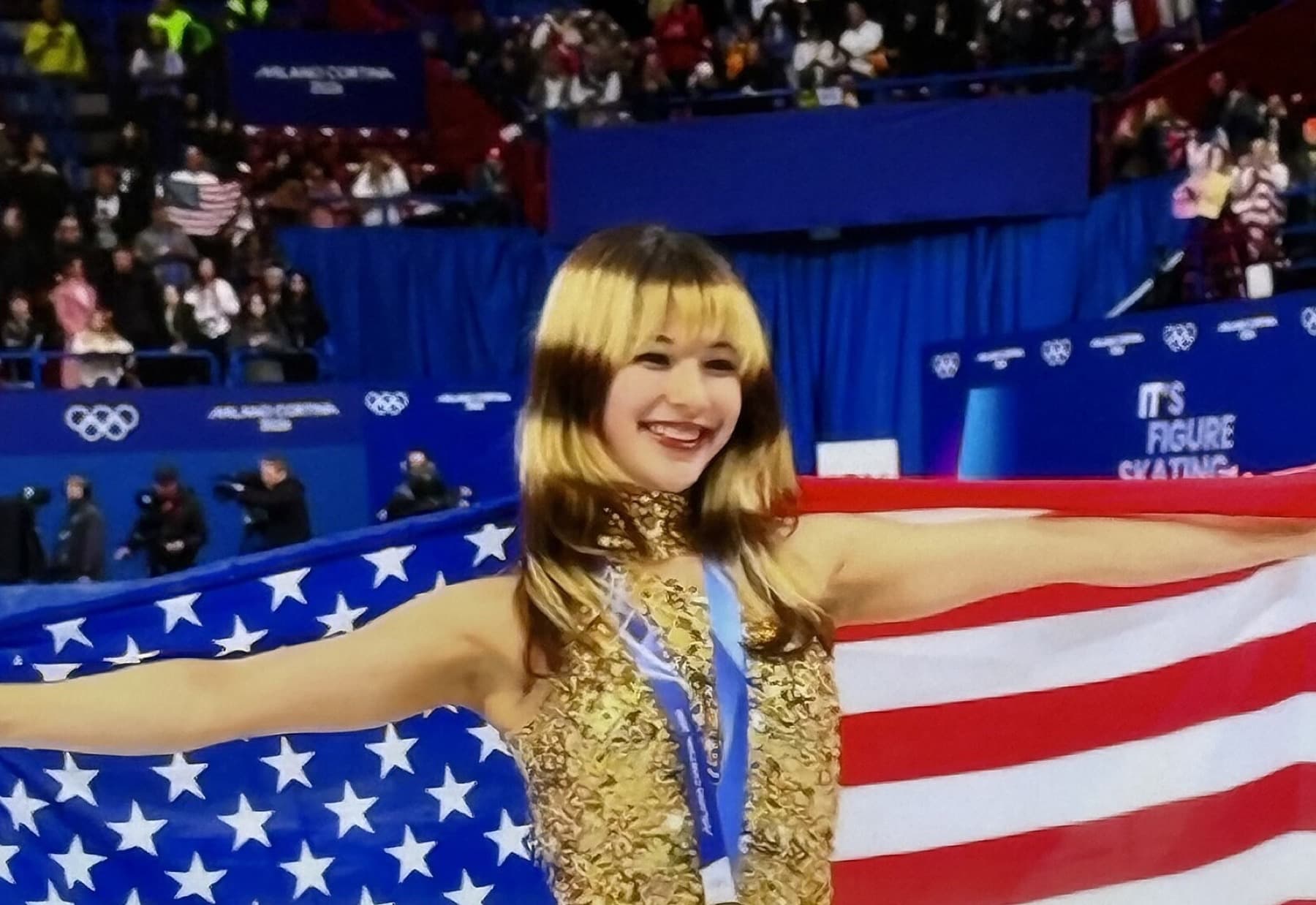
Alysa Liu with Olympic gold and the U.S. flag after the women’s figure skating final at Milano Cortina 2026 — the first American woman to win the title since 2002.
Photo: Jaybeeinbigd22 / CC0
When Alysa Liu took women’s figure skating gold at Milano Cortina in February, she ended a 24-year American drought. She skated like someone who had quit once and come back on her own terms — joyful, airborne, hard to pin with one adjective.
Chloe Kim, competing in Livigno with a torn shoulder labrum, took halfpipe silver behind South Korea’s Choi Ga-on and still left as one of the fortnight’s clearest American stars: stubborn, funny, and culturally loud.
Those nights are a start, not the whole map. U.S. sports media has long been comfortable celebrating Asian and Asian American athletes in figure skating, gymnastics, diving, badminton, and table tennis — sports where excellence gets sold as precision.
Plenty now look like mainstream American stars in football, golf, Olympic pools, and action-sports primetime. The language around them has not always kept up.
“Technical” is the compliment that can turn into a ceiling. Coverage still reaches first for discipline, immigrant sacrifice, strict parents, or — at its ugliest — “robotic” focus, as when Nathan Chen’s Beijing gold was framed that way in a major newspaper.
The words sound like praise. They leave less room for power, swagger, aggression, and cultural influence — the vocabulary American sports uses freely for other stars.
Look past the usual lanes. Kyle Hamilton, the Ravens safety with a Korean mother and African American father, is a multi-time All-Pro built on length, range, and violence in space. Rose Zhang won her LPGA debut and stacked Adidas, Callaway, and Rolex before most rookies finish a first sponsor binder. Collin Morikawa has two majors. Torri Huske took Paris 100 butterfly gold by four hundredths.
Representation still splits hard by sport. Figure skating and women’s golf already treat Asian excellence as normal business. The NFL’s Asian American roster remains a short list.
Aspen Institute’s Project Play work has long shown Asian American students among those most likely to say school doesn’t offer a sport they want — or that schoolwork crowds sports out. Kids copy what they see. If the only faces they get are on ice or a balance beam, the imagination narrows.
Immigrant parents, private coaching, and academies are part of the story — Liu in the Bay Area, Kim’s Mammoth Mountain pipeline, Zhang’s California junior grind. Treating that infrastructure as the whole personality is the trap. White American Olympians grow up in expensive systems too without being reduced to their parents’ calendars.
Kim has spent a decade saying she will not stay in the model-minority box.
Endorsements still trail the résumé in places. Jeremy Lin’s 2012 Knicks run moved American and Asian markets at once; more than a decade later, Hamilton can wear a South Korean flag on his helmet and still feel rare in a league of roughly sixteen hundred players. Golf and snowboarding sell the star faster. Football and basketball are slower.
The next wave is already forming around Kim, Liu, Zhang, Morikawa, and Hamilton. Milano Cortina refreshed the showcase. The vocabulary still needs to catch up — power and charisma included, not only the safest half of praise.