
Martial arts at the elite level: sport vs. tradition
Olympic combat sports keep rewriting the codebook between heritage and broadcast clarity — judo’s rule cycles, taekwondo’s electronics, and wushu’s Youth Olympic foothold.
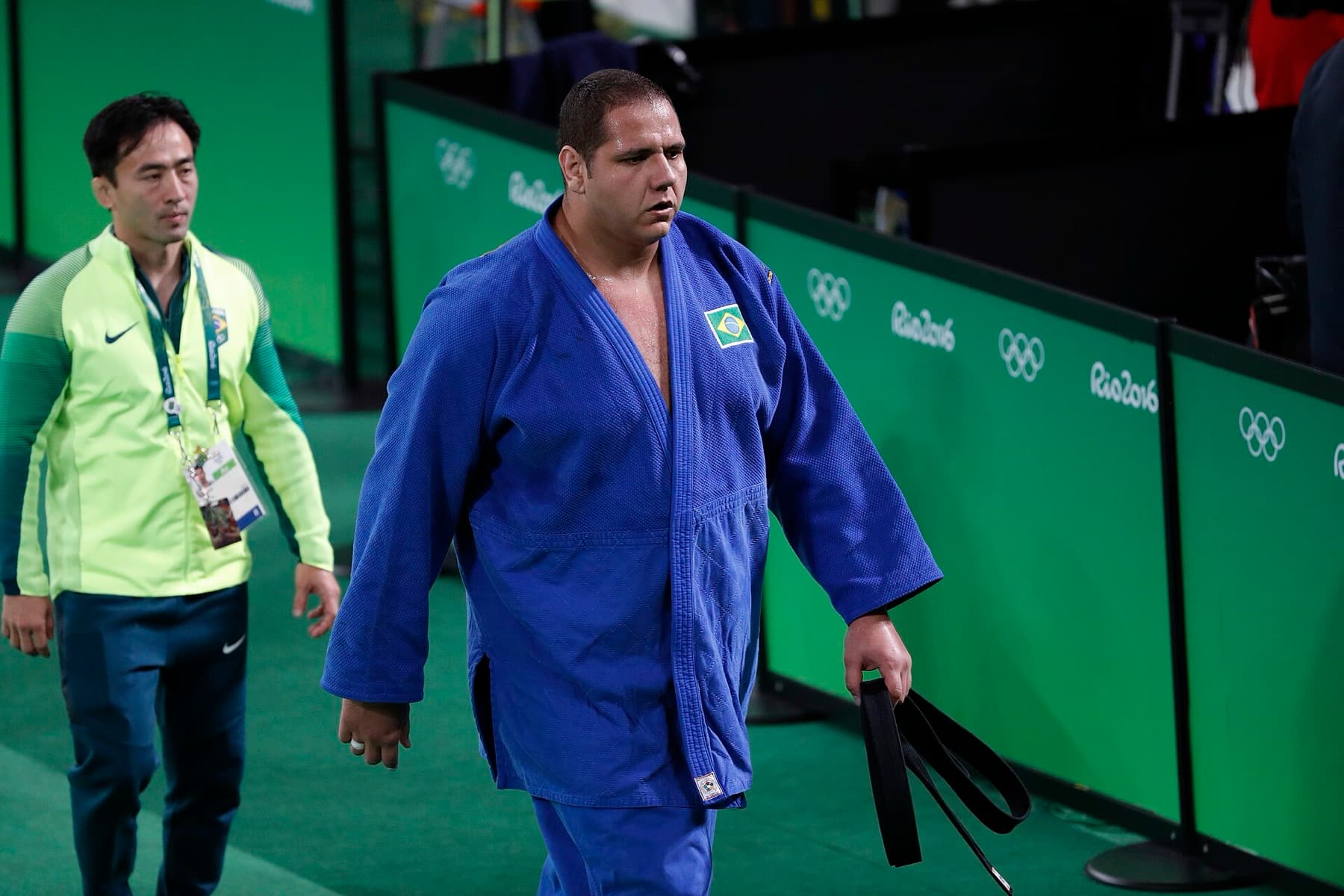
Teddy Riner against Rafael Silva of Brazil in the Rio 2016 men’s +100 kg quarter-final — Olympic judo scored, timed, and televised on a mat that still carries Jigoro Kano’s art.
Photo: Fernando Frazão / Agência Brasil / CC BY 3.0 BR
When Teddy Riner beat Brazil’s Rafael Silva in the Rio 2016 heavyweight quarter-final — regulation on the edge, then a waza-ari — the arena saw Olympic judo: weight class, timed contest, scoreboard, bracket. The art underneath that bout still traces to Jigoro Kano’s late-nineteenth-century redesign of jujutsu around efficiency and mutual benefit. Elite martial arts live in that overlap. Federations keep selling heritage to cultures and clarity to broadcasters, and the athletes who medal train whichever codebook is live this Olympic cycle.
Start with judo, because its modern history is a rulebook story. Contests are decided by ippon and waza-ari for throws, pins, and submissions; if regulation ends level, golden score continues until a technical score or disqualification. Across the 2010s the International Judo Federation shortened contest times, dropped older score tiers such as yuko, capped shido ladders, and tried to push what it called positive judo — attacking for scores rather than winning on stacked penalties. Coaches and athletes treat those cycle-end revisions as training data, not philosophy seminars. Etiquette, grip fighting, and national stylistic habits still travel from the dojo. Medals follow whoever adapts fastest when the latest shido and scoring tweaks land.
Taekwondo’s Olympic product moved further toward measurement the eye can trust on television. World Taekwondo’s Protector and Scoring System registers trunk and head kicks electronically; punches and turning-kick bonuses still need judges. Paris 2024 ran best-of-three rounds with the score resetting each round — a format built for reset drama as much as cumulative attrition. That is a different bargain with tradition than judo’s. The art remains Korean in origin and club culture; the Olympic match is an instrumented contest with published point values for spinning head kicks.
Wrestling shows the other durable pattern: classical identities kept inside a modern Olympic pathway. Freestyle and Greco-Roman still announce themselves as different sports under United World Wrestling, with different permitted holds and different national pipelines, while sharing the same Games logistics of weight cuts, seeding, and medal funding. Athletes solve the ruleset in front of them. Federations decide which identity gets the next coaching hire when Olympic quotas are finite.
Wushu’s story is still about access. The International Wushu Federation has spent years seeking a foothold in the Olympic system; Dakar 2026 puts wushu on the Youth Olympic Games programme as a full medal sport for the first time — taolu events such as changquan and taijiquan combinations for a limited field — while a Summer Games place remains a longer political climb. Inclusion is not a purity test. It is a distribution deal: federations accept rule standardization, athlete quotas, and broadcast formats in exchange for the funding and prestige that follow an Olympic logo.
Weight-class economics sit under all of this. Cutting weight, recovering between weigh-in and contest, and choosing whether to move up a division are as strategic as a favorite throw or kick. National budgets still track Olympic medals, which pulls money toward sports already on the programme and leaves traditional forms competing for cultural sponsorship when they cannot sell an IOC quota. Riner’s Rio path — Silva in the quarters, Or Sasson in the semis, Hisayoshi Harasawa in a shido-decided final — was one Olympic heavyweight’s week inside that system. The clubs that taught him still teach Kano’s art to people who will never chase a Games bracket. Elite combat sports work when federations can hold both truths without pretending the ruleset and the tradition are the same object.