
The WTA Finals are back in the U.S. Here’s how they differ from a Slam.
Indian Wells hosts the top eight singles players and doubles teams for a $10 million purse. How the Race, the round-robin, and this week’s groups work if you know Slams better than year-end tennis.
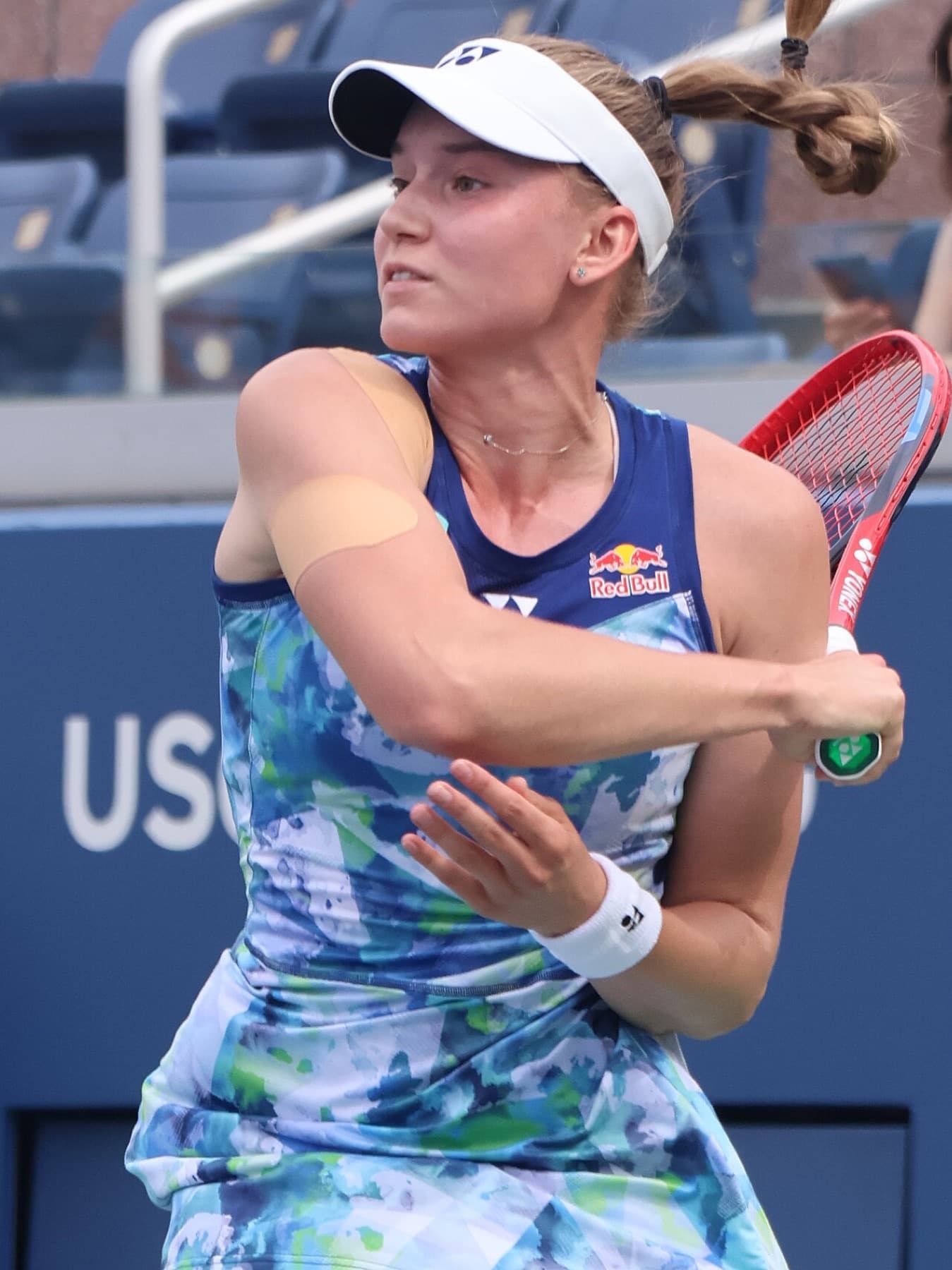
Elena Rybakina in the first round of the 2023 US Open. The defending WTA Finals champion and world No. 1 opens Group 1 at Indian Wells on Nov. 8.
Photo: Hameltion
From Nov. 8 to 15, the WTA Finals come back to the United States for the first time since Fort Worth in 2022. The stage is the Indian Wells Tennis Garden — Stadium 2, about 8,000 seats — not the 16,100-seat main bowl that fills every March for the BNP Paribas Open. Eight singles players and eight doubles teams will share a $10 million purse. If you mostly watch Grand Slams, the week will look like tennis you know until the field size, the Race, and the round-robin change what each match is for.
A Slam starts with 128 singles players and a knockout draw. Lose in the first round and you go home. The Finals start with eight players who already spent a calendar year earning a place. There is no wild card into the field, no lucky loser, no Tuesday night qualifier. Everyone here finished near the top of the Race to the Finals, a season-long points board that is separate from the rolling ranking most fans see week to week. That changes the watching habit: a midweek match is a standings result as much as a night’s score.
Qualification is the Race. Points come from the four Slams, the best results at the biggest WTA 1000 weeks, and a player’s strongest other tournaments across the Race year. The top seven on that board get in. The eighth spot can go to a current-year Slam winner ranked between Nos. 8 and 20 if one is available; otherwise it goes to the next player on the Race. Elena Rybakina locked her berth first after the US Open. Karolina Muchova took the last singles seat on Oct. 21. Three of the eight — Mirra Andreeva, Linda Noskova, and Muchova — are making their Finals debuts. Three former singles champions are back: Rybakina from last year in Riyadh, Coco Gauff from 2024, and Elina Svitolina from 2018.
The format is the other break from Slam week. Two groups of four play a round robin over the first six days. Each player faces the other three in her group once. The top two in each group move to the semifinals on Nov. 14, with the group winner meeting the runner-up from the other side. Wins come first in the table. If two players are tied, head-to-head decides; if three are tied, the order runs through matches completed, then set percentage, then games. A loss on Monday does not end the fortnight the way a Slam first round does. Dominika Cibulkova advanced from the groups at 1–2 in 2016 and still won the title. Read every round-robin match as a table result.
The money follows that structure. Of the $10 million total, $8 million is for singles and $2 million for doubles. An undefeated singles champion can leave with about $3.37 million including participation fees; an undefeated doubles pair can take $725,000. Ranking points stack the same way: 200 for a round-robin win, 400 for a semifinal, 500 for the final, up to 1,500 for a clean run. At a Slam the payday and the ranking leap concentrate on deep runs through a huge draw. Here every group win pays and moves the table. The Billie Jean King Trophy and the Martina Navratilova Trophy are the hardware.
Group 1 is Rybakina, Gauff, Jessica Pegula, and Noskova. Rybakina is the defending champion and world No. 1. She won the Australian Open and the US Open this year and still leads with the serve-and-first-strike game that ends points early. Gauff covers more court than most of the tour. Pegula hits early and flat and has sharpened the serve so she spends less time stuck defending. Noskova, the Wimbledon champion, hits a flat first ball and then mixes drop shots and slices once the court opens. The WTA has Rybakina opening against Noskova. Watch whether Noskova can take time away on hard courts the way she did on grass, or whether the serve finishes the point first.
Group 2 is Aryna Sabalenka, Andreeva, Svitolina, and Muchova. Sabalenka swept Indian Wells and Miami in the spring and still hits through the court as hard as anyone in the field, even without a Slam title this year. Andreeva, 19, won Roland Garros and arrives with 50 match wins, tied with Pegula for the tour lead. Svitolina is back after seven years away from this stage; she won Rome and still builds points by absorbing pace. Muchova breaks patterns with angles and change of pace and holds a 3–2 career edge on Sabalenka — the live problem inside that group. Across both pools, Noskova is 0–3 against Rybakina and 0–3 against Sabalenka, and Andreeva is 0–6 against Gauff. A first Slam title does not settle every hard-court rematch.
Doubles uses the same round-robin shape. Guo Hanyu and Kristina Mladenovic, the Wimbledon champions, sit with Dabrowski/Stefani, Hsieh Su-wei and Jelena Ostapenko, and Elise Mertens with Zhang Shuai. Mertens won the Finals last year with Veronika Kudermetova; this year she arrives with Zhang. The other group is led by Taylor Townsend and Katerina Siniakova. Touch and the return still decide who lifts the Navratilova Trophy.
Sessions start at noon local time, one block a day, with two singles matches and two doubles — closer to a single stage than to a Slam’s dozen courts humming at once. Keep the group tables open. In Group 1, see whether the short point or the scramble wins. In Group 2, see whether Sabalenka’s first strike holds, or whether Muchova and Andreeva can make her hit one more ball. These players were already in this desert in March. Now there are eight of them, a $10 million purse, and every win moves a standings line.