
The triple Axel that earned Ami Nakai 9.37 points at Skate America
On Nov. 14 in Everett she opened with an 8.00 base-value triple Axel, added 1.37 in GOE, and left the ice at 82.20 — nearly eight points clear into Sunday’s free.
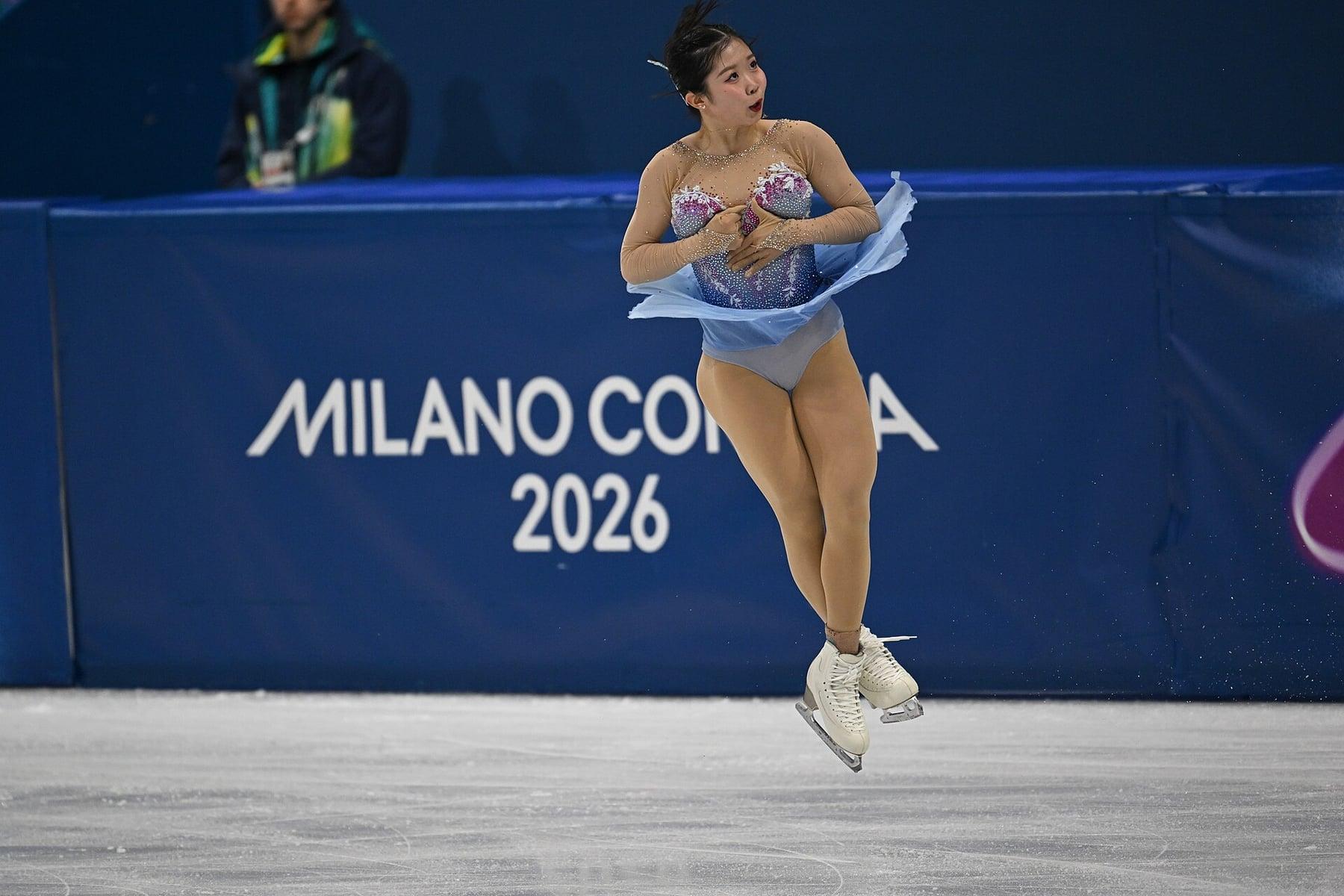
Ami Nakai in a jump at the Milano Cortina 2026 Olympics, where she won women’s singles bronze. On Nov. 14 in Everett she opened the Skate America short with a triple Axel worth 9.37.
Photo: YantsImages
Ami Nakai opened Skate America’s short program the way the protocol still shows it: a triple Axel, base value 8.00, plus 1.37 in Grade of Execution, for 9.37 on the first element. She was the last skater of the night in Everett, Washington, on Nov. 14. When the marks came up, the 18-year-old from Japan had 82.20 — a personal best, the highest women’s short of the Grand Prix season so far, and a 7.96-point lead into Sunday’s free. “I couldn’t feel my legs,” she told reporters afterward. “I was so nervous, but I was able to trust myself.”
Line up the first elements of the top three and the lead starts to make sense. Alexandra Ignatova, the 2022 Olympic silver medalist skating as an Individual Neutral Athlete, sat second at 74.24. She opened with a double Axel — base 3.30, GOE 1.08, total 4.38 — nearly five points behind Nakai before either of them had done anything else. Yujae Kim of South Korea, third at 73.92, also opened with a triple Axel, and hers scored higher than Nakai’s: 8.00 base and 1.83 in GOE for 9.83. Against Kim, the first landing was not the gap. The second jump was.
Nakai followed the Axel with a triple Lutz–triple toe worth 11.53. Kim’s Lutz-toe was under-rotated; the judges cut the base and put a –2.02 GOE on it, for 7.24. That is a 4.29-point swing on the combination after both skaters had already landed the 3½-revolution jump. By the time the spins started, Nakai still had her opening and her combo. Kim had matched the opening and given the points back on the landing that came next.
The rest of Nakai’s short stayed clean: a flying sit spin, a triple loop in the second half for the 10 percent bonus, a level-four step sequence, a layback, and a change-foot combination spin, all with positive GOE. She finished with 48.25 in technical score, 33.95 in components, and no deductions, skating Por Una Cabeza with choreography by Yea-Ji Shin. After that first 9.37, nothing on the sheet went negative.
Ignatova built her night another way. After the double Axel she landed a triple loop, a flying camel, then a Lutz-toe in the bonus for 12.71 — the highest-scoring element of her short. Her technical total was 41.74, about 6.5 behind Nakai’s. The safer opening left her in second and still nearly eight points back, because Nakai had already stacked the Axel, the combination, and the components. Kim’s technical score (42.71) actually topped Ignatova’s, but the damaged combo and lower components left her third by three-tenths. Both Nakai and Kim opened with a triple Axel; only Nakai’s combination held after it.
The night also fits a longer Grand Prix math. Nakai won Grand Prix de France last month. Another first or second in Everett would lock her into December’s six-skater Final in Chongqing, and even a lower finish can still get her there depending on how the rest of the series shakes out. She is the top returning women’s singles skater from Milano Cortina after Alysa Liu’s season off and Kaori Sakamoto’s retirement, with Olympic bronze already on the résumé. Everett was the second of her two regular-season Grand Prix assignments.
Sunday’s free skate is still ahead — 1:05 p.m. Pacific, last to skate again behind Ignatova and Kim. The Nov. 14 sheet is what put her there: a triple Axel that paid 9.37, a combination that paid more than Kim’s damaged one, and a double-Axel start from Ignatova that never closed the first-element gap. That is how 82.20 happened. Whether the lead holds is Sunday’s question.