
An Se-young becomes the first woman to defend Asian Games singles gold
She beat Japan’s Akane Yamaguchi 21-17, 21-9 in Ichinomiya — no games dropped in singles — and still called back-to-back gold “part of the process.”
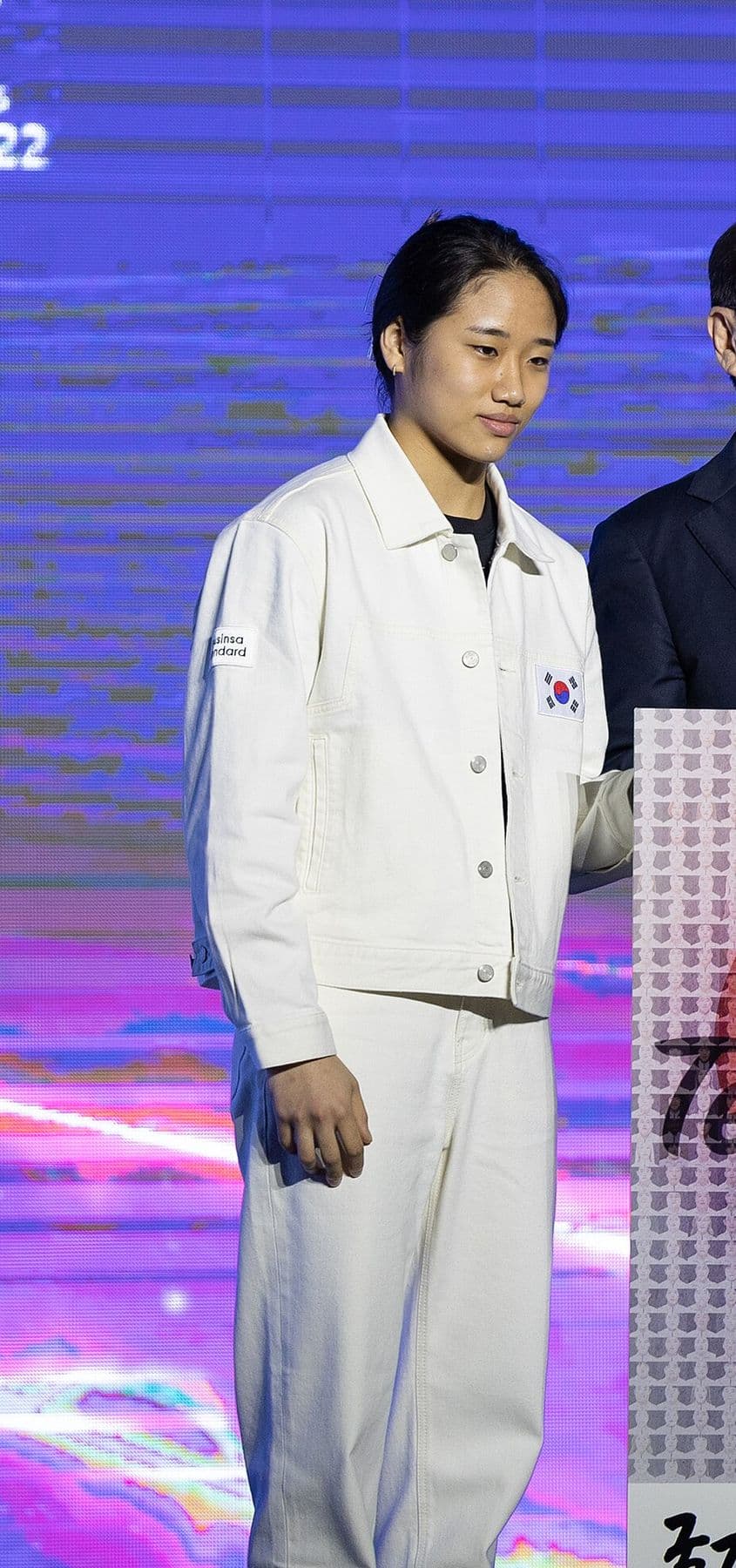
An Se-young at South Korea’s Hangzhou Asian Games team send-off in Seoul on Sept. 12, 2023.
Photo: Kim Sunjoo / Korea.net / Korean Culture and Information Service / CC BY-SA 2.0
In Ichinomiya on Tuesday, An Se-young beat Japan’s Akane Yamaguchi 21-17, 21-9 for Asian Games women’s singles gold — the first successful defense of the title since the event began in 1962. The 24-year-old world No. 1 needed 49 minutes. From the middle of the first game on, it rarely felt that long.
Yamaguchi, world No. 3 and a three-time world champion, came out pressing. An absorbed it, then ran away with the second game 21-9. It was their ninth straight meeting for An, including the team-event semifinal earlier in Nagoya and the World Championships final in New Delhi last month. South Korea’s Lee So-hee and Baek Hana had already won women’s doubles gold the same afternoon. The Taegeukgi went up twice before An even left the gym.
She did not drop a game in five singles matches. Early rounds were short work; the quarterfinal against Thailand’s Ratchanok Intanon, a former world No. 1, lasted 31 minutes. In the semis she put China’s Chen Yufei — the rival from her Hangzhou final three years ago — away 21-5, 21-12 in 38 minutes. The top four in the world rankings all reached the last four here. Only one of them looked like she was still chasing the week.
After the gold, An refused to treat the history as a finish line. “I think winning back-to-back Asian Games titles is just part of the process,” she told Korean reporters. She smiled when the first-ever label landed: she had walked in hoping to win, and only afterward did the record feel heavy. “An Asian Games gold medal is simply a step in my career,” she said. “I will be competing in many more tournaments ahead, and nobody knows just how much further I can grow.”
That line sounds cooler than the week felt from the outside. She had already been the favorite before a shuttle was struck; the talk was how the wins would look. She still talked about overthinking Yamaguchi’s defense and speed, and about the unforced errors that crept in when she hesitated. “I had a lot of concerns on the court,” she said. The scoreboard did not advertise them.
Hangzhou is the comparison she keeps making. In 2023 she won her first Asian Games singles gold through a hard final with Chen while managing injury. This time the gap looked wider than a rematch. “I have changed a lot compared to Hangzhou,” An said. “Those intense matches back then are why I was able to grow this much.” She still grades herself short of the attack she wants. Chen, she said, can hit precise winners from anywhere; she cannot yet. Perfection, for her, still means giving away almost nothing.
The season around the gold explains why she talks that way. She is 57-1 in 2026. The one loss was the All England final in March to China’s Wang Zhiyi, who snapped a long streak and denied An a third All England crown. Since then she has added a second world title in New Delhi — again without dropping a game, again over Yamaguchi — and now an Asian Games defense no woman had managed. She has held No. 1 for more than 100 weeks, won a record 11 international titles in 2025, and already has Olympic gold from Paris. The résumé keeps growing. She keeps talking about the shots she still cannot hit.
Team gold is the piece that got away. Korea’s women took bronze after Japan won the semifinal 3-1, even after An beat Yamaguchi in three games as first singles. She still talks about team weeks as the rare ones that feel shared. The individual draw is where her gap shows: five matches, zero games lost, and a home final that ended 21-9.
She left Ichinomiya with a first that she will treat as another step. Asian Championships and Super 1000 weeks are next; Los Angeles is further out. Most of those afternoons will still end in straight games. The work she is naming for herself is simpler — whether the attack can catch up to the retrieval that already wins them.