
Money & Media
Asia’s rich are buying sports teams, not just sponsoring them
Asia-Pacific sports M&A hit a record $3.69 billion through mid-July. IPL sales near $1.8 billion show why families and funds want ownership, not another logo deal.
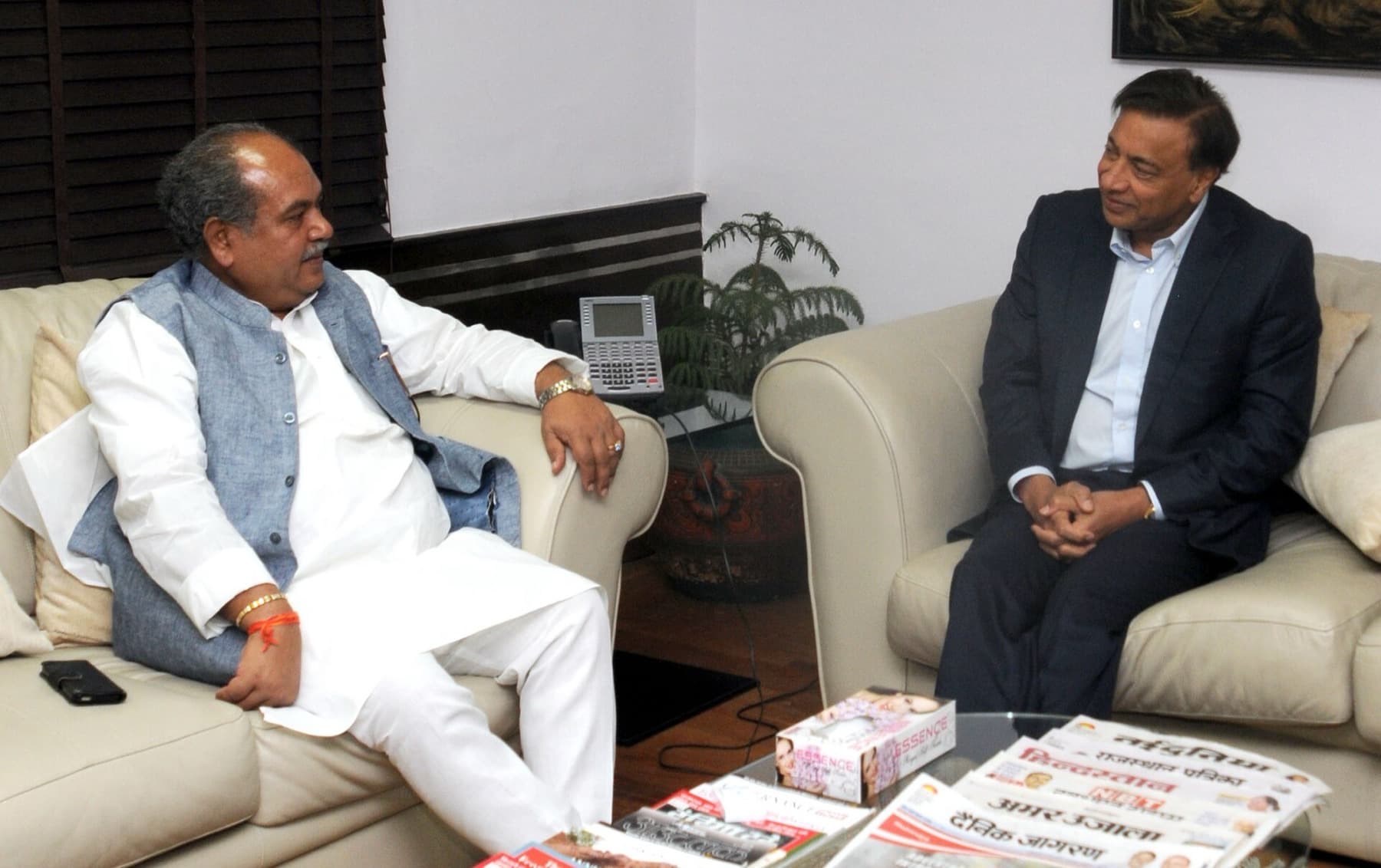
Lakshmi Mittal, right, in New Delhi in May 2015. His family and Adar Poonawalla agreed in May to buy most of Rajasthan Royals at a $1.65 billion valuation.
Photo: Ministry of Steel (India) / GODL-India
Asia-Pacific sports dealmaking hit $3.69 billion in the year to July 13 — the highest total in LSEG records going back to 1980, and more than twelve times the year before. Globally, sports M&A was roughly flat at $8.34 billion. Almost all of the growth is regional.
What people are buying has changed too. Bankers told Reuters that wealthy Asian families and funds are moving past jersey sponsorships and charity match nights toward minority stakes in franchises, leagues, and sports technology. Full takeovers are still rare: they cost a fortune, and many leagues limit who can own what. A slice is easier to price. It also fits buyers who want a share of media-rights money without running the club day to day.
India’s cricket market showed what those pieces now cost. In March, Diageo’s Indian arm, United Spirits, agreed to sell Royal Challengers Bengaluru for about $1.78 billion to a group that includes the Aditya Birla Group, The Times of India Group, David Blitzer’s Bolt Ventures, and Blackstone. In May, steel magnate Lakshmi Mittal and Serum Institute chief Adar Poonawalla led a buy of most of Rajasthan Royals at a $1.65 billion valuation — about 75 percent for the Mittal family, 18 percent for Poonawalla, and roughly 7 percent left with existing investors.
The Goenka family, which owns Lucknow Super Giants outright, has explored selling 5 to 10 percent at a $1.8 billion to $2 billion valuation, people familiar with the talks told Reuters. They have not decided whether to sell.
The bet underneath those checks is simple. Bigger live audiences mean broadcasters pay more for rights, and some of that money lands with the teams. “Attention is a currency,” Singapore businessman Kiat Lim told Reuters. Lim controls Spanish club Valencia and has held stakes in McLaren Automotive and Salford City. “With more people watching, broadcasters are willing to pay more for the rights, and as the value of those rights increases, that ultimately trickles down to the teams.”
Citigroup’s global sports banking head, John Hutcheson, said institutional money in Asia is suddenly calling the sector resilient and “AI proof” — returns that do not swing with the rest of the market. “We’ve gotten more inbounds from institutional capital in Asia recently saying, we love this asset class,” he said. “We’d love to find ways to invest.” Those calls were not coming a year ago. EnTrust Global’s Sophia Park Mullen sees the same shift: fewer trophy buys by a handful of billionaires, more capital treating sports like a real asset class.
Advisers are already looking at baseball businesses in Japan and South Korea for what comes next. Singapore’s Temasek still calls sports emerging rather than core, even with its Fanatics stake. “It’s a nascent thing,” said Nagi Hamiyeh, president of Temasek Global Investments.
The caution is worth hearing. Mark Affolter, co-head of sports, media and entertainment at Ares Management, said newer leagues and sports-adjacent businesses can look safer than they are. “There is a sports halo that’s cast wide across the entire industry,” he said. “I think that’s a mistake.” Ownership stakes are hard to sell, league rules differ, and a minority share cannot invent a rights market that never shows up.
Jersey logos still buy a night of goodwill. The money moving now is chasing something stickier: cricket rights checks, packed World Cup screens, clubs that fill Saturday nights. That is the story inside the $3.69 billion figure.