
Chopra’s ICC plaque remembers the India that built women’s cricket
Edinburgh’s Class of 2026 put Anjum Chopra beside Sourav Ganguly — one plaque for the captain who made Indian women’s cricket durable, another for the captain who remade the men’s side after the match-fixing crash.
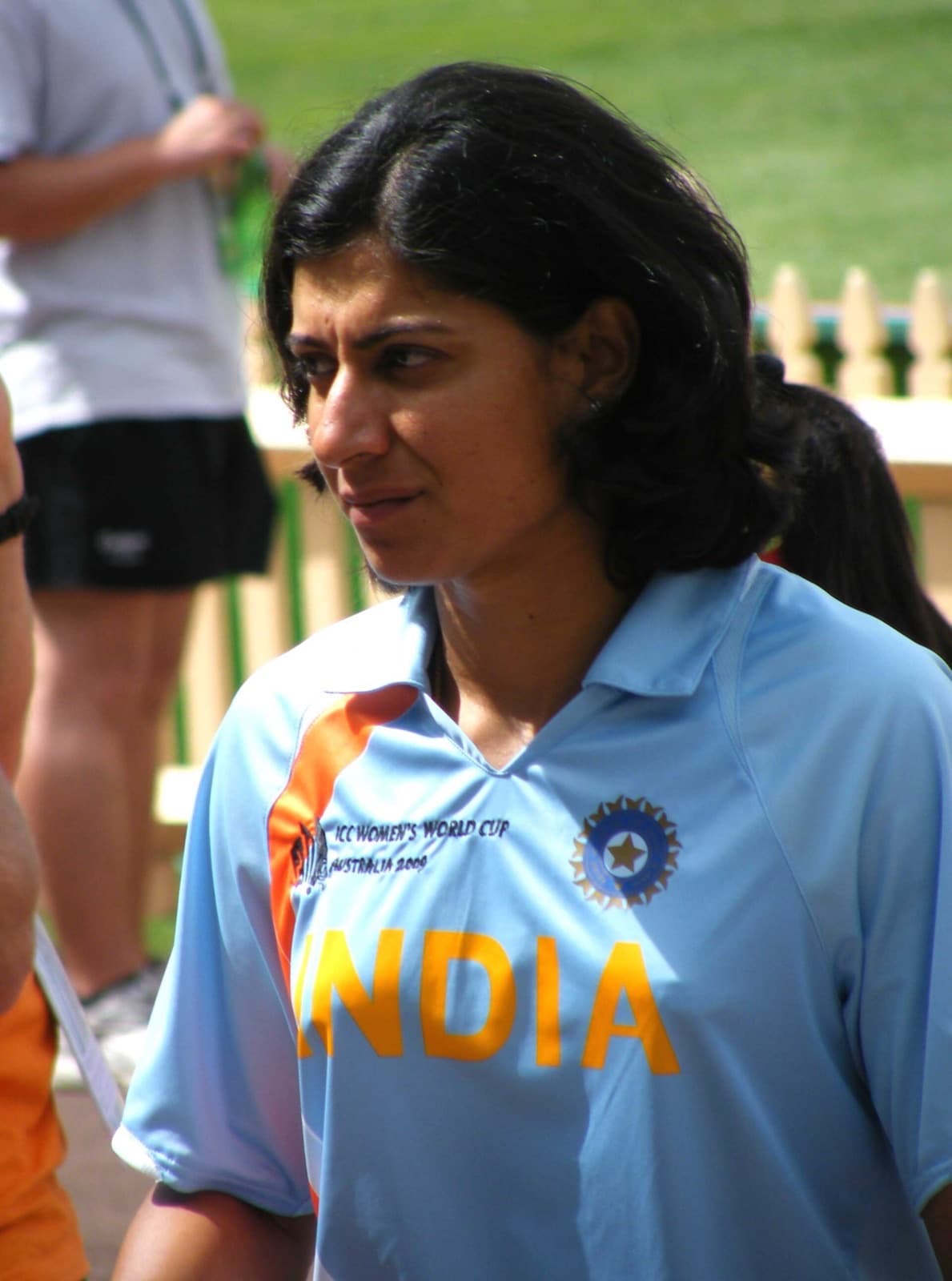
Anjum Chopra in India’s kit at the ICC Women’s World Cup in Sydney on March 10, 2009 — one of six World Cups across a career that made her the first Indian woman to 1,000 ODI runs and 100 ODIs.
Photo: paddynapper / CC BY-SA 2.0
In Edinburgh on July 11, the ICC Hall of Fame Class of 2026 put two Indian captains on the same night’s stage: Anjum Chopra and Sourav Ganguly, with England’s Kevin Pietersen completing the trio. The ceremony raised the Hall to 125 members. Chopra was the sole woman inductee. That detail matters more than the glitter. Ganguly’s plaque will travel on the familiar story of a left-hander who rebuilt men’s India after the match-fixing crisis. Chopra’s plaque is the rarer one — memory for the era when Indian women’s cricket still had to invent its own durability.
Chopra’s ledger is the kind of foundation a later golden age quietly stands on. Across 12 Tests, 127 ODIs, and 18 T20Is from 1995 to 2012, she scored 548, 2,856, and 241 runs — more than 3,500 international runs in a bowling-led women’s game. She became the first Indian woman to reach 1,000 ODI runs and the first to play 100 ODIs. Her only ODI hundred, 100 off 128 balls against England at Northampton in July 1999, was also India’s first by a woman in the format. Six World Cups followed, four fifty-over and two T20, including the 2000 campaign as vice-captain and India’s first World Cup final in South Africa in 2005, when Australia still proved too strong at Centurion.
The captaincy years sharpen the case. In January 2002, in her first series as skipper, Chopra’s India whitewashed England 5–0 in ODIs at home. Months later in Paarl she led India to their first overseas Test win, scoring 80 in a ten-wicket victory over South Africa. In 2006 at Taunton she made 98 — her Test high — in a five-wicket win that sealed India’s first Test series victory over England. The ICC shortlisted her for the inaugural Women’s Cricketer of the Year; Karen Rolton took the award. The Arjuna Award followed in 2007, the Padma Shri in 2014, and in 2016 she became the first Indian woman cricketer awarded honorary life membership of the MCC.
Ganguly arrives in the same class as a parallel, not a twin. He scored 7,212 runs in 113 Tests and 11,363 in 311 ODIs, opened with Tendulkar, and still lives in the popular memory of the Lord’s balcony after the 2002 NatWest final. The Hall case, as the ICC framed it, is captaincy: the side that reached the Champions Trophy final in 2000, shared the 2002 Champions Trophy title, and made the 2003 World Cup final while a generation of match-winners learned to travel without apology. He is the twelfth Indian overall in the Hall; Chopra is the thirteenth, and the third Indian woman after Diana Edulji (2023) and Neetu David (2024). Two captaincies, one country, two different scarcities of recognition.
Chopra’s afterlife has stayed public. She became one of the first women in IPL commentary boxes, carried women’s cricket into men’s broadcast rooms, and kept arguing that visibility was infrastructure. ICC chairman Jay Shah, presenting the Class of 2026, called the three inductees leaders who had worn national colours with pride. Chopra’s own line from Edinburgh was quieter and more exacting: the honour, she said, belonged to the parents, teachers, coaches, and administrators who let a sporting household dream become a national career. Weeks earlier, Shah had called women’s cricket a “golden era” after Australia’s seventh T20 World Cup title. The plaque sits upstream of that language — for the player who helped make the era possible before the product looked inevitable.
Read Edinburgh that way. Pietersen’s induction is England’s Ashes-and-T20 chapter. Ganguly’s is the men’s rebuild that Indian television never forgot. Chopra’s is the rarer institutional memory: a left-hander who made 100 ODIs feel like a destination when the pathway was still being laid, captained an overseas Test win when that sentence barely existed in Indian women’s cricket, and then kept narrating the game for the next generation. Hall of Fame nights love highlight reels. This one also files a blueprint.