
All-time rankings: cricket's greatest batters
Format context, era adjustment, and the impossible comparison problem.
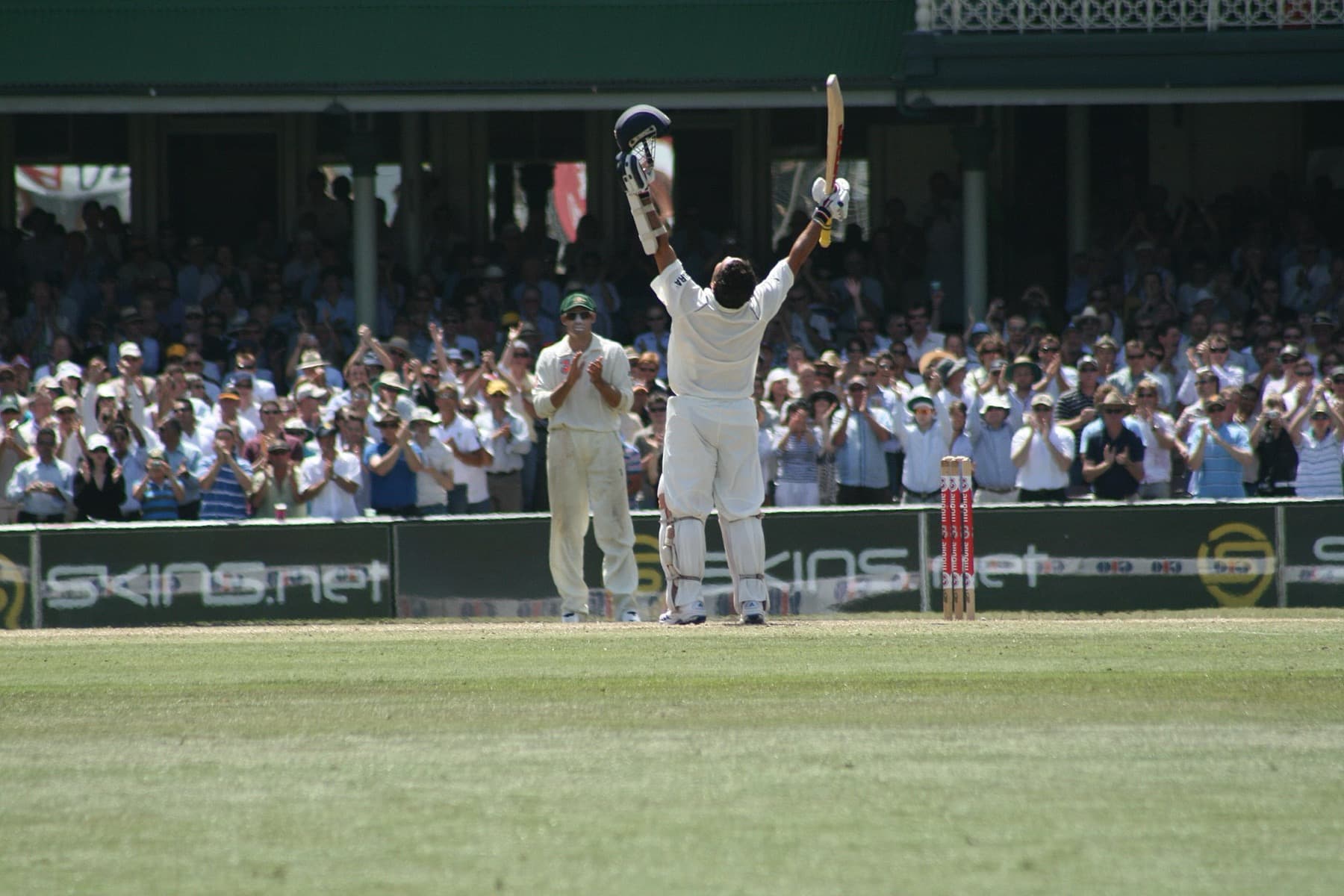
Sachin Tendulkar — the batting standard against which cricket’s all-time lists are still measured.
Photo: Privatemusings / CC BY-SA 4.0
Every all-time batting list is an argument wearing a number. Test cricket rewards occupancy and technique against the new ball. One-day cricket rewards pacing a chase across fifty overs. T20 rewards strike rate under a shot clock. Put those skills on one podium without saying which format you mean, and you have not ranked batters — you have ranked nostalgia.
Start with the cleanest outlier. Don Bradman’s Test average of 99.94 across 52 matches and 6,996 runs sits alone in the statistical record: no other batter with a meaningful Test sample has finished above the low sixties. That is why Bradman wins almost every Test-only poll and why “greatest batsman ever” often collapses into “greatest Test batsman.” The argument against him is not the average; it is the sample and the sport around him — fewer matches, different travel, uncovered pitches, no helmets, no ODIs or T20s to dilute or complicate the résumé. Bradman is the era’s ceiling. He is not a multi-format spreadsheet.
Sachin Tendulkar is the opposite kind of standard: volume across a global calendar. He finished with 15,921 Test runs and 18,426 ODI runs, the all-time leads in both formats when he retired, and 100 international centuries — still the round number every chase is measured against. His combined international aggregate above 34,000 runs came from 200 Tests and 463 ODIs in an era when India played everywhere and the audience treated every innings as national weather. Tendulkar’s claim is not that he averaged like Bradman. It is that he carried excellence, expectation, and two major formats for a generation. That is why his face still sits at the top of “modern greatest” arguments even when someone else’s ODI average or century rate looks prettier.
Peak and longevity pull in different directions. Brian Lara’s 400 not out against England and his twin world-record high scores made individual innings feel like events; Viv Richards’s West Indies peak made bowlers look temporary. Rahul Dravid and Jacques Kallis force another axis — value as the person who occupies the crease when the team needs occupation, not fireworks. A list that only counts aesthetic sixes will underweight them. A list that only counts career averages can bury a shorter, brighter peak. Say which virtue you are buying.
ODIs deserve their own room. Virat Kohli passed Tendulkar’s ODI century record and has lived for long stretches as the format’s efficiency king — higher average, higher conversion, chase grammar that became coaching curriculum. That does not automatically make him the greatest Test batter of the century, nor does Tendulkar’s Test mountain erase Kohli’s white-ball case. The honest comparison states the format first: Kohli as the outstanding limited-overs batter of his generation; Tendulkar as the dual-format longevity standard; Bradman as the Test statistical anomaly. Mixing those sentences without labels is how pub arguments become bad rankings.
T20 broke the old map again. Franchise leagues and T20 internationals reward different batting jobs — powerplay launchers, middle-over manipulators, death-over finishers — and careers can be built primarily inside leagues rather than national bags of caps. AB de Villiers, Chris Gayle, and a rotating cast of innovators force lists to decide whether “greatest batter” means international résumé, league dominance, or shot-making influence on how everyone else trains. A batter who never mastered five-day cricket can still rewrite what young players practice. That is greatness of a kind. It is not Bradman’s kind.
Era adjustment is the other quiet rule. Covered pitches, better bats, DRS, athlete strength programs, and bowling athleticism all move the difficulty dial. Raw averages across 1930 and 2020 are not the same currency. Relative dominance — how far a batter sat above contemporaries — travels better than absolute numbers. Bradman’s gap to his peers remains the extreme case. Modern multi-format stars should be judged against the workloads and bowling quality of their own calendars, not against a fantasy tour of Bodyline without helmets.
So how should a reader use an all-time list? Demand three disclosures up front: which format(s), whether the metric is peak or career, and whether franchise T20 counts. Then watch for the usual traps — stacking counting stats without context, elevating World Cup moments into career verdicts, or pretending one number settles a three-format sport. A useful ranking is a map with a legend. A useless one is a podium with no caption.
Tendulkar remains the practical measuring stick for modern arguments because he forces the legend into the open: if your list is Test-only, say so and face Bradman; if it is ODI-primary, argue Kohli and the chase era on those terms; if it includes T20, admit you have changed the sport mid-sentence. The comparison problem is not a bug in cricket history. It is the price of a game that kept inventing new ways to bat — and then insisted on ranking all of them together.