
Iconic games that changed their sport
Not the loudest nights — the ones that rewrote rules, tactics, television, or who got to matter afterward.
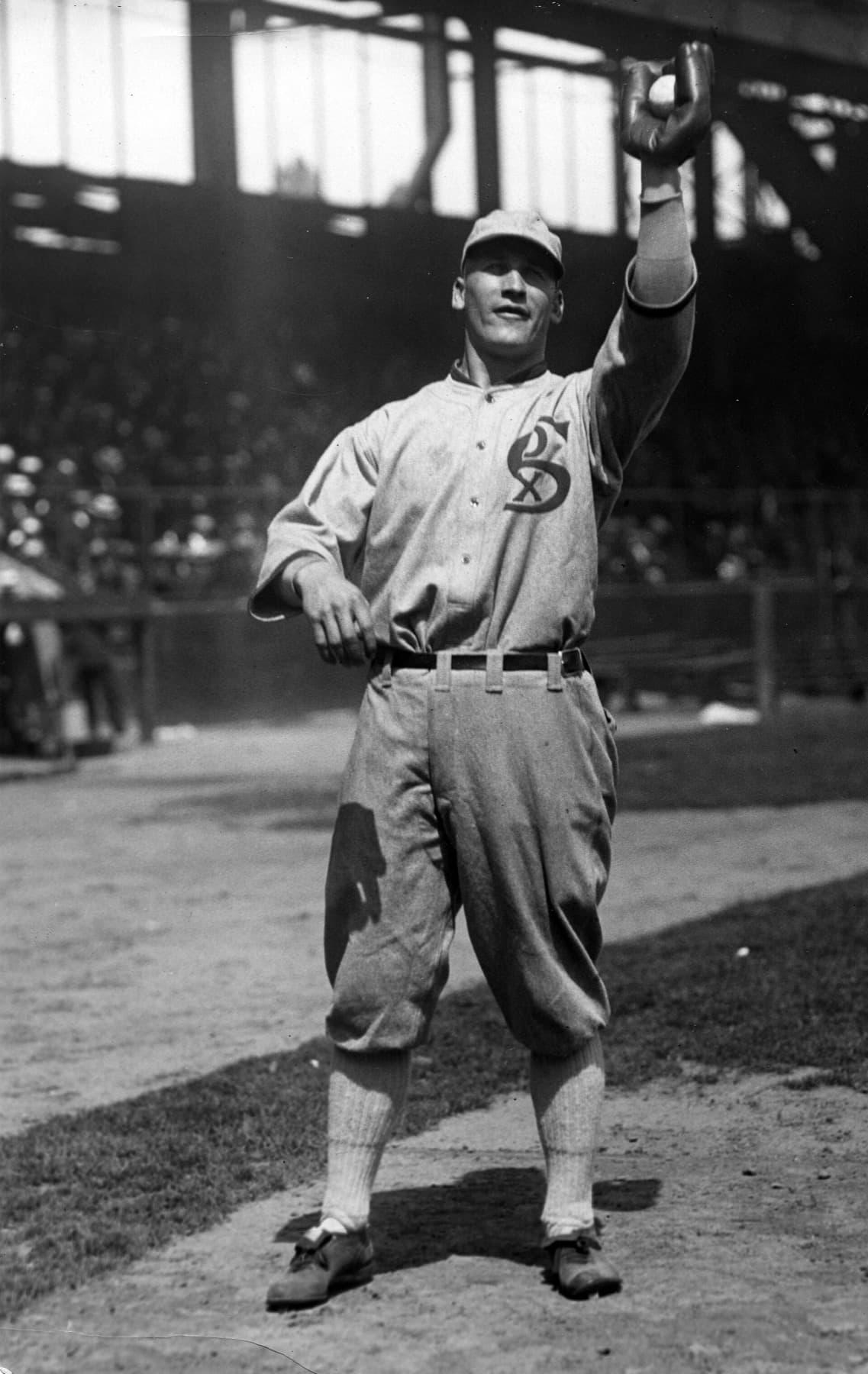
Oscar “Happy” Felsch of the Chicago White Sox — one of eight players banned after the fixed 1919 World Series that remade baseball’s governance.
Photo: Bain News Service / Public Domain
Fans call a lot of nights iconic. Fewer nights leave the sport different when the lights come back on. The useful test is not the highlight reel. It is the aftermath: a new law, a new formation, a new commissioner, a new television habit, or a new audience that refuses to shrink again.
Baseball’s cleanest example is still the dirty one. In 1919, eight Chicago White Sox players — including center fielder Oscar “Happy” Felsch — were tied to a plot to throw the World Series to Cincinnati. The criminal case ended in acquittals. The sport’s answer did not. Owners dissolved the old National Commission and installed federal judge Kenesaw Mountain Landis as baseball’s first commissioner with near-absolute authority. The day after the verdicts, Landis banned the eight for life, writing that no player who threw a game, entertained a fix, or sat in on the planning without reporting it would play organized baseball again. The Series scoreboard became secondary to a governance model that still frames how baseball police integrity — even after Commissioner Rob Manfred reinstated the deceased Black Sox in 2025.
Cricket’s Bodyline Ashes of 1932–33 changed the Laws rather than the org chart. England captain Douglas Jardine’s answer to Don Bradman was fast, short bowling into the body with a packed leg-side field — legal then, corrosive to the idea of fair play, and nearly a diplomatic crisis between Australia and England. The Marylebone Cricket Club first tried to leave the problem to “spirit.” When that failed, it moved the Laws: direct attack bowling was declared unfair in 1935, and later fielding restrictions made classic Bodyline fields impossible. Short balls never vanished. The sport did learn that a winning tactic can force the rulebook to catch up.
Football’s equivalent shock arrived at Wembley on November 25, 1953, when Hungary beat England 6–3. England still marked by shirt numbers inside a rigid WM. Gusztáv Sebes’s Magyars moved with a deep-lying center forward in Nándor Hidegkuti and strikers who would not stay where English defenders expected them. Stanley Matthews called the visitors wonderful; Tom Finney later likened England’s reply in Budapest to carthorses against racehorses. Alf Ramsey said he learned more about tactics that afternoon than in years around the game — and went on to manage England’s 1966 World Cup winners. The match did not invent modern football alone. It ended English isolationism as a working theory.
American football’s pivot was a media event as much as a championship. On December 28, 1958, Johnny Unitas’s Baltimore Colts beat the New York Giants 23–17 in the NFL’s first sudden-death overtime title game at Yankee Stadium. NBC’s national broadcast reached an estimated 45 million viewers. The game was sloppy — eight combined fumbles — and still became “the Greatest Game Ever Played” because television found a product that paused for commercials without killing the drama. Pete Rozelle’s NFL, the AFL challenge, and the eventual Super Bowl economy sit downstream of that night’s proof that pro football could hold a country on a Sunday.
Some contests change who the public believes belongs. On September 20, 1973, Billie Jean King beat Bobby Riggs in straight sets at the Houston Astrodome in the televised “Battle of the Sexes,” with U.S. audiences near 50 million and global estimates far higher. King later said she feared a loss would set women’s tennis back fifty years. The exhibition was theater. The aftereffect was permission: women’s tennis rode a surge of attention that made equal-pay fights and tour legitimacy harder to dismiss as niche.
Cricket’s commercial center of gravity shifted on June 25, 1983, when Kapil Dev’s India defended 183 and bowled West Indies out for 140 at Lord’s. The holders had won the previous two World Cups; India had never reached a final. The trophy on the balcony mattered less than what followed in India — a mass audience that treated cricket as national event television, sponsorship that found a reliable stage, and a long arc toward BCCI power and, much later, the IPL’s franchise economics. Upset scores fade. Market maps do not.
Women’s football got its American mass-media stamp in Pasadena on July 10, 1999. The United States beat China on penalties before 90,185 at the Rose Bowl — then a record crowd for a women’s sporting event — with Brandi Chastain converting the decisive kick. The celebration photograph traveled farther than most match reports. Professional leagues still had to be built and rebuilt afterward; the 99ers did not invent the NWSL overnight. They did make girls’ soccer and women’s national-team football impossible to treat as a curiosity in the U.S. media market.
Read “iconic” that way and the list stays short on purpose. Great games entertain. Transformative games leave a rulebook page, a tactics chalkboard, a commissioner’s office, a broadcast template, or a generation of athletes who saw themselves differently. The next candidate is not the loudest final. It is the night someone, months later, still has to coach, legislate, or sell around.