
Baseball Hall of Fame voting explained
How BBWAA ballots, the 75 percent bar, and Era Committees actually decide Cooperstown — using the Class of 2026 as the working example.
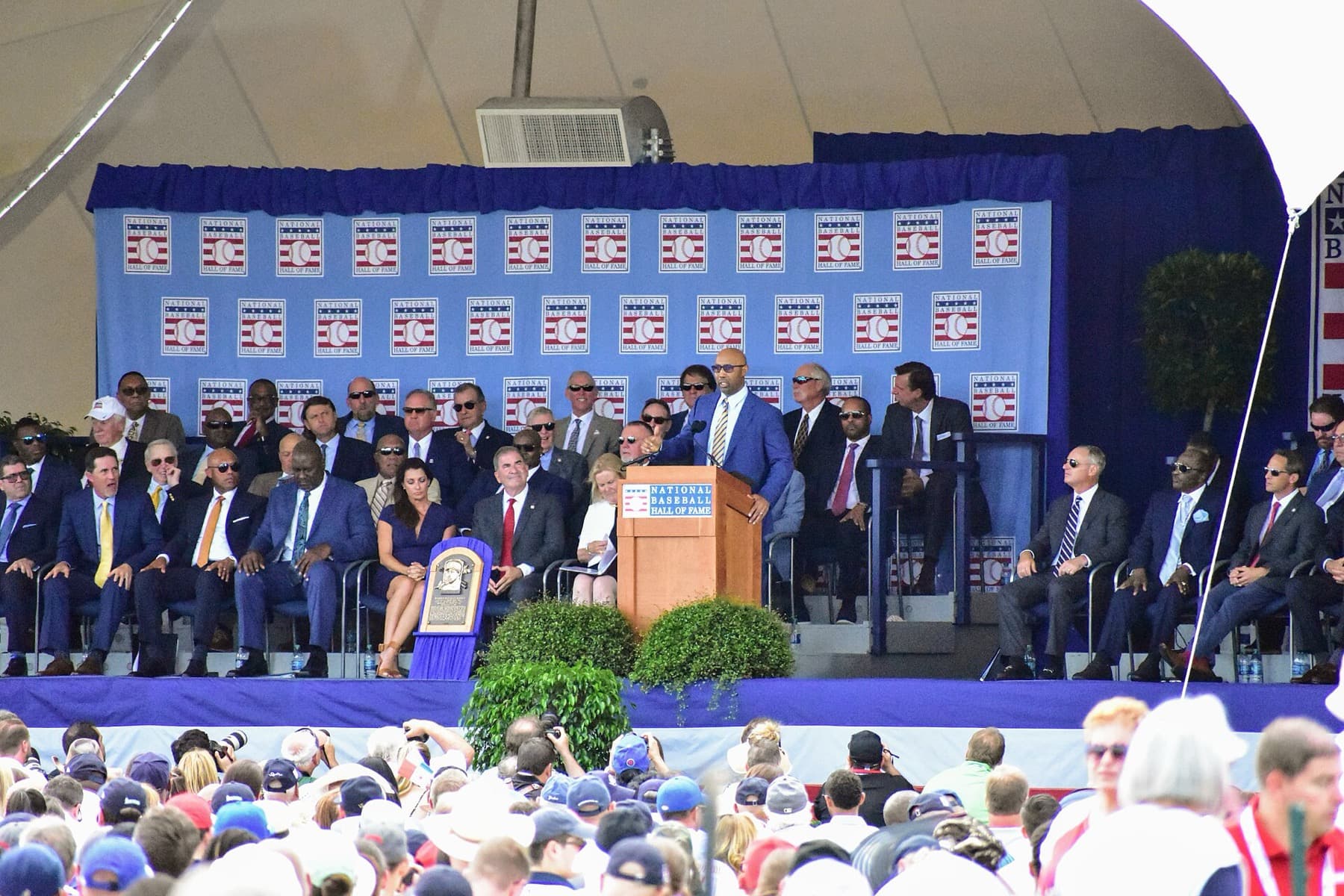
Harold Baines giving his Baseball Hall of Fame induction speech in July 2019 — the voting process that decides Cooperstown.
Photo: Y2kcrazyjoker4 / CC BY-SA 4.0
Cooperstown’s Class of 2026 arrives by two doors that often get collapsed into one phrase — “Hall of Fame voting.” Carlos Beltrán and Andruw Jones cleared the Baseball Writers’ Association of America ballot in January. Jeff Kent had already been elected in December by the Contemporary Baseball Era Committee. Understanding those routes is the difference between reading a percentage and understanding a system.
The BBWAA ballot is the main path for recently retired players. Eligible voters are BBWAA members with at least ten years of active baseball writing membership. Ballots go out in late November and must be returned by December 31. Writers may list as many as ten candidates and as few as none. There are no write-ins. A player needs votes on 75 percent of ballots cast to be elected.
Eligibility itself is narrow. A candidate needs ten major-league seasons, must have been active sometime in a window that starts fifteen years before the election and ends five years before it, and must have been retired for five full seasons. Players on baseball’s ineligible list cannot appear. The Hall’s published criteria ask voters to weigh record, ability, integrity, sportsmanship, character, and contributions to the teams on which a player played — the language that fuels every argument about the steroid era.
Staying on the ballot is a second election. Candidates remain for up to ten years if they draw at least five percent each cycle; fall below that floor and they drop off BBWAA consideration. Since a 2014 rule change (effective for the 2015 election), the old fifteen-year maximum became ten. In the 2026 election, 425 ballots were cast, so election required 319 votes and the five-percent line sat at 22. Beltrán reached 84.2 percent in his fourth year; Jones reached 78.4 percent in his ninth. Manny Ramírez finished his tenth and final BBWAA year short of election.
Era Committees exist for players and non-players who are no longer on the writers’ ballot, or whose careers fall into older periods. The Contemporary Baseball Era covers roughly 1980 to the present and splits into a players ballot and a managers/executives/umpires ballot. The Classic Baseball Era covers pre-1980 baseball, including Negro Leagues and pre-Negro Leagues figures. Those committees are small — sixteen voters for Contemporary players — and still use a 75 percent threshold (twelve of sixteen).
Kent’s election shows why the second door matters. He never cleared 75 percent with the writers; his best BBWAA showing was in the mid-40s. On the December 2025 Contemporary players ballot he received 14 of 16 votes. The same panel left Barry Bonds, Roger Clemens, Gary Sheffield, and Fernando Valenzuela under five votes. Under a 2025 rule, candidates under that floor skip the next three-year cycle of that ballot, so those names are not eligible for the 2028 Contemporary players vote.
The arguments that dominate January results — peak versus longevity, defense, postseason heroics, and the character clause — do not disappear in Era Committee rooms. They simply move to a smaller electorate of Hall of Famers, executives, and historians, meeting on a staggered calendar at the Winter Meetings. Writers still set the first verdict for modern careers. Committees decide who gets a second hearing, and on what timeline.
When results land each winter, read three numbers before the takes: ballots cast, the 75 percent line, and the five percent survival line. Then ask which door a name is actually walking through. Induction weekend in late July is the ceremony; the voting architecture that filled the stage was finished months earlier.