
Football pressing triggers
When elite teams hunt the ball — and the positional cues that start a press.
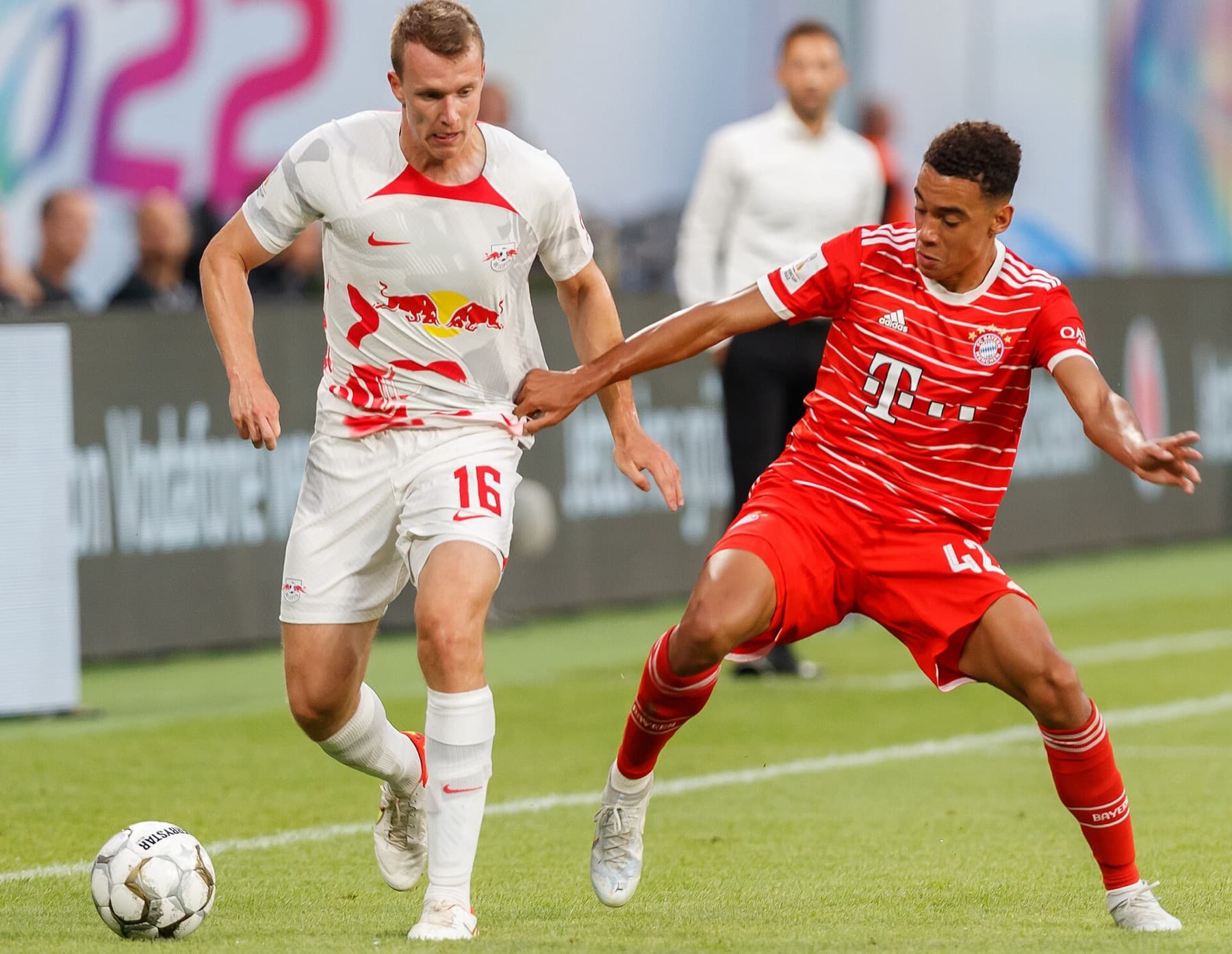
Bayern Munich’s Jamal Musiala pressing RB Leipzig’s Lukas Klostermann in 2022 — pressing triggers that turn possession into a turnover hunt.
Photo: Steffen Prößdorf / CC BY-SA 4.0
Pressing is not constant sprinting. It is timed activation: a cue that a defender or midfielder is facing the wrong way, a full-back is isolated, or the ball has arrived in a zone where your nearest three players can form a trap. Elite sides train the cue more carefully than the chase.
The classic triggers are well known. A heavy touch into the presser’s half. A pass played into a player whose hips are open toward his own goal. A throw-in or goal kick that lands short of the first line. A lateral pass across the back three that invites a curved run from the near-side forward. Once the first player jumps, the second and third must arrive on a delay — early enough to cut the escape pass, late enough not to open the lane behind them.
At a World Cup the same cues travel across styles. Spain under Luis de la Fuente often presses from a high rest defense, using Yamal and the near midfielder to force play into a pocket. Argentina under Scaloni mix mid-block patience with sudden vertical presses when Messi or the eight can jump a receiver. France’s best spells still start from Mbappé’s first step toward a center-back who has taken an extra touch. The systems differ; the question is the same: who is allowed to receive freely?
Knockout football raises the cost of a wrong jump. A failed press in the Round of 32 becomes a three-versus-two transition; over five or six knockout nights that error compounds. Coaches who survive deep runs usually protect a rest shape — the midfield platform that stays connected even when the front line rests — so that a broken press does not become a broken structure.
For readers watching Sunday’s final, ignore possession percentages for a minute. Watch the first three seconds after Spain or Argentina lose the ball in the opponent’s half. If the nearest forward’s body shape closes the easy sideways pass, the press has already started. If that forward turns to chase from behind, the cue was missed and the defending side is about to run.