
Spain’s second World Cup arrives the way the first one did
Ferran Torres’ 106th-minute finish beat Argentina 1–0 in extra time, sealed a Euro–World Cup double, and left Messi’s likely last final without a reply.
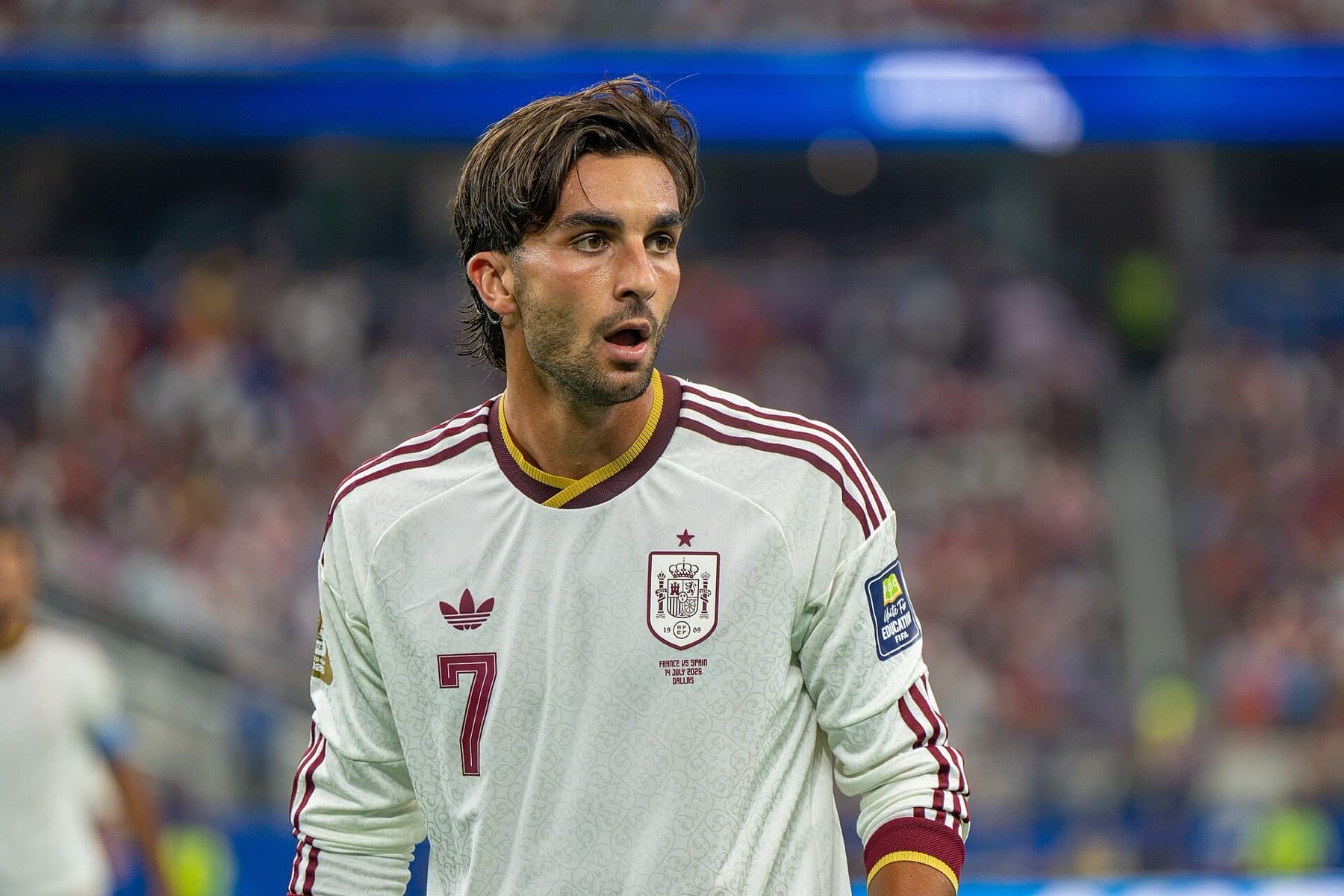
Ferran Torres in Spain’s white kit during the World Cup semi-final against France in Dallas on July 14. Five days later in New Jersey, the substitute scored the extra-time winner against Argentina.
Photo: Bryan Berlin / CC BY-SA 4.0
Spain won the World Cup the same way it won the first one: late, narrow, and after making the other finalist live without the ball. Ferran Torres struck in the 106th minute at New York New Jersey Stadium, and Spain beat Argentina 1–0 after extra time in front of 80,663 — a largely pro-Argentina crowd that watched the holders finish with ten men and no shot on target across 120 minutes.
The goal was built from the bench. Pedro Porro’s deep cross looked ready to drift beyond the far post until Nico Williams, on since the 75th minute, headed it back into the path of Torres. The Barcelona forward, introduced just past the hour for Mikel Oyarzabal, finished left-footed for his first goal of the tournament. It was Spain’s 20th shot of the night; Argentina still had none on goal. Sixteen years after Andrés Iniesta’s extra-time winner against the Netherlands, Spain again needed a substitute’s finish beyond 90 minutes to put a second star on the badge.
Argentina’s route into that deficit began in stoppage time of regulation. Enzo Fernández, already booked for arguing, caught Pau Cubarsí with a reckless challenge and received a second yellow from Slavko Vinčić. Lionel Scaloni’s side spent all of extra time a man down. Even before the red card, Emiliano Martínez had kept the final scoreless with a World Cup final-record 11 saves, including a stop from Lamine Yamal’s whipped free kick in the 95th minute. Spain had already seen a Nico Williams finish wiped out for a foul on Nicolás Otamendi. The pressure finally told when Torres converted.
The result completed more than a final. Luis de la Fuente’s Spain now hold Euro 2024 and World Cup 2026 — the same continental-to-global sequence the country managed after Euro 2008 and South Africa 2010. The win also stretched Spain’s unbeaten run to 38 matches in all competitions, past Italy’s previous men’s mark of 37. De la Fuente, 65, became the oldest coach to win the men’s World Cup. Captain Rodri took the Golden Ball; Unai Simón the Golden Glove after seven clean sheets; Pau Cubarsí the young-player award.
Defense was the quieter story of the whole campaign. Spain conceded once in eight matches — Charles De Ketelaere’s header for Belgium in the quarter-final — the fewest goals allowed by any World Cup champion. The path ran through a 0–0 with Cabo Verde, then wins over Saudi Arabia, Uruguay, Austria, Portugal, Belgium, France, and Argentina. Yamal, still 19, started seven of those eight and became the youngest player to win both a European Championship and a World Cup. In the final he led the match in shots and completed dribbles while Messi, 39, managed 54 touches and none of the eight goals he had scored earlier in the tournament.
Messi left MetLife in tears, silver medal in hand, with his international future still unconfirmed. He had said 2022 would be his last World Cup before returning for a sixth. Scaloni said he had not yet spoken with him about continuing. Kylian Mbappé, meanwhile, finished with the Golden Boot on 10 goals after France’s bronze-match loss to England; Messi settled for eight and the Silver Ball. The farewell narrative was always going to hang over Sunday. Spain’s night was about refusing to let that narrative decide the score.
For Asia-Pacific readers, the final arrived after the continent’s campaign had already closed. Nine AFC sides produced three wins in 29 matches; only Japan and Australia reached the Round of 32, and both exited there — Japan 1–2 to Brazil after leading, Australia on penalties to Egypt. South Korea’s group-stage exit and subsequent FIFA ranking drop to 32nd have already triggered domestic reform talk. The trophy ceremony in New Jersey did not change those results. It did underline the gap this expanded tournament still measured: Europe’s best closed the month; Asia’s best spent it trying to survive the first knockout round.
Torres’ own line after the goal kept the emphasis on the group rather than the moment. “I think at the end of the day, it was a goal scored by 47 million people,” he said, noting the criticism he had carried through a quiet tournament. De la Fuente praised solidarity and a generation raised inside the same youth pathway that produced Nations League, European Championship, and now World Cup titles in three years. Spain did not invent a new identity in New Jersey. It finished one that had been visible since Berlin.
The cleanest read of the final is therefore structural, not sentimental. Argentina could not create a shot on target against the best defense of the tournament. Spain could afford Martínez’s heroics until the substitutions produced the one finish that counted. Messi’s last World Cup final — if that is what it was — ended without a goal. Spain’s second World Cup began with one, from a player who had not scored all summer, in the minute that turned a long night into a title.