
Rest defence explained
The structure a team keeps while it attacks — so a lost ball does not become a clean counter. Spain’s one-goal World Cup is the clearest recent proof.
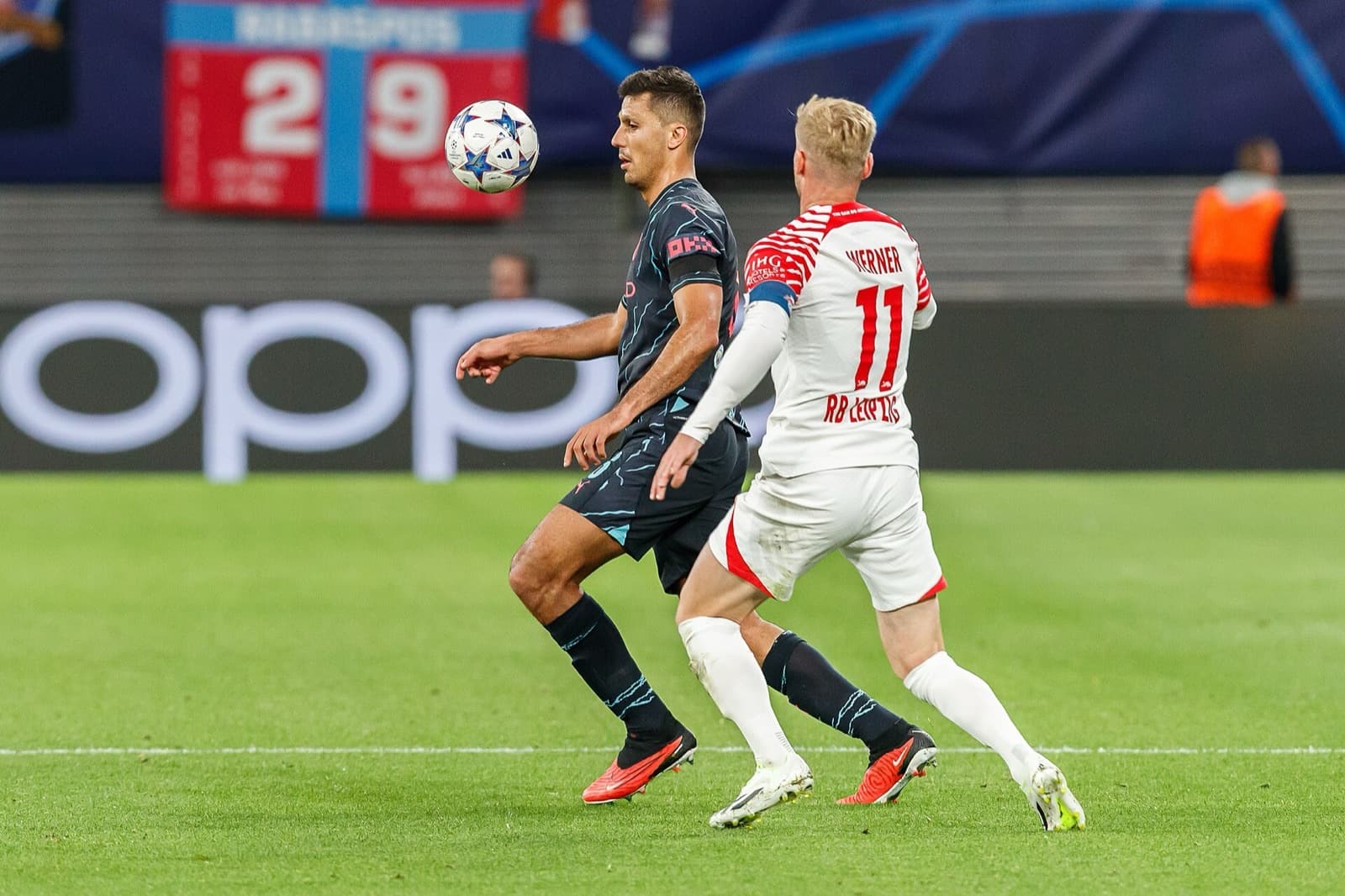
Manchester City’s Rodri controls under pressure from RB Leipzig’s Timo Werner in the Champions League in October 2023 — the pivot’s job of holding the platform while teammates attack ahead of him.
Photo: Steffen Prößdorf / CC BY-SA 4.0
Spain won the 2026 World Cup while conceding once in eight matches — Charles De Ketelaere’s header for Belgium in the quarter-final — the fewest goals ever allowed by a men’s champion. Broadcasters sold the tournament through Yamal’s one-v-ones and Torres’ extra-time finish. Coaches sold something quieter: the platform underneath the attack. That platform has a name. Rest defence is the structure a team deliberately keeps while it has the ball, so that a turnover does not leave three attackers stranded against an empty midfield.
Our pressing guide covers the cues that start a hunt. Rest defence is the insurance those same teams buy before the hunt begins. Typically five outfielders attack and five stay connected behind the ball — not as spectators, but as a ready shape. The higher line (often midfielders, sometimes a stepped centre-back) is meant to win the first duel when possession flips. The deeper line covers the long ball, the runner in behind, and the space a broken press would otherwise gift. If the higher line arrives and the deeper line has wandered too high or too wide, you get the transition highlight every manager fears.
Elite sides usually arrange those five in a 2-3 or a 3-2. A 2-3 keeps two centre-backs deep with three players — often a pivot plus inverted full-backs — screening ahead of them. It clogs the middle and helps counter-press near the ball; it can leave the touchline soft if opponents keep fast wingers high and wide. A 3-2 spreads three across the back (sometimes a centre-back stepping up, sometimes a full-back tucking) with a double pivot in front. That shape covers half-spaces better against a front three and underpins the “box midfield” looks City and Arsenal made familiar. Neither shape is a formation badge. Both are answers to the same question: who is allowed to receive the first pass after we lose it?
Inverted full-backs exist largely for this problem. When a Cancelo or Zinchenko steps inside during possession, the team gains an extra midfielder for circulation — and a body already near the counter’s preferred lane when the ball turns over. Rodri’s club and country roles make the principle visible even without the jargon. He organizes distances, occupies the lane that would otherwise become a through-ball, and lets the wingers hold width because someone trustworthy is still under the attack. Spain’s Golden Ball summer was the same job written larger: possession as the first defence, rest shape as the second, press as the third.
Watch it without a tactics board. When a team is in the final third, freeze the frame before the shot or cutback. Count how many of their players are ahead of the ball and how many sit underneath it. Then watch the three seconds after they lose it. If the first receivers are closed down and the centre stays occupied, the rest defence held. If a winger is suddenly one-v-one against a centre-back who has been left alone, it did not. Spain’s knockout nights against France and Argentina made that habit look boring on purpose — Mbappé without a shot on target in the semi-final; Argentina without one across 120 minutes in the final. Boring is the point. Rest defence is how modern possession teams buy the right to attack.