
F1 tire strategy explained
Compound selection, degradation curves, and undercut timing — race strategy in 20-car chess.
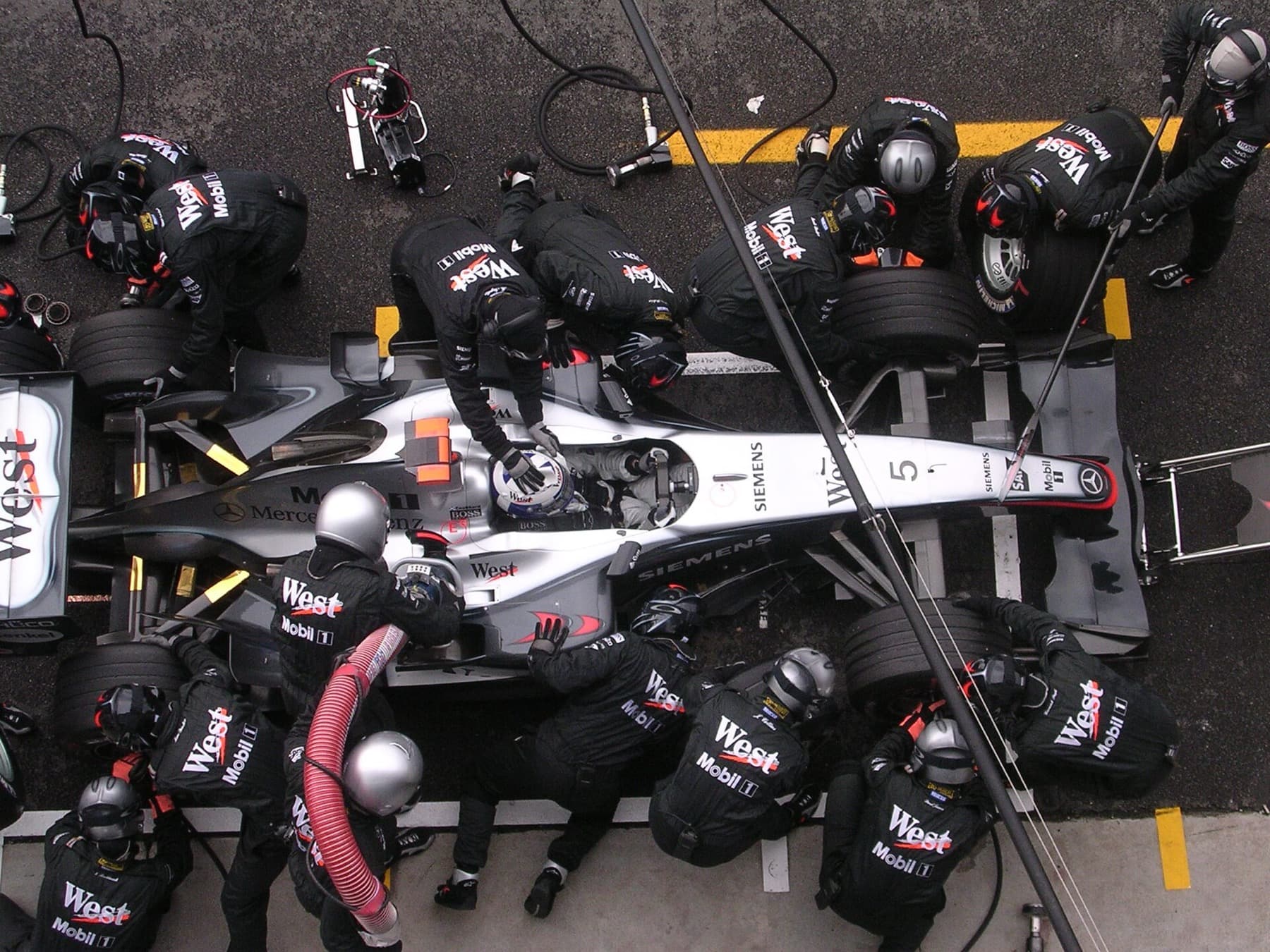
McLaren pit stop at Monza during the 2004 Italian Grand Prix — strategy decided races long before today’s compound windows.
Photo: Fabio Alessandro Locati / CC BY-SA 3.0
Formula 1 races are sold as driver duels. On most Sundays they are also tire math. Soft rubber is faster until it is not. Hard rubber lasts until the car ahead has already undercut you. Pit windows are priced in seconds against the time you lose in the lane — and against whatever your rival is doing on the same rubber. Learn that grammar and the radio calls stop sounding like gibberish.
Pirelli brings a ladder of dry “slick” compounds each season, numbered hardest to softest (C1 through C5 in the current range). For every Grand Prix it nominates three of those compounds and labels them hard (white), medium (yellow), and soft (red) for the weekend. The soft at Monza is not the same rubber as the soft at Singapore; it is whichever nominated compound sits at the soft end of that track’s trio. Softer means more grip and faster lap times early, then steeper drop-off. Harder means less peak grip and a longer usable life. The medium is the compromise stint tire most strategies orbit.
Sporting rules force the chess. In a dry race, each driver must use at least two different slick compounds, which means at least one pit stop even if a single set could somehow last the distance. Weekend allocations are finite — a standard race weekend gives each driver a capped number of dry sets split across the three nominated compounds, plus intermediates (green) and full wets (blue) for rain. Teams spend Friday learning degradation curves: how many laps until the soft falls off a cliff, whether the hard ever reaches temperature, whether a one-stop or two-stop race is even legal against the clock.
The undercut and overcut are the two classic moves once the race is live. An undercut means you pit before the car you are fighting. Fresh tires should produce a faster out-lap than your rival can manage on worn rubber; when they stop, you hope to rejoin ahead. It works best when degradation is high and new tires switch on immediately. An overcut means you stay out longer. You bank clean-air lap time while the rival’s new tires are still cold, then stop later and leapfrog them. It works when degradation is low, warm-up is slow, or traffic would ruin an early stop. Neither move is a button. Both die in traffic, a slow stop, or a compound that refuses to wake up.
Weather and cautions rewrite the spreadsheet mid-race. Intermediates clear light standing water; full wets handle heavier rain; both overheat if the track dries. The crossover call — when slicks become faster than inters, or vice versa — can jump a midfield car into the points or dump a leader into the wall of bad timing. A Safety Car or Virtual Safety Car shrinks the pit-stop delta because the field is circulating slowly, so the same lane time costs less track position against rivals who stay out. Teams call that a “cheap” stop. Miss the window and you gift it to everyone else.
How to watch strategy without a factory model: note which compound each car started on, watch gap sizes around typical pit-loss (often roughly twenty-plus seconds under green flags, circuit-dependent), and ask whether the car behind is inside undercut range. When the radio says “Box, box,” check whether they are reacting to degradation, covering a rival, or diving for a Safety Car. The 2004 Monza pit lane in our photo still shows the same essential trade — stationary time versus on-track pace — even though refueling eras and today’s Pirelli compound windows look different. Tire strategy is not predicting every race. It is knowing which variable the teams are solving when the order suddenly changes without a pass.