
From Asia to the NCAA
Yuting Deng played Texas after two practices. Her coach talked about the language. The women who made this move earlier describe the same months.
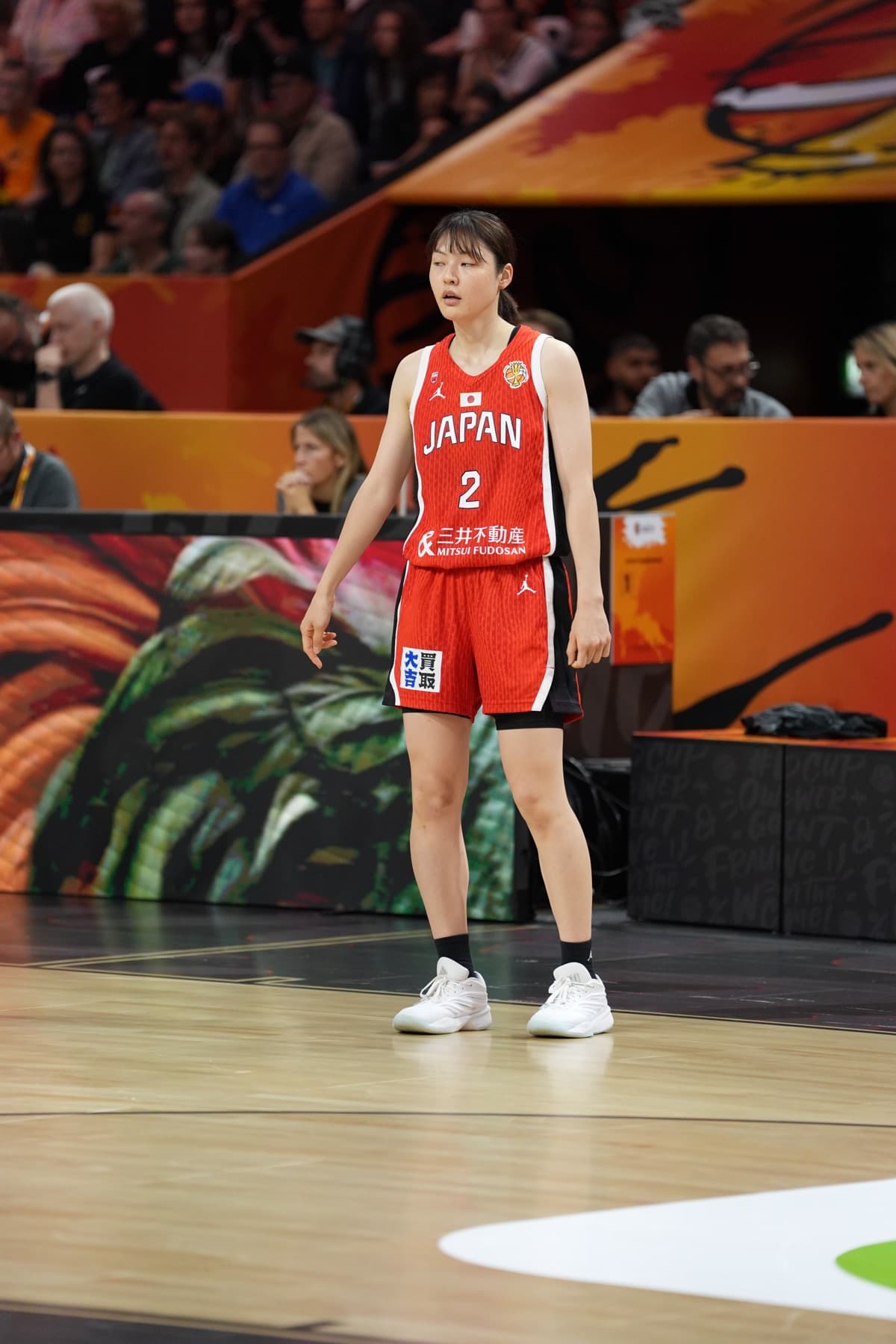
Norika Konno, in Japan’s No. 2, during the Women’s Basketball World Cup game against Germany on Sept. 5, 2026, in Berlin. She arrived at Louisville from Sendai in 2019.
Photo: Zafer
Yuting Deng played six minutes against No. 7 Texas on Jan. 16, 2025, and did not score. She had been in Auburn less than a week, and she had practiced twice. Johnnie Harris, the coach, said the language meant giving her less to learn at once. “She’s just coming into the country,” he said. “She’s learning a lot and has had a lot thrown at her in a couple of days.”
She had signed in November, after visits in the fall, and picked Auburn over Indiana, Washington, BYU, and San Francisco. The coaches’ sheet had her 27th in China, a guard from Hunan Province who had already played for the national 3x3 team. The NCAA’s 2024 handbook says more than 25,000 international students are studying and competing at member schools. Deng’s first week was still a huddle she was learning to follow.
Jeff Walz found Norika Konno in a gym in Tokyo. He was coaching the U.S. under-19 team, and she scored 18 on them. “I knew we had a kid that could play,” he said. She arrived at Louisville from Sendai for the 2019–20 season. Ikematsu, from Kumamoto, had seen American basketball on a visit to the United States when she was 11. She told a Pittsburgh station she wanted an American school and Division I, and she had not heard of Robert Morris until Asami Morita asked. Morita is Japanese, and she was already an assistant on that staff. “RMU was the first option,” Ikematsu said. She was the first Japanese player in that program.
In March 2018, during that freshman season, Ikematsu told the campus paper she had expected to need to be stronger and faster. The paper had her at 101 turnovers, more than anyone else on the team. In Japan, practice had run five hours. She liked the shorter NCAA version, she said, because she could concentrate. “I feel like it’s really short. Yes, I like it of course, and I can really focus here.” She also said, “I wanted to talk to my friend, but I don’t know how to explain in English. I didn’t say anything.”
Cindy Hsu had gone to an international school in Taiwan, and she was on the national team in 2021, when Texas recruited her from Tainan. She still could not follow a coach’s instruction, or what a teammate was saying. “Language is still a thing that takes a while for me to get used to because my English wasn’t that good by that time,” she told the Daily Texan in September 2025. Teammates explained. Associate head coach Kate Golden drove her to practice as a freshman. In Taiwan the golf had been individual. Austin was the first time she was on a formal team. A year later she asked Selina Liao, a friend from a junior tournament when Hsu was 10 and Liao was 9, to come too. “It might be scary at first because it’s new,” Liao said, “but once you get used to it, you’ll figure out a lot of stuff is not that hard.”
Hsu is too busy with the travel and the homework for a long call, so she FaceTimes her parents while she packs, or calls them instead of putting music on. “It feels very warm when they’re like, ‘Oh, did you bring this?’ ‘Did you bring that?’” An evening in Austin is the next morning in Tainan.
In July 2021, researchers at the University of Tsukuba interviewed 13 Japanese Division I athletes, seven of them women, all of them educated in Japan. Ten said the hard part of class was English. A golfer said it was hard, at first, to watch teammates’ parents at matches when hers could not make the trip. One of them described a dorm buffet that did not fit training, and weight gain they had not wanted. The authors, citing NCAA counts, called Japan the biggest recruiting market in Asia: at least 100 athletes in 2021, more than double the 2015 figure. In January 2025, Harris was still shortening a newcomer’s offense so she could understand it.
Konno picked up her English from Louisville teammates. “I learned some words from my teammates,” she said in November 2019, her first season. “Sometimes bad words. Sometimes good words. It’s fun.” In December 2022, her senior season, her family was in the arena for a game against Syracuse.
Deng played 12 games that spring at Auburn. In February she scored 27 against Vanderbilt. She then transferred to Baylor, where Harris is an associate head coach and where Taliah Scott, her teammate from Auburn, is her roommate. In January 2026 she stood in front of that team and said, “You guys are like my family.” “They have my back,” she said, “because when I do anything, they support me and believe me, so I feel my power. It’s from the coaches and teammates.”
Morita could say the thing Ikematsu could not finish. Golden could get Hsu to the course. Before the flight, a parent can ask who on the staff can hold a real conversation in her language, and who can get her to practice until she can get herself there.