
Can you get stronger lifting twice a week?
Both sessions need the major muscle groups, and the load has to creep up over time. ACSM’s 2026 guidance puts that twice-a-week floor in writing.
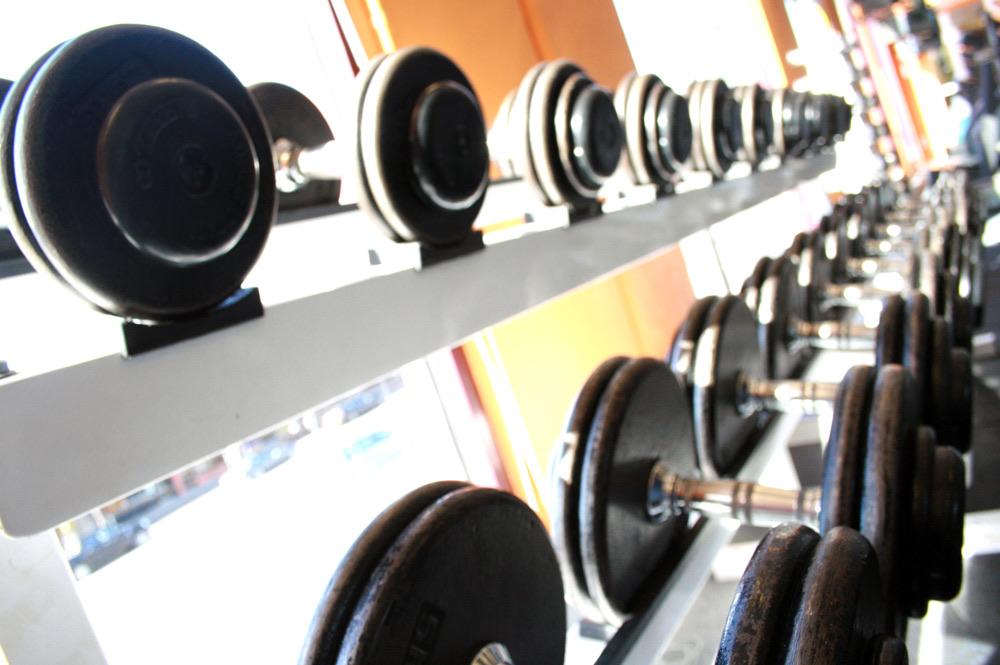
A dumbbell rack in a gym. Free weights, machines, bands, or bodyweight can all fill a twice-weekly full-body plan.
Photo: LocalFitness.com.au
In March 2026 the American College of Sports Medicine published its first major resistance-training Position Stand since 2009 — an overview of 137 systematic reviews covering more than 30,000 participants. For healthy adults, the guidance landed in one clear line: train all major muscle groups at least twice a week. Stuart Phillips, a McMaster University professor and Position Stand author, said the program you stick with beats the complicated one you abandon, whether the load is a barbell, a band, or your bodyweight. Two days, done well, counts.
That floor matches how busy weeks actually look. You do not need a five-day split to get stronger. You need two full-body sessions that cover a squat or leg press pattern, a hinge, a push, a pull, and some work for the trunk and shoulders — then enough recovery between them that you can show up again. A 12-week trial in previously untrained women found that two longer full-body days produced similar strength, jump, and muscle-mass gains as four shorter split sessions that matched the same weekly sets. More of the four-day group quit for time or motivation. The shorter calendar was easier to keep.
Progression is what turns those two days into real strength. ACSM still dials the details by goal: heavier loads around 80 percent of a one-rep max for two to three sets when strength is the target; higher weekly volume — roughly ten sets per muscle group — when muscle size is the target; moderate loads moved quickly when power matters. For someone starting out, the usable version is simpler. Pick a weight you can move for about eight to twelve controlled reps with one or two left in reserve. When the top of that range feels solid for two or three sets, add a little load or another rep the next week. Showing up twice without ever changing the weight is maintenance dressed up as a plan.
Training to failure is optional for most people. The Position Stand found that momentary muscle failure, machines versus free weights, and complex periodization did not reliably change outcomes for the average healthy adult. What still mattered was real effort and covering the whole body twice. Home-based and elastic-band work counted in the evidence review, which helps on weeks when the gym is out of reach and a living-room floor is what you have.
Most of that evidence pool is still generalized — reviews built from studies that rarely break out ethnicity. The gap matters because baseline muscle and fat patterning are not identical across groups even when the training principle is the same. DXA work has found Asian women among the lowest skeletal-muscle values across adulthood compared with African American, White, and Hispanic women after accounting for size. Separate body-composition studies have shown Asian Indian women carrying more body fat and less appendicular muscle at a given BMI than European and Pacific peers. Those are starting-point differences. They tell you a Western sample average is incomplete as a map of a strong week, and that the work is still worth doing.
Where Asian women have been studied directly, twice a week still builds strength. Perimenopausal Chinese university teachers in a 12-week program that included progressive resistance training twice weekly — plus walking on other days — improved muscular strength, with the largest gains in the group that started with the poorest metabolic health. Korean trials in adult women saw strength rise after twelve weeks of resistance work at both lower and higher intensities. Older Japanese women gained maximal strength and lean mass on structured lifting. The pattern matches ACSM’s floor: get the work in, and strength follows.
The South Asian picture is thinner. A Glasgow comparison of South Asian and White European men — not women — found similar thigh-muscle and strength responses to twelve weeks of twice-weekly resistance training. That is useful context, and it still leaves fewer trials built around South Asian women. Culturally tailored strength programs for young South Asian women remain rare enough that feasibility studies are still figuring out how to recruit people and keep them coming back. You do not need that perfect sample before you put two sessions on the calendar.
Keep the week small on purpose. Schedule two full-body sessions with at least a day between them. Hit the big patterns. Add load or reps when the set gets easy. Count bands and home sessions as real training when that is what the week allows. The studies we have in East Asian women, and the thinner ones around South Asian adults, still show strength moving when the work gets done. Twice a week is enough to start.