
Sindhu turns a comeback season into a Japan Open title
Her 21–17, 21–17 win over Akane Yamaguchi delivered a first Super 750 crown — and stronger evidence than the uneven route that brought her to Sunday.
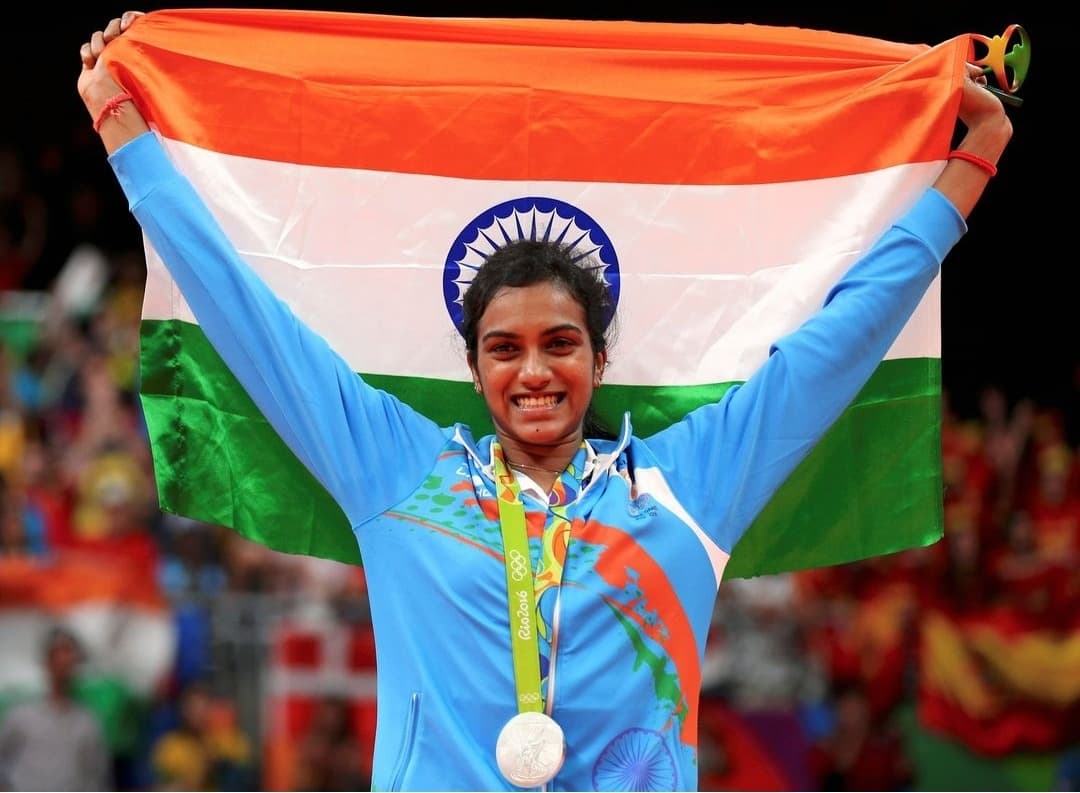
P. V. Sindhu with her Rio 2016 Olympic silver and the Indian flag. Ten years later in Tokyo, she became the first Indian women’s singles champion at the Japan Open.
Photo: Prashant123japla / CC BY-SA 4.0
P. V. Sindhu completed the part of her Japan Open week that could not be explained by a friendly draw. Facing four-time champion Akane Yamaguchi and a home crowd at Tokyo Metropolitan Gymnasium, Sindhu won 21–17, 21–17 in 50 minutes. The title is her first at the Japan Open, her first at BWF World Tour Super 750 level, and the first women’s singles championship there for an Indian player.
The final turned on Sindhu’s willingness to take the shuttle early without rushing the point. Yamaguchi led by two at the first interval, then met a tighter net game and a more purposeful attack. When the opening game reached 17–17, Sindhu won four straight points. In the second, she built leads of 8–3 and 14–7, absorbed a late push to 19–17, and closed when Yamaguchi’s final return landed long after a video review upheld the call.
The long rallies mattered as much as the familiar power. BWF highlighted a 44-shot exchange early in the second game; Sindhu won it and continued to make Yamaguchi cover the full court. Yamaguchi said afterward that she was not injured but had been tired by two demanding earlier matches. She also gave the cleaner explanation for the result: Sindhu’s attack was strong, her pace held, and the Japanese player could not answer it quickly enough.
Sindhu described the emotional release in less technical terms. “I had tears in my eyes because it was really important to me,” she said after the match. She had kept believing through questions about her form, she added, and called winning the final — rather than merely reaching it — an important difference. The victory moved her career record against Yamaguchi to 16–14 and ended a run of four years without a completed-match win over the Japanese star.
The route to the trophy still needs an honest accounting. Sindhu opened by beating Malaysia’s Wong Ling Ching 21–14, 21–11, then produced a sharp 21–16, 21–14 win over world No. 5 Han Yue in 35 minutes. Nozomi Okuhara withdrew before their quarter-final, and Chen Yufei retired from the semi-final with Sindhu leading 21–19, 15–10. Those breaks reduced her court time. They did not win Sunday’s two completed games for her.
That distinction is why the final changes the read on the week. Before Sunday, Han was the strongest proof that Sindhu’s movement and attacking patterns had returned; the later rounds had mostly kept the question open. Against Yamaguchi — a three-time world champion playing her sixth Japan Open final — Sindhu supplied a full, uninterrupted answer. She finished the tournament without dropping a game in any match that reached the court.
The timing gives the result more weight. Sindhu ended her 2025 season early to recover from a foot injury, resumed full training in December, and started 2026 outside the top 10. Semi-final runs at the Malaysia Open Super 1000 and Australian Open Super 500 showed progress, but neither ended with a trophy. Tokyo is her first tour title since the Super 300 Syed Modi International in December 2024 and her first title above that tier since the Super 500 Singapore Open in 2022.
It also arrives one month before the World Championships in New Delhi, scheduled for August 17–23. Sindhu already owns five world medals, including the 2019 gold, and will enter a home championship with a much more useful signal than reputation alone. One week does not settle the durability questions that come with a 31-year-old athlete’s return from injury. It does show that her best attacking badminton can still survive the long exchanges and closing points against the sport’s elite.
The sharpest conclusion is therefore narrower than a declaration that the old Sindhu is fully back. Her draw contained two incomplete rounds, and Yamaguchi carried fatigue into the final. But Sindhu beat the opponents who stood across from her, dominated the best completed match of her week, and closed a tournament at a level she had never won before. The comeback now has a title sturdy enough to measure.