
Audrey Shin and Spencer Akira Howe Just Got Into Finlandia Trophy
The ISU promoted the U.S. pair from the alternate list on Wednesday after Finnish entry rules blocked the Russian pairs who had been entered. They skate the short Friday at 14:26 in Helsinki. Two elements from their Skate America sheets matter most.
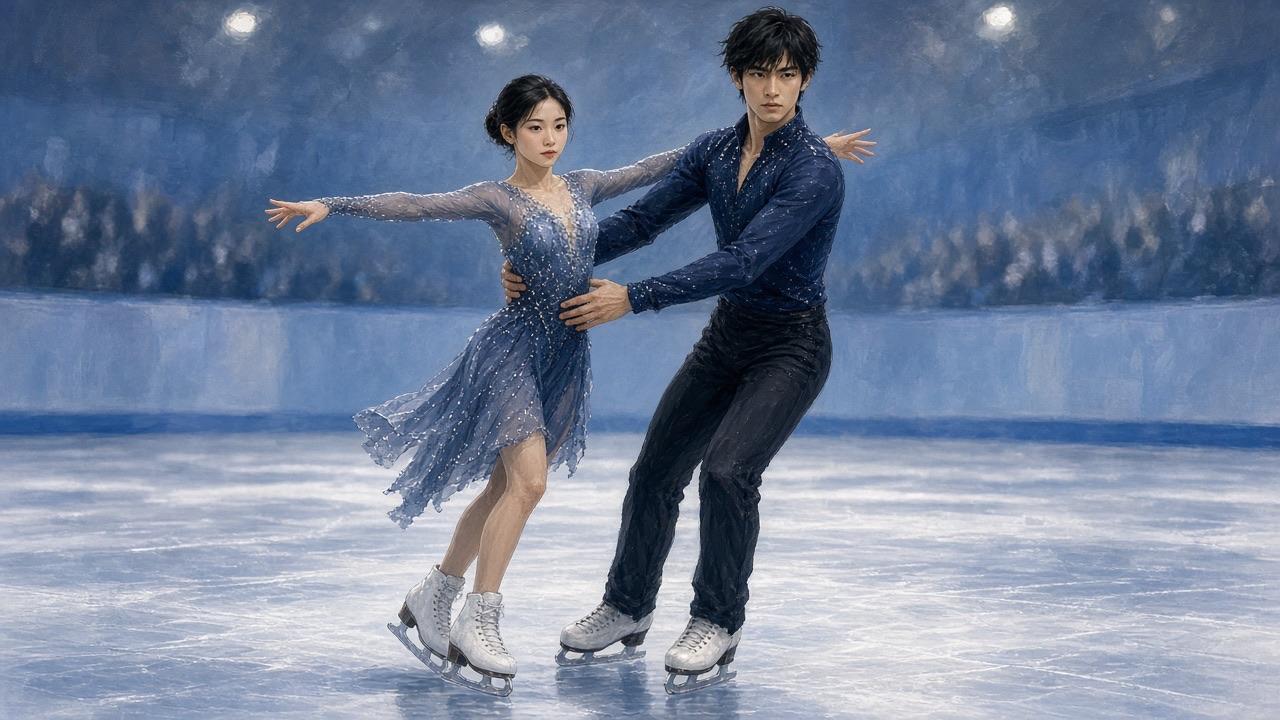
Editorial illustration of a pairs team on the ice — not a photograph of Audrey Shin and Spencer Akira Howe.
Illustration: The Medalist
Audrey Shin and Spencer Akira Howe were still on the alternate list when the week started. By Wednesday night they had a Grand Prix start in Helsinki. The International Skating Union confirmed that the U.S. pair — along with Katie McBeath and Balazs Nagy, and France’s Megan Wessenberg and Denys Strekalin — would join the Finlandia Trophy pairs field after Individual Neutral Athlete skaters could not enter Finland under measures adopted by Finnish authorities. The short program opens the meet Friday.
Finland had tightened short-term entry rules that reach professional sport, and the ISU said AIN skaters were unable to enter the country as a result. Three pairs who had been on the Finlandia list — Anastasia Mishina and Aleksandr Galliamov, Aleksandra Boikova and Dmitrii Kozlovskii, and Ekaterina Chikmareva and Matvei Ianchenkov — were among those replaced, along with men’s skater Yevgeny Semenenko. Those AIN athletes keep first priority for any NHK Trophy withdrawals next week. Helsinki’s pairs draw now runs eight teams deep, with three of them American.
The official pairs short-program time schedule puts Shin and Howe in Warm-Up Group 1, start No. 4, skating 14:26:30 to 14:32:50 local time at Helsinki Ice Hall — 7:26 a.m. Eastern. McBeath and Nagy go immediately ahead of them at 14:20:10. Shin’s previous partner was Nagy; Howe’s previous partner was Emily Chan. Both new teams formed in July and train under different coaches. Peacock is set to stream the Grand Prix weekend; U.S. Figure Skating listed the pairs short as the first segment of the day.
For Shin and Howe, Finlandia is a second Grand Prix assignment that did not exist on their calendar a week ago. They are a new partnership out of The Skating Club of Boston, coached by Aleksey Letov and Olga Ganicheva. Shin, 22, is Korean American, from Northport, New York. Howe, 30, is Japanese American, from Burbank, California, and skates as a soldier-athlete in the U.S. Army World Class Athlete Program. At Saatva Skate America last weekend — their first Grand Prix together — they finished sixth with 171.18 after a 64.86 short and a 106.32 free. The Challenger silvers that earned them the Everett host spot still sit higher on the season sheet. Helsinki is another look at what this team can do on the Grand Prix.
The Skate America protocols already show where the points live. Watch the triple twist first. In Everett’s short they opened with a level-three twist for 7.25 — 5.70 base and 1.55 in Grade of Execution, with every judge in positive territory. In the free they raised it to a level-four twist for 7.46. Across both segments the twist was their safest bank: high base, strong GOE, no trouble on the sheet. When that first element lands in Helsinki, the rest of the program starts from a better place.
Then watch the throw triple Salchow — the element that still costs them. In the Everett short they fell on it. The judges gave a fall mark and unanimous –5 GOE; a 4.40 base value left 2.20 on the sheet, and they took a 1.00 deduction. Everything else in that short held: a triple toe, a forward-inside death spiral, a level-four group-three lift for 6.70, a level-four step sequence, a pair combination spin. “Besides the throw, everything felt really good,” Shin said afterward. The free told a longer version of the same story. They fell on the opening side-by-side Salchow and on the throw loop, took –3.00 in deductions, and still only managed 3.83 on the throw Salchow later in the program after negative GOE. The lifts, death spiral, and choreographic elements stayed positive. The throws did not.
That split matches what the coaches have been saying. After Nebelhorn, Ganicheva named throw consistency — adapting to Howe’s different timing from Shin’s previous partner — as the biggest challenge left. Howe has talked about going back to foundations after seven years with Chan. Finlandia will not rewrite their programs overnight. It will show whether the days since Everett changed the throw that hurt them there while the twist and lifts keep paying.
The field is thinner at the top than the original entry list, and denser with U.S. teams. Canada’s Lia Pereira and Trennt Michaud close the short as the last skaters. Germany’s Annika Hocke and Robert Kunkel, Italy’s Irma Caldara and Riccardo Maglio, and Ukraine’s Hannah Herrera and Ivan Khobta fill out the rest. Shin and Howe get a second Grand Prix short with a clear job on two elements the Everett sheets already marked: land the twist, hold the throw. The rest of Friday follows from there.