
Audrey Shin and Spencer Akira Howe Climbed From Fourth to Finlandia Bronze
They won the free skate with a personal-best 125.92 and finished on 193.18. The short and free sheets show where the points came from — and leave them on 16 Grand Prix points with both starts done.
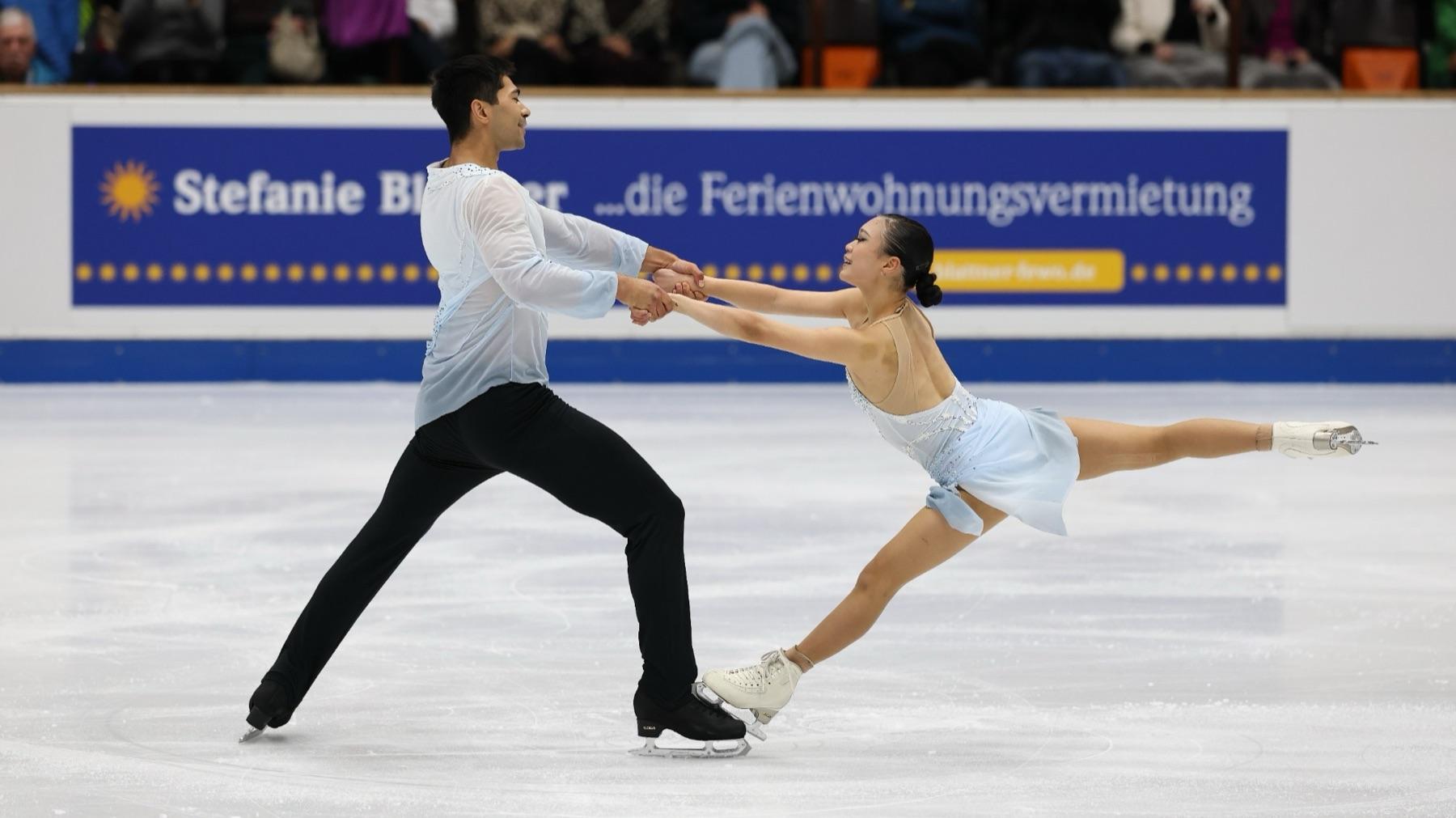
Audrey Shin and Spencer Akira Howe at Nebelhorn Trophy in September. On Saturday in Helsinki they won the free skate and took Finlandia Trophy bronze.
Photo: Robin Ritoss
Audrey Shin and Spencer Akira Howe left Helsinki Ice Hall on Saturday with a free-skate win and a Grand Prix bronze. Skating Romeo and Juliet, they scored 125.92 — a personal best, and the highest free of the pairs event — then finished on 193.18 overall, also a personal best. Germany’s Annika Hocke and Robert Kunkel took gold at 196.40. Canada’s Lia Pereira and Trennt Michaud, overnight leaders, settled for silver at 195.28. Shin and Howe had been fourth after Friday’s short. One clean free moved them onto the podium.
The short had already fixed the throw that wrecked their first Grand Prix. In Everett a week earlier they fell on the throw triple Salchow and left with 64.86. In Helsinki they opened with a level-four triple twist for 6.94, landed side-by-side triple toes for 4.50, and held the throw Salchow for 4.90 with positive GOE. The death spiral and group-three lift both went level four; the lift paid 6.70. The step sequence and pair spin stayed at level three, which left a few points on the table, but nothing went negative and they took no deduction. The sheet read 67.26 — 37.00 technical, 30.26 components — good for fourth behind Pereira and Michaud (74.39), Hocke and Kunkel (72.63), and Katie McBeath and Balazs Nagy (70.81).
That order mattered on Saturday. Pereira and Michaud had the lead and the last skate. McBeath and Nagy — Shin’s former partner with his new teammate — sat third. Shin and Howe went out fifth of eight and put the free on the board before either team ahead of them finished. The opening twist went level four again for 7.46. Side-by-side triple Salchows took a quarter call and scored 3.93, the only soft jump pass of the program. Everything after that scored positive. The throw triple loop drew a unanimous +2 GOE for 6.00. The triple toe–double Axel sequence made 7.92. A group-five lift at level three scored 8.30, their best single element of the night. The throw Salchow that had been a fall mark in Everett came back at 5.59. Death spiral, second lift, choreographic lift, and choreographic spin all held. They left with 62.03 in technical score, 63.89 in components, and no deductions.
“I felt like I could redeem myself today,” Shin said afterward. “I was really disappointed with my performance at Skate America because it wasn’t how I’d been training. I’m so grateful we got this second chance in the Grand Prix series and that we stayed together and supported each other throughout the process.” Howe still sounded surprised they were in Helsinki at all. “We didn’t even know we’d be competing here until about three days ago,” he said. “To come here and deliver one of our best performances so far, especially as a new team, shows that we’re making really good progress.”
The free numbers explain the climb. Pereira and Michaud dropped to 120.89 after doubled Salchows, a broken toe–Axel sequence, and a stepped-out throw flip — 55.77 on technical elements against Shin and Howe’s 62.03. Hocke and Kunkel were cleaner at 123.77 and still finished 2.15 behind on the segment. McBeath and Nagy posted personal bests of 120.44 and 191.25 and finished fourth, 1.93 behind Shin and Howe. Over two Grand Prix weekends the former partners each took a bronze: McBeath and Nagy in Everett, Shin and Howe in Helsinki, where the free finally put Shin ahead of Nagy on the same sheet.
The partnership is four months old. Shin, 22, is Korean American, from Northport, New York. Howe, 30, is Japanese American, from Burbank, California, and skates as a soldier-athlete in the U.S. Army World Class Athlete Program. They train at The Skating Club of Boston under Aleksey Letov and Olga Ganicheva. Challenger silvers at the John Nicks Pairs International (183.81) and Nebelhorn Trophy (177.83) earned the Skate America host spot. Everett went 171.18 and sixth. Helsinki jumped more than 22 points from that total. U.S. Figure Skating counts four competitions and three medals for them this fall. The bronze is the first Grand Prix medal of the new team.
On the Grand Prix board, the haul is smaller. A third-place finish is worth 11 series points. Added to five from sixth in Everett, Shin and Howe sit on 16 with both designated events done — seventh in the unofficial pairs standings after Finlandia. Pereira and Michaud are already into the Final in Chongqing on 28. Hocke and Kunkel have 26. Alisa Efimova and Misha Mitrofanov have 26. McBeath and Nagy have 20. Sixteen with no second start left will not get them to December. The season still changed in Helsinki: the throws that leaked points in Everett can hold on a Grand Prix sheet, and a free in the mid-120s is now something they have done, not only something they have trained.
NHK Trophy next weekend closes the regular Grand Prix calendar without them. Nationals and the rest of the Olympic cycle are next. Howe already pointed that far ahead in Helsinki. “We’ve got our eyes set on the next Olympics,” he said. “We know that journey starts right now.” On Saturday that start looked like a free skate that won its segment and a throw that stayed up — enough, after a late call-up, to leave with bronze.