
Korea didn’t lose Group A. It lost the decade Japan used.
A must-not-lose game against South Africa, a captain on the bench, and another early exit under Hong Myung-bo showed how far Korean football has drifted from a system that can survive without a perfect week.
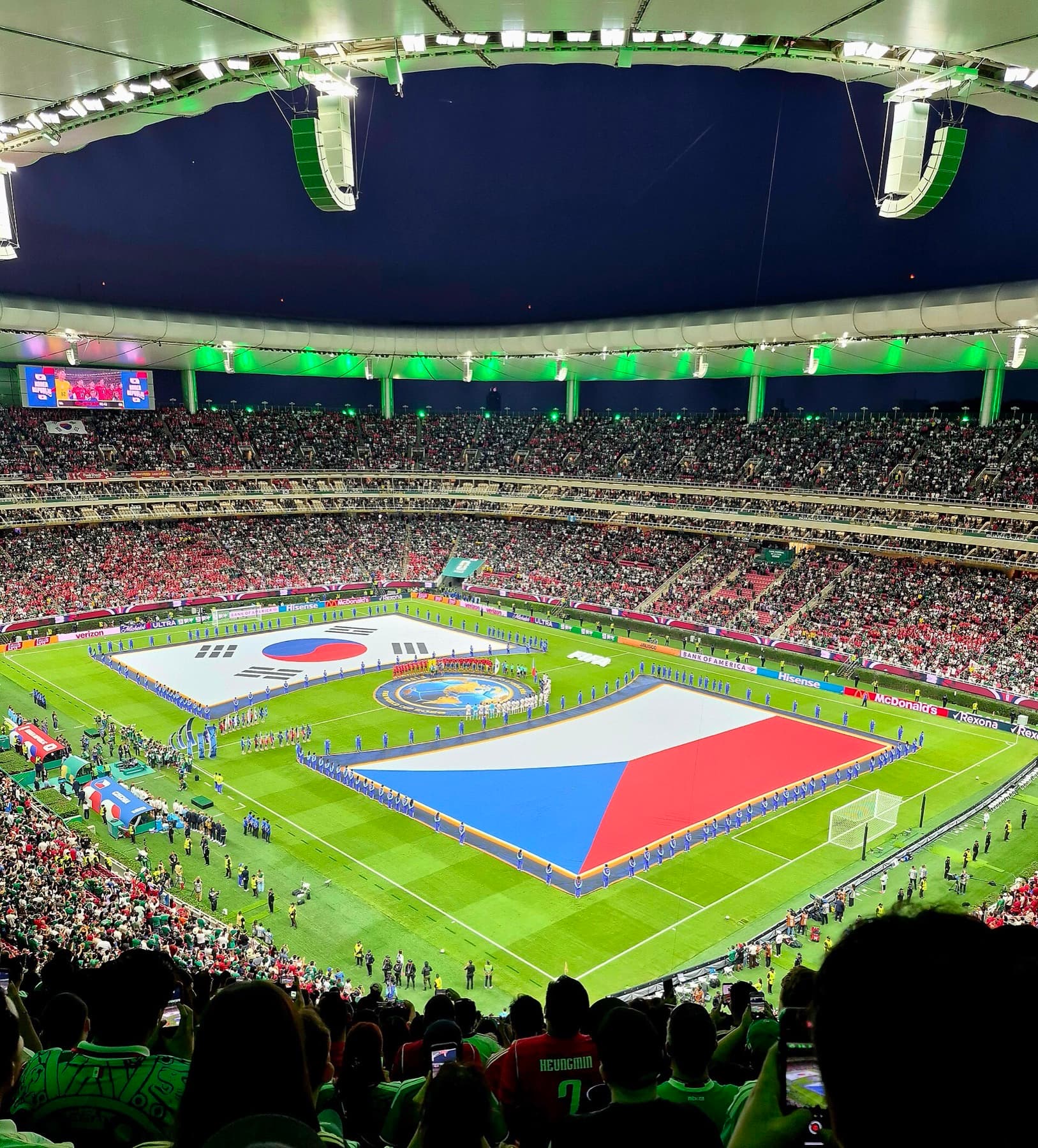
Flags of South Korea and Czechia on the pitch before their Group A opener at Guadalajara Stadium. Korea came from behind to win 2–1, then lost the next two matches 1–0 and missed the knockout wild card.
Photo: Erik Cleves Kristensen / CC BY 4.0
FIFA’s July rankings put the stamp on a summer Korea already felt in its stomach. The Taeguk Warriors fell to No. 32 — lowest since late 2021 — and fourth in Asia behind Japan, Iran, and Australia. Spain’s final in New Jersey will dominate the highlight reels. For Asian football, the clearer postmortem is why Korea, seeded above Czechia and South Africa in Group A, finished 34th of 48.
The short answer is three matches: a comeback win over Czechia, then consecutive 1–0 losses to Mexico and South Africa. The longer answer is that those results were not a surprise so much as a confirmation. Korean football still organizes around big names and contested appointments. Japanese football has spent twenty years organizing around a system that can lose stars and still look like itself.
The South Africa night made that difference visible. Needing only a draw in Monterrey to take second place automatically, Hong Myung-bo left Son Heung-min on the bench for the first time in twelve World Cup starts. He wanted a fresher captain when the opponent tired. Son came on at half-time at 0–0; Thapelo Maseko scored in the 63rd minute; South Africa reached a knockout round for the first time. Korea dropped into the third-place scramble, then watched the expanded wild-card net close when other groups finished. A draw would have changed the bracket. It would not have changed the pattern.
Hong resigned the next day in Zapopan, his second World Cup exit as head coach after 2014. The deeper bruise was how he got the job again in 2024 — a process so disputed that President Lee Jae Myung answered this summer’s exit by saying personnel decisions determine everything. KFA president Chung Mong-gyu accelerated his resignation. A reform committee with Park Ji-sung at the table is now trying to rebuild trust the association spent years spending down. That is not a match report. That is a federation admitting the product on the pitch followed the politics off it.
Japan’s campaign was the foil Korea could not ignore. Hajime Moriyasu has had continuity since 2018. The JFA’s long “Japan’s Way” project kept running while Korea’s newer “Made in Korea” model lost altitude amid audits and credibility fights. Japan advanced from a harder group without several of its biggest names. Korea entered a softer group with Son, Lee Kang-in, Hwang In-beom, and Kim Min-jae available and still needed other countries’ results to stay alive. One culture manufactures depth. The other keeps asking its best player to solve structural problems in eighty minutes — or forty-five.
Son finished the tournament without a goal, apologizing to teammates after the South Africa loss and saying he never wanted advancement to depend on other scorelines. Whether it was his last World Cup is his call. The next Korean coach inherits something harder than a vacant dugout: a public that no longer trusts how the job is filled, a ranking outside the top 30, and a rival next door that treated this World Cup as another waypoint on a plan, not a referendum on one man.