
Why Asian American girls drop sports — and how to keep one season
They start behind in the national numbers and often leave when homework wins the calendar. A parent rule for keeping one team without treating every jersey like a scholarship bet.
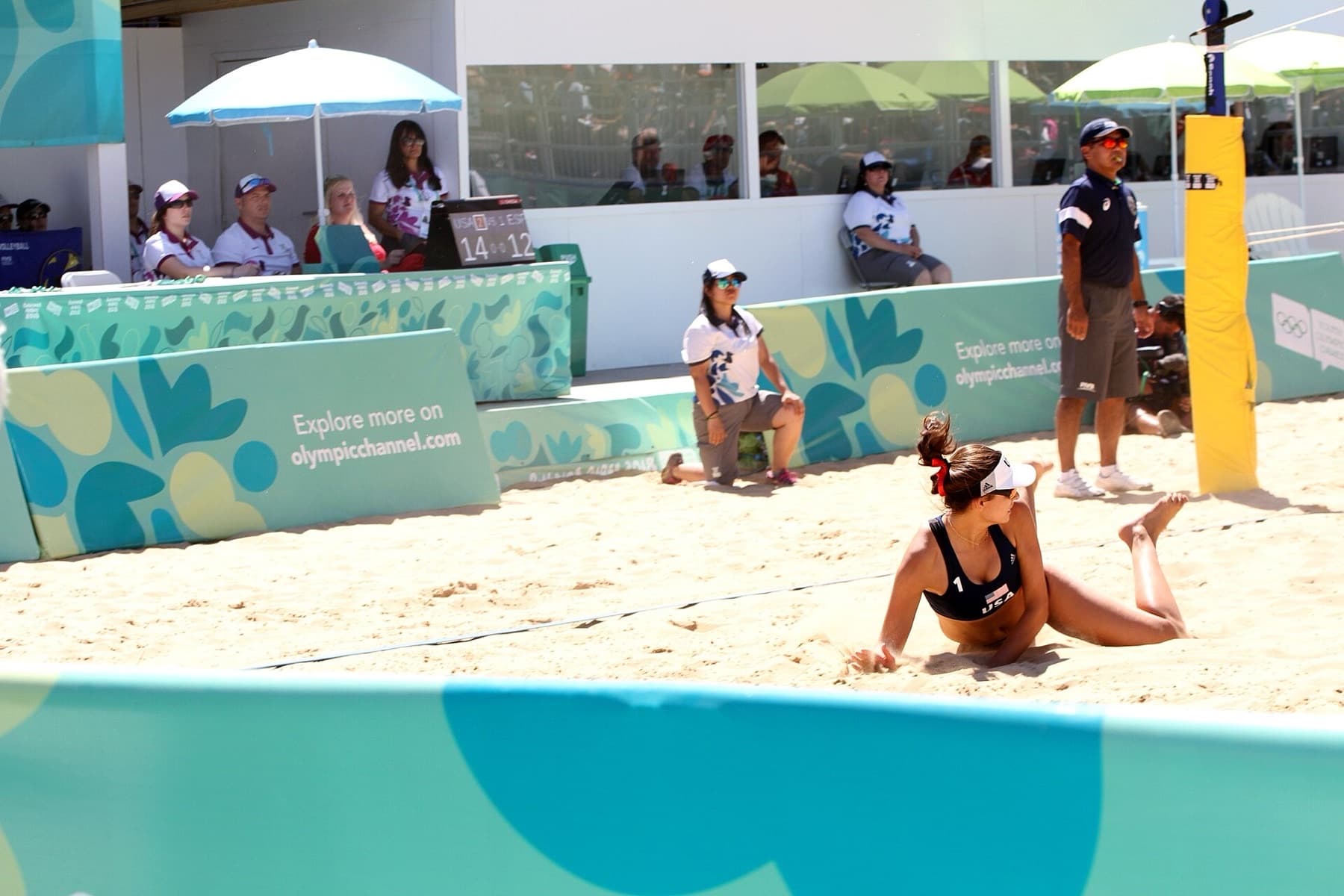
A USA player digs in the sand during the girls’ beach volleyball quarterfinals at the 2018 Summer Youth Olympics — the kind of competitive afternoon that starts years earlier on a school or club court.
Photo: Marcus Cyron / CC BY-SA 3.0
The conversation usually starts in the kitchen, not on the court. A grade dips. An AP load stacks. Practice runs past dinner twice a week. Someone says, gently or not, that she should quit the team and focus. In a lot of Asian American households that sentence sounds responsible. It can also be the moment a girl leaves sport for good — and the numbers say those exits are not rare.
National figures already put Asian kids behind. The federal survey Aspen’s Project Play tracks for 2024 had Asian youth ages 6–17 in a sports team or lessons at 56.8 percent, against 65.5 percent for white youth. That is before you zoom into girls. A 2022 Minnesota Student Survey analysis of more than 4,000 Asian American female youth found only about 37 percent played sports. East Asian and South Asian girls sat near 45–46 percent. Southeast Asian girls were closer to 27 percent. One label covers childhoods that do not look alike.
Girls leave sport in greater numbers than boys nationwide, and school shows up earlier than many parents expect. The Women’s Sports Foundation’s 2026 Sport Report found 22 percent of girls ages 14–18 had already played and quit, versus 17 percent of boys. Fun still tops the quit list for both. The early gap is elsewhere: among the youngest girl dropouts in that survey — ages 8 to 10 — 15 percent named schoolwork, four times the rate for boys the same age. The sample at that age is small, so treat the exact percent as a signal, not a census. The signal still lands before puberty, before varsity cuts, before anyone is arguing about college recruiting.
Sociologist Natasha Warikoo spent years in an affluent East Coast suburb she called Woodcrest for her book Race at the Top — Chinese and Indian immigrant families next to U.S.-born white ones, same money, different hours. Immigrant Asian parents more often treated academics as the ladder and asked kids to drop intensive extracurriculars when homework slipped. One Indian mother told her varsity swimmer, again and again, to leave the pool because he was not finishing homework; he still made a top-twenty college. That story is about a boy. The same bargain lands on daughters every fall. White parents in the same town more often capped AP loads to protect club sports and theater. Asian kids took more advanced classes. White kids were over-represented on varsity teams relative to their share of the school. The fight is ordinary and specific: a calendar, and a theory of college often imported from places where athletics do not buy a seat.
Sport is not only a résumé line. In the Minnesota analysis, Asian American girls who played sports had lower odds of anxiety and depression after adjustment — about 24 percent lower for each. A related look at South Asian adolescents in the same survey found sports-team participation linked to roughly half the odds of elevated depressive symptoms and higher odds of mostly A’s. Pull the team and you can pull more than a jersey. That does not make every club season sacred. It means the quit deserves the same seriousness as adding another honors class.
Cost and the menu make the tradeoff sharper. An earlier Aspen school-sports survey found Asian American students among those most likely to sit out because no offered sport interested them — about 27 percent of Asian non-players named that reason. Two Chinese mothers in Warikoo’s study asked their school for something lighter: a running club twice a week you can skip the night before a test. Varsity and travel ball are not built that way. Fees, weekend showcases, and year-round schedules turn “exercise” into a second job. When the choice is framed as AP calculus versus a multi-thousand-dollar club season that still will not produce a scholarship, quitting looks rational. Sometimes it is. The trap is treating every conflict as proof that sport was never worth keeping.
Before you cancel the season, name the problem out loud. Is she sleeping under seven hours on school nights? Is a grade in freefall across a month, not one quiz? Is she hurt, or is a coach burning her out? Or is the panic mostly adult — a fear that sport “doesn’t count” next to a tutor hour? Sleep debt and a real slide earn a lighter team or a later practice. Stable grades and parental status panic earn a renegotiated elective load, not a quiet exit from the roster. One team she loves beats three she endures. Multi-sport childhoods help. Stacking travel soccer, club volleyball, and showcase weekends in the same month usually does not.
Protect the season that stays the way you would protect an exam week. Put practice and homework on the same family calendar so Thursday’s collision is visible on Monday. Keep breakfast real, protein at lunch, and a snack after practice — underfueling looks like laziness and becomes another reason to quit. Ask the school or rec desk about intramural or no-cut options when travel ball is the only model on offer. Talk to the coach once, early, about exam weeks and sleep; a good one would rather adjust than lose her in October. Say out loud that the team is not a rebellion against grades. In that Minnesota South Asian sample, the kids on teams were more likely to bring home mostly A’s, not less. Quitting everything for another AP is not a proven shortcut to a healthier kid.
Revisit the quit when the reasons are about who she is allowed to be, not how heavy the load is. If adults keep steering her toward “acceptable” sports and away from the ones she asks for, or if strength training gets framed as making her look too big, that is not an academic plan. NCAA sheets already show AANHPI women over-indexed as a share of golf, tennis, fencing, and gymnastics — and still thin as a share of soccer and basketball, even though soccer and swimming carry hundreds of AANHPI women in absolute numbers. Lacrosse’s growth story is real and still tiny. The path starts with a 12-year-old who is still allowed to show up on Tuesday.
Keep one season she chose, priced honestly, with sleep non-negotiable and academics measured by a semester trend — not a single bad quiz. Cut when injury, chronic exhaustion, or a toxic bench is the problem. Do not cut because another family’s tutor calendar looked cleaner from the outside. She needs adults who will not trade the only practice slot for a theory of college that never counted the team in the first place.