
The Board
China’s hottest football league is amateur — and named after a province
Jiangsu’s city league drew 2.43 million fans in its first season and put 62,000 in Nanjing for a final decided on penalties. Adidas arrived for year two. Hubei, Guangdong, and Shandong are already building their own versions.
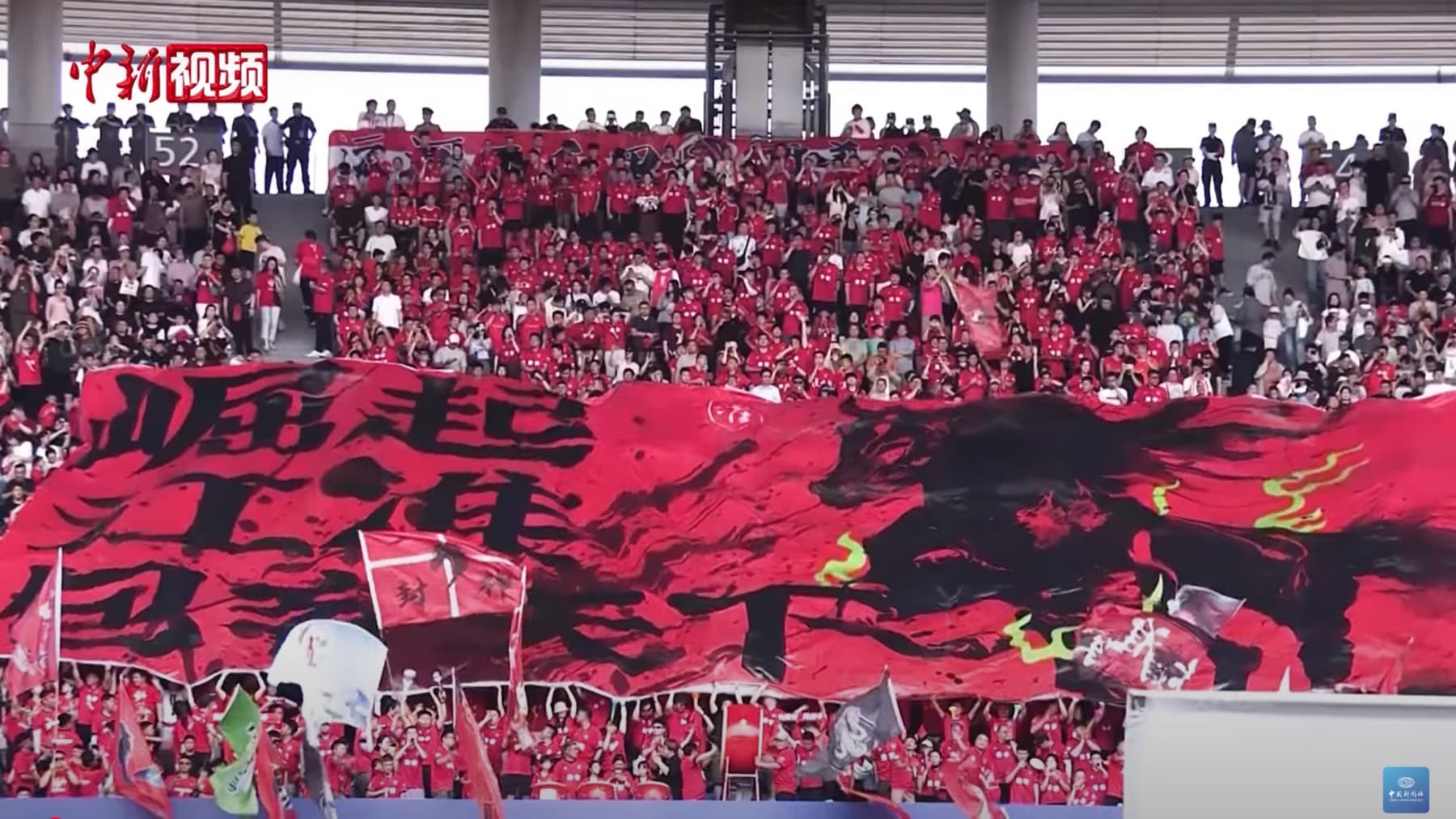
Huai'an supporters fill a stand during the Jiangsu Football City League in June 2025. The amateur city league, nicknamed Su Chao, packed stadiums in its first season and is now being copied by other provinces.
Photo: China News Service / CC BY 4.0
On a Saturday night last November in Nanjing, 62,329 people watched an amateur final go to penalties. Taizhou beat Nantong 4–3 from the spot after a scoreless ninety minutes and lifted the first Jiangsu Football City League trophy. Fans call the competition Su Chao — the Su Super League. Chinese Super League matches were on elsewhere that night. Nanjing still filled an Olympic stadium for city amateurs.
The first season, which ran from May to early November 2025, drew more than 2.43 million spectators across 85 matches, about 28,000 a game. Organizers counted more than 2.2 billion online stream views. A July Nanjing–Suzhou meeting at the Olympic Sports Centre put 60,396 in the seats, a Chinese amateur attendance mark that the final then beat. Face-value tickets often started around 10 to 20 yuan, then disappeared into resale. Cities that worried about empty stands in May were asking for bigger stadiums by June.
The setup is simple. All 13 prefecture-level cities in Jiangsu field a team named after the city. Players are mostly amateurs with local ties: residency, a year of local social insurance, or six years of local schooling keep squads from turning into rented lineups. The 2026 rules push youth harder still — at least six under-22s on the pitch at once, with professionals capped at four on the roster and two on the field. Matches land on Saturdays.
Rivalries write themselves. Jiangsu’s cities already compete over GDP, food, and high-speed-rail bragging rights. Putting that on a pitch after Jiangsu Suning’s professional club was dissolved in 2021 filled a hole fans had been walking around for years.
Sponsors noticed. For 2026, Adidas signed on as an official strategic partner and exclusive kit supplier, designing city kits at its Shanghai creative center — the brand’s first dedicated kit deal for a Chinese non-professional football league, according to Chinese business reporting. Coca-Cola, Heineken, Yili, HLA, and a dual title sponsorship from Jiangsu Bank and Soho Holding joined a provincial partner list that now runs into the dozens. Organizers said sponsorship revenue for the new season was expected to clear 100 million yuan.
The province is not shy about the economic story. Jiangsu vice governor Shen Jianrong told a May press conference that every yuan spent on Su Chao tickets last year generated about 7.3 yuan in related spending: hotels, meals, attractions, the usual weekend stack. Match days come with ticket-stub discounts, free scenic-spot entries for visiting fans, and outdoor “second venues” showing the game on big screens. Treat the multiplier as an official claim, not an audited ledger. The behavior underneath it is easier to see. People take the train to another city’s stadium and spend money while they are there.
That is why the copycats matter more than any single Jiangsu result. Hubei opened its Chu Super League in April with 17 city teams and 9.9-yuan tickets that sold out in batches measured in minutes. Guangdong is running a 21-city league. Shandong’s Qilu Super League has 16. Sichuan’s Chuan Chao started in late 2025 and carried into a 2026 finals stage. None of them invented one-city, one-team football. They are betting Jiangsu proved the weekend can pay for itself.
Chinese professional football has spent a decade swinging between big spending and club collapses. Su Chao asks for less: local players, cheap seats, city pride that was already there, and a calendar that fits the high-speed rail map. The 2026 season opened April 11 in Changzhou with more than 40,000 in the rain, Zhou Shen singing the theme song, and hundreds of robots dancing on the touchline. The ceremony was memorable. The stands are what other provinces are trying to copy.