
The Board
Why pickleball’s next boom is happening in Asia
DUPR’s fastest-growing markets are all Asian. Mall courts in Manila, converted badminton halls in Guangxi, and a $1.1 million slam in Hong Kong explain why growth rates look different from America’s player count.
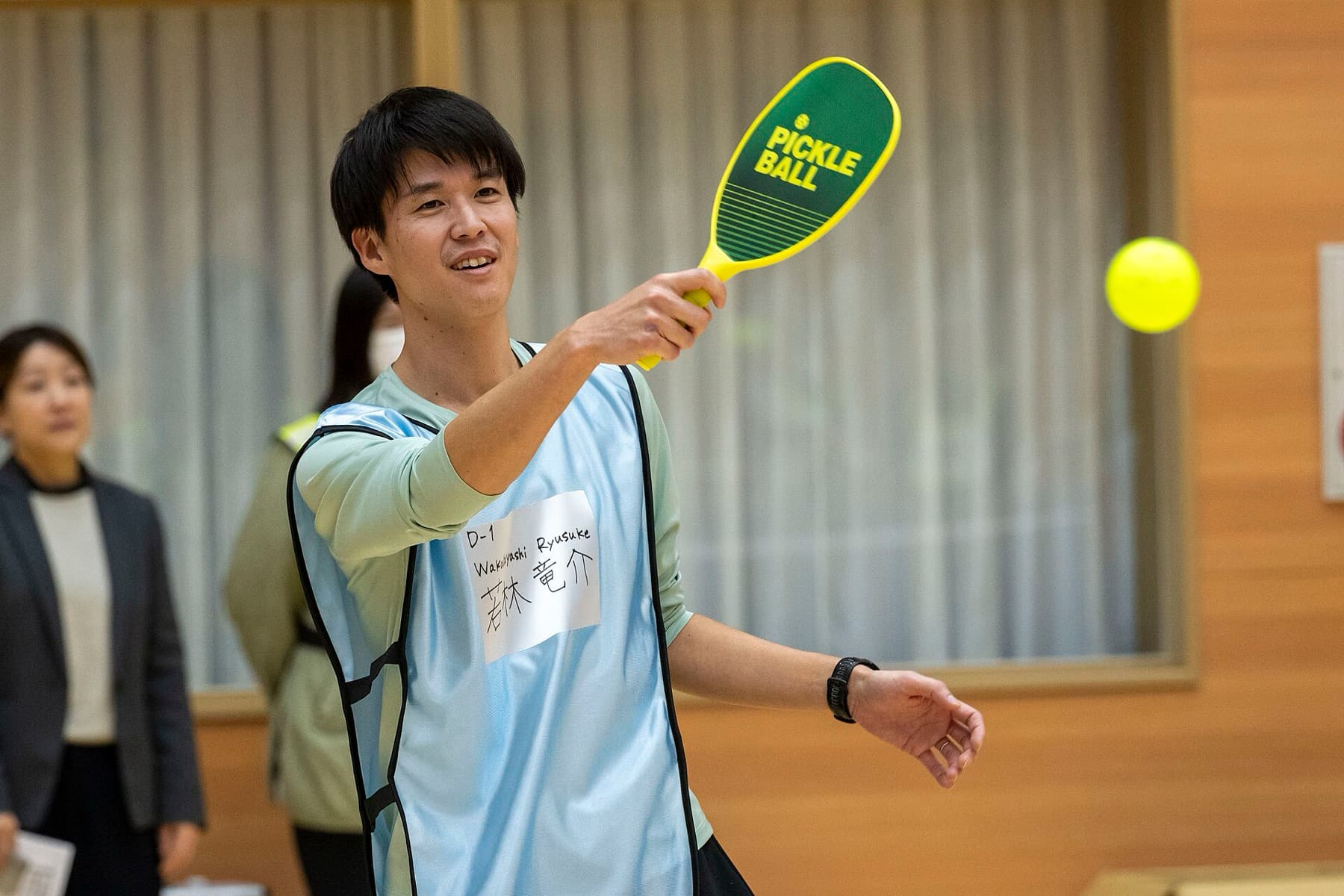
Wakabayashi Ryusuke mid-rally during a Japan–U.S. pickleball exchange in Misawa in December 2025. Japan’s two federations merged the following spring as the sport’s Asian growth rates pulled away from everywhere else.
Photo: U.S. Air Force / Senior Airman Patrick Boyle
In Manila, you can book a pickleball court the way you used to book a movie. SM Active Hub, the mall operator’s sports brand, now runs 102 courts across 32 malls. The Philippine Pickleball Federation’s directory lists 509 clubs, 439 venues, and about 47,000 registered players.
A decade ago the sport barely existed here. In February 2016, Filipino-American pro Sara Ash ran what organizers still call the country’s first clinic in Cebu.
That climb shows up in the ratings apps. DUPR, the sport’s main rating platform, published its latest list of the ten fastest-growing countries over the past twelve months. Every one of them is in Asia. The Philippines leads at 1,213 percent growth in DUPR users. Indonesia follows at 405 percent. From China and India through Japan, Thailand, Korea, Singapore, Malaysia, and Vietnam, the rest of the top ten are Asian too — all triple-digit except Vietnam at 110 percent, off a base that was already large.
The United States is still the heavyweight. The Sports & Fitness Industry Association counted 24.3 million Americans who played pickleball in 2025, up nearly 23 percent. That is the biggest single-country player base by a wide margin. What Asia has is the growth rate, and a court size that fits how Asian cities already play.
A pickleball rectangle is about 20 by 44 feet. Operators can paint lines on a tennis court, hang a lower net, or convert a badminton hall. Guangxi’s sports bureau told local media it wants at least 1,000 new or renovated pickleball courts by the end of 2026, and it is telling counties to prioritize dual-use badminton space.
The Chinese Tennis Association, which oversees the sport nationally, says the domestic calendar jumped from roughly 80 competitions in 2024 to more than 600 planned for 2026. Pickleball is also one of five required sports at the second National Fitness Games this year, a mass-participation event that opened in Qingdao in June. Industry reporting has floated a nationwide target of 100 million players by 2030. Treat that as ambition, not a census. The court and calendar build is the part you can already see.
India’s story is private money racing ahead of federation paperwork. Industry counts put operational courts somewhere north of 1,200 after roughly 200 in early 2024, with three or four new courts opening most weeks in Mumbai, Bengaluru, Delhi, Hyderabad, and beyond. Active-player estimates run from about 150,000 upward depending on who is counting. Mumbai hosted a world championship in 2024; Bengaluru followed in 2025. The inaugural World Pickleball League crowned the Bengaluru Jawans in February 2025. The sports ministry recognized the Indian Pickleball Association as the national federation in 2025; the older All India Pickleball Association challenged that in Delhi High Court and lost in February. The courts kept opening either way.
Japan spent the spring cleaning up the paperwork. The Japan Pickleball Association and the Pickleball Japan Federation signed a merger in March and began operating as one body, Pickleball Japan, in April. In July, Higashiizu opened a 20-court complex at Izu Resort Villa, billed as the country’s largest. Singapore’s government, facing booking rates above 90 percent at peak hours, promised 50 new multi-purpose badminton and pickleball courts over five years. Malaysia already ranks third globally in total DUPR users, behind only the United States and Canada.
Two numbers travel badly and should stay labeled. A 2025 UPA Asia and YouGov survey extrapolated monthly play rates from roughly a thousand respondents per country and produced huge totals: about 16 million for Vietnam, 60 million for China, 178 million for India. Vietnamese and Indian reporters have called those figures soft. DUPR’s growth rates measure people joining a ratings platform, not every casual rally in a mall atrium. Both datasets still point the same way. Asia is where the steep part of the curve is.
The pro money is catching up. PPA Tour Asia’s 2026 calendar runs ten stops from Hanoi to Tokyo to Ho Chi Minh City. The season ends October 19–25 at Kai Tak Arena with the Hang Seng Bank Hong Kong Slam: up to $1.1 million in prize money, the richest professional purse the sport has staged in Asia, on 24 temporary courts inside a venue built for bigger nights.
American pickleball grew because tennis clubs and rec centers could convert courts cheaply and seniors kept showing up. Asia’s version runs on mall floorspace, badminton halls that already exist, and young urban players who want a social sport that fits a lunch hour. Federations are still catching up to the habit. The United States still has the biggest player base. For the next few years, the growth chart worth watching is the Asian one.