
College baseball has another map. Japan just won the first world title.
At Taichung’s WBC stadium, Japan’s university side beat USA Baseball’s Collegiate National Team in 11 innings — proof that elite college baseball isn’t only an NCAA story.
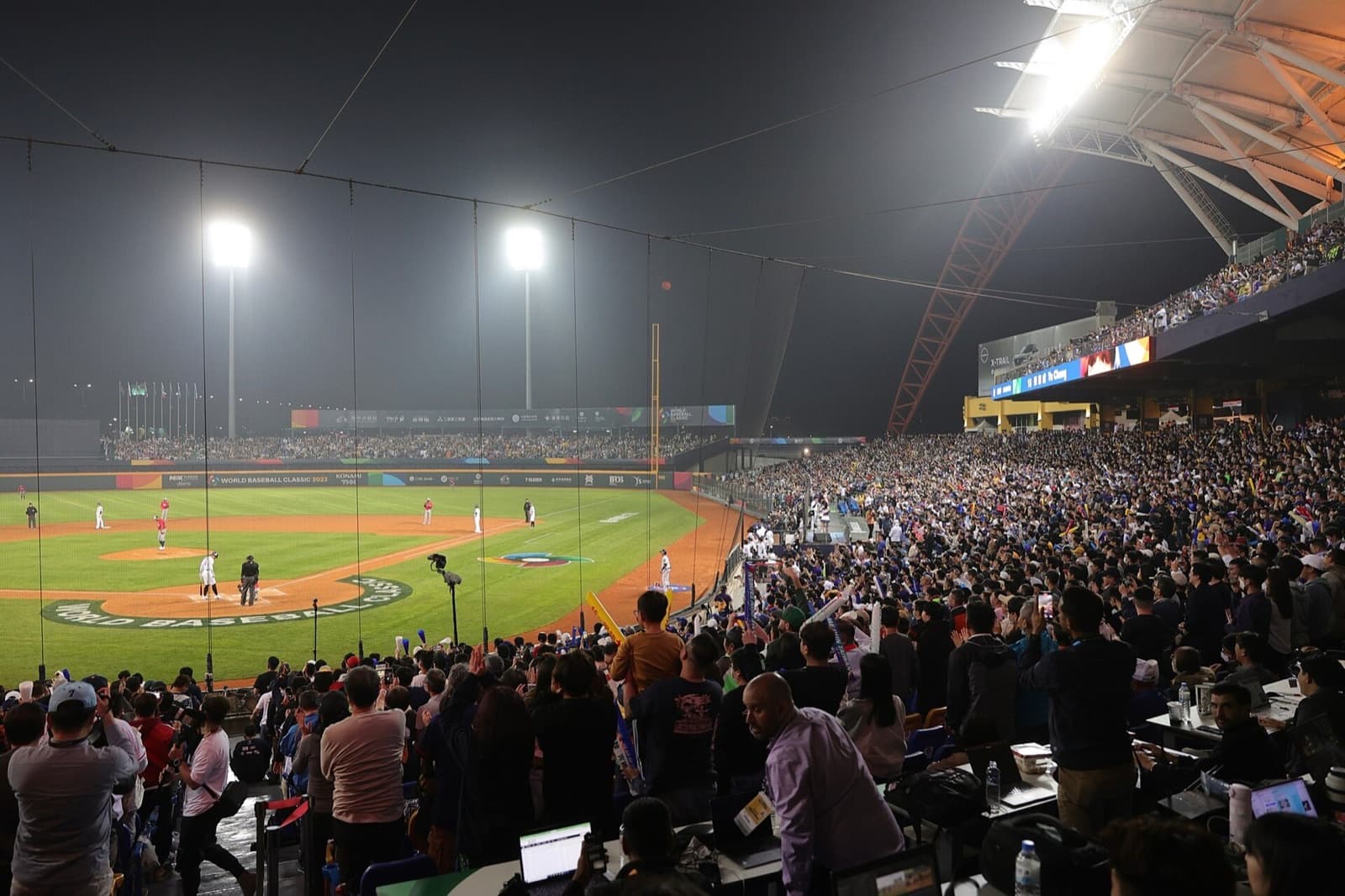
Taichung Intercontinental Baseball Stadium during a 2023 World Baseball Classic Pool A game — the same venue that hosted the inaugural World Collegiate Baseball Championship in July 2026.
Photo: Simon Liu / Office of the President, Republic of China (Taiwan) / CC BY 2.0
Japan’s university baseball team needed 11 innings, a rainy week in Taiwan, and one more chance at the United States. On July 15 at Taichung Intercontinental Baseball Stadium — the same bowl that hosted World Baseball Classic pool play in 2023 — Samurai Japan’s college side finished the inaugural World Collegiate Baseball Championship with a 6–3 win over USA Baseball’s Collegiate National Team. Each club managed five hits. The difference arrived in extras, when Japan scored three in the 11th and closed the bases-loaded threat that followed.
That result is bigger than a friendship-series rematch. USA Baseball, the Chinese Taipei Baseball Association, and the Japan University Baseball Federation built the WCBC as a rotating four-team title: the three founding federations every year, plus a wild card chosen by the host. Chinese Taipei invited Korea for the opener. WBSC recognition gave the event institutional weight that summer exhibitions rarely get. Cary, North Carolina, hosts in 2027; Japan hosts in 2028. College baseball now has a world championship calendar with Asia on the spine.
America’s roster looked like a College World Series all-star card — 21 schools, SEC depth up front, Florida, UCLA, Texas, and Mississippi State names on the lineup sheet. Japan’s 28 came out of a different machine: Tokyo Big Six programs such as Meiji, Tohto powers such as Aoyama Gakuin, and other university leagues that feed Nippon Professional Baseball the way the SEC feeds MLB. Meiji outfielder Nanato Sakakibara hit .563 across four games and took tournament MVP on his 22nd birthday. Aoyama Gakuin right-hander Taisei Suzuki, a fall draft favorite, struck out 14 in six innings against Korea and started the final. Captain Kai Watabe caught both ends of that battery and lifted the cup.
The path through the bracket was not clean. The United States took the pool meeting 3–2 behind four hitless relief innings from UCLA’s Easton Hawk, then ran the table into the gold-medal game. Japan answered Korea 10–0 in seven innings, survived weather reshuffles, and used the final as revenge theater. Down early, Japan tied in the seventh on pinch-hit work from Hosei’s Kazuki Inoue and Osaka University of Commerce’s Yuzuki Nakayama, traded runs in the international tiebreaker 10th, then broke the game open when Ritsumeikan catcher Keiya Nishino singled home the last of three 11th-inning runs.
For U.S. readers, the useful frame is not that Japan “surprised” anyone. Japanese university baseball has been beating American college all-stars with regularity — including a five-game sweep of the Collegiate National Team in Japan last summer, the first such sweep since 2004. Alumni of those series already sit on WBC and MLB/NPB stages; USA Baseball itself cites paths that run through Tomoyuki Sugano and Shota Morishita on the Japanese side and Alex Bregman and Kyle Schwarber on the American side. The WCBC simply turned a long bilateral rivalry into a multilateral title with Korea and Chinese Taipei in the same room.
College Court spends most of its pages on the NCAA’s operating system — scholarships, NIL, the portal, March Madness. Those tools still matter. They are not the only college baseball map. Japan’s university leagues, Taiwan’s amateur-to-CPBL ladder, and Korea’s collegiate pipeline develop players without an American campus stop, then meet the U.S. summer team on neutral Asian dirt. When the next title moves to Cary in 2027, the rematch will look domestic on the calendar. The talent that just won the first one was built somewhere else.