
Torri Huske’s Next Pool Is Half the Length. Here’s What That Changes.
Short-course worlds open Dec. 1 in Beijing’s Water Cube. Huske declined the U.S. roster after trials. Her butterfly still shows what a 25-meter pool does to turns, underwater swimming, and race rhythm.
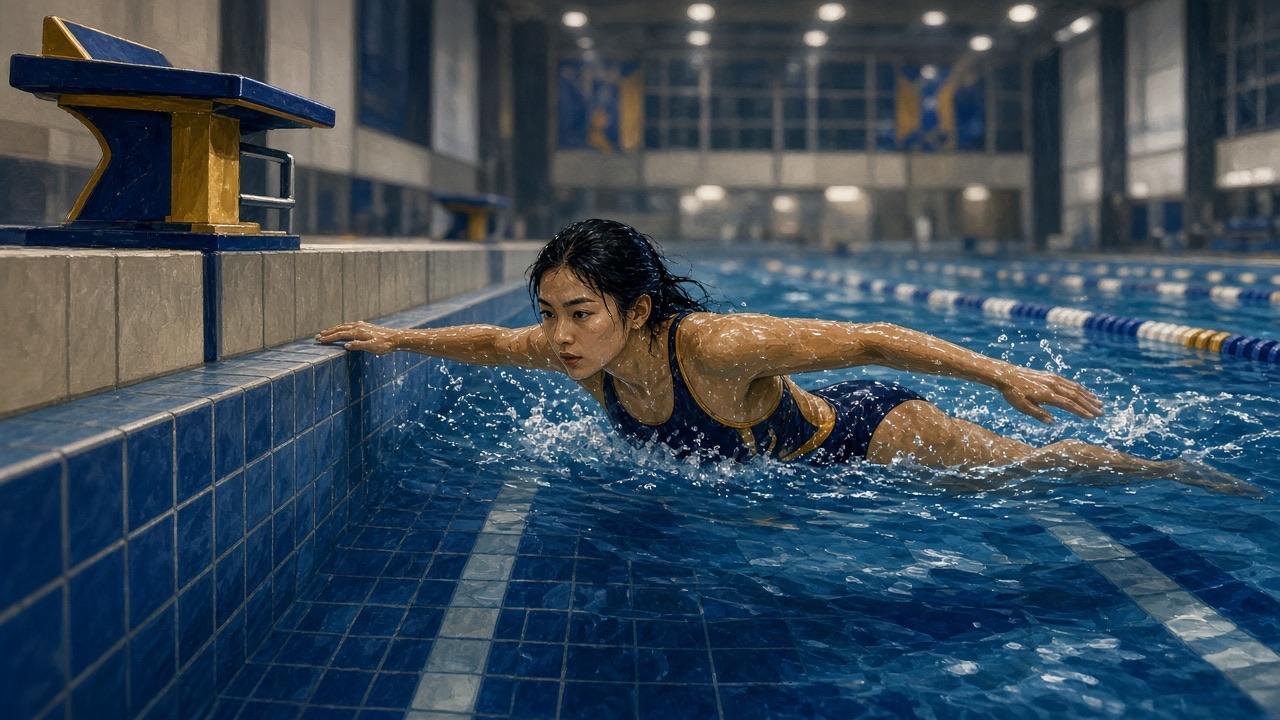
Illustration of a butterfly swimmer touching the wall in a short-course pool. A 100 fly here has three turns and four underwater phases; in a 50-meter pool it has one turn.
Illustration: The Medalist
The World Aquatics short-course championships open Dec. 1 in Beijing, inside the Water Cube, in a 25-meter pool — half the Olympic length. For six days the sprint and middle-distance fields will race a meet that lives on the walls: more turns, more underwater dolphin kick, and less unbroken swimming even when the stroke looks the same from the stands.
Torri Huske will not be there. The Chinese American Olympic champion in the 100 butterfly swam the U.S. short-course trials in Westmont at the end of October. She finished second in the 100 individual medley in 58.24, made the 100 butterfly prelims and scratched the final, then declined the roster spot that would have put her on the plane. Phoebe Bacon moved up in her place. Huske’s stroke is still the right place to learn the pool. She has already won Olympic gold in a 50-meter fly and taken short-course silver in Melbourne in 2022. The difference between those races is the length of the tank.
Three turns instead of one
In a 50-meter pool, a 100 butterfly is two lengths and one turn. In a 25-meter pool, it is four lengths and three turns. Every wall is a chance to push off faster than surface swimming. The stroke cycle that carries Huske through the middle of an Olympic final gets broken up more often. She has to hit the wall cleanly, turn, and break out without giving back the speed the push-off just handed her.
That is why some swimmers look like different athletes in short course. A messy turn costs more because you pay for it three times, and because the next underwater phase starts from whatever speed you kept or lost at the wall. The wall is part of the race, not a rest stop between lengths.
The same 15-meter rule, more of the race
World Aquatics still caps underwater swimming at 15 meters from the wall in butterfly, freestyle, and backstroke. The rule does not change with the pool. The share of the race does. Fifteen meters is 30 percent of a 50-meter length and 60 percent of a 25-meter length. A short-course 100 butterfly has four underwater phases — off the start and after each of the three turns — against two in long course. A strong dolphin kick covers a large slice of the distance, well past the first few meters after the dive.
Huske’s Melbourne final already showed that. In the 2022 short-course world final she turned first at the 50 in 25.08. Canada’s Maggie MacNeil was third at the turn, then used a stronger back-half underwater to close in 28.27 and break the world record in 54.05. Huske finished silver in 54.75. She had the better first half on the surface. MacNeil still had more speed left under the water when the walls kept coming.
Where the finish lives
Long-course 100 fly asks for a different kind of late race. In Paris, Huske chased down teammate Gretchen Walsh after trailing at the turn, held her breath for the last five strokes, and touched in 55.59 for gold by four hundredths. The decisive work was surface butterfly into the wall — stroke length, timing, and keeping her head down. That finish still exists in short course, but it sits after more interruptions. You rebuild the stroke three times off the walls before you ever reach that last length.
The pacing feels different too. Short-course times run faster because of the walls — elite 100 fly conversions often come in a few percent quicker than long course — and the effort arrives in shorter bursts. You cannot settle into the same continuous undulation for 50 meters. Breath patterns change. The last hard push comes earlier relative to how many strokes you have left, because so many meters disappear underwater. In Beijing, watch who is still fast after the third turn more than who looked smoothest in the first 25.
How to watch Beijing without her
The U.S. women’s short-course roster that is going includes Gretchen Walsh in the 50 and 100 fly, Alex Shackell in both fly events, Claire Curzan in the 50 fly, and Regan Smith in the 200 fly. Their races will still turn on the same things Huske’s career has already shown: clean walls, strong underwaters, and whether a lead at the first turn survives the ones that follow.
Huske’s skip keeps her on another calendar — school, training, and the long-course Olympic cycle that still holds her best race. For December in the Water Cube, count the walls and watch the breakouts. Butterfly in 25 meters is the same stroke doing different work.