
Event Guide
College Court Tournament Guide
March basketball, decoded
The first 76-team NCAA tournament — Opening Round, seeding math, and the roster economy behind March.
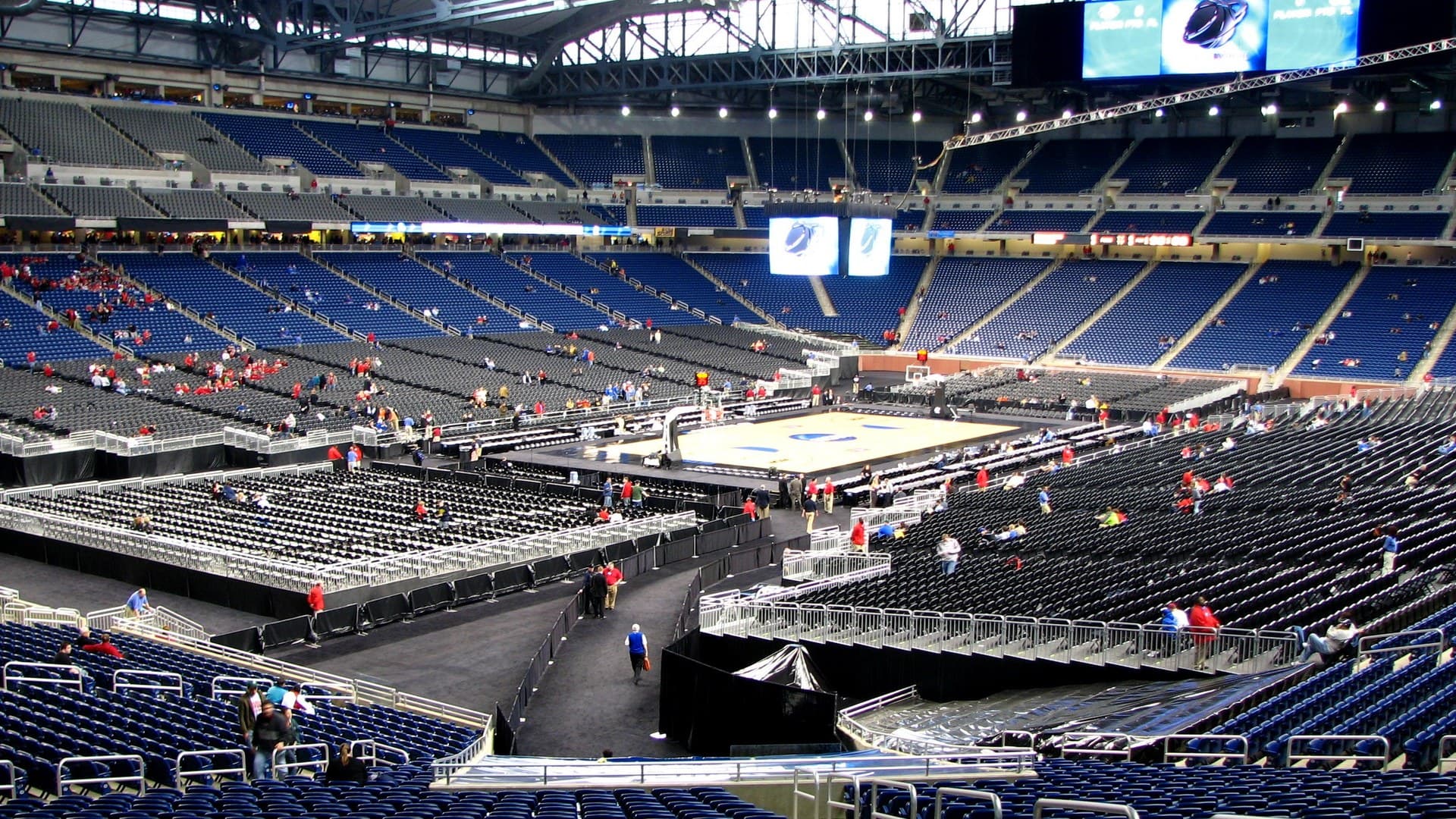
Ford Field configured for NCAA tournament basketball — Detroit hosts the 2027 men’s Final Four on April 3 and 5.
Photo: Dave Hogg / CC BY 2.0
Overview
This guide is built for the first 76-team NCAA Division I basketball championships — men’s and women’s — starting with the 2026–27 season. It is not a bracket filler. It is the context layer: how the Opening Round replaces the First Four, how NET and quadrant math still decide the bubble, and how House-settlement roster economics change which teams arrive in March with continuity.
Selection Sunday is March 14, 2027. Men’s Opening Round tripleheaders land in Dayton and Wichita on March 16–17; the women’s Opening Round spreads across twelve campus sites on March 17–18. After those twelve games, the familiar 64-team single-elimination rhythm returns. Men’s title weekend is Ford Field in Detroit (April 3 and 5). Women’s Final Four is Nationwide Arena in Columbus (April 2 and 4).
Expansion adds eight teams per gender and lifts at-large access — roughly 44 at-large berths once Pac-12 automatic bids return to the count of 32 conference champions. The political sell is opportunity. The competitive question is whether the new Opening Round dilutes jeopardy the way World Cup third-place advancement did, or whether it simply stages more win-or-go-home basketball before Thursday.
Key Dates
Résumé season opens
Nonconference games start stacking NET and quadrant data the committee will still read in March.
Conference tournaments
Auto-bids lock; bubble teams play for seeding and survival in the same week.
Selection Sunday
76-team fields revealed; 24 sides learn they open in the Opening Round.
Men’s Opening Round
Twelve games across Dayton and Wichita — AQs vs AQs, at-larges vs at-larges.
Women’s Opening Round begins
Twelve campus-site games over Wednesday–Thursday before the round of 64.
Men’s First Round
The traditional 64-team bracket opens Thursday–Friday across eight host cities.
Women’s Final Four
Semifinals at Nationwide Arena in Columbus; championship Sunday, April 4.
Men’s Final Four
Ford Field, Detroit — semifinals Saturday, championship Monday, April 5.
How This Tournament Works
76 teams, Opening Round
Twenty-four teams play twelve games before the round of 64: the 12 lowest-seeded automatic qualifiers and the 12 lowest-seeded at-larges. AQs face AQs; at-larges face at-larges. Winners feed the familiar bracket.
What stays the same
Once the Opening Round clears, First Round through the title game keep the old cadence — 32 Thursday/Friday games for men, campus-site early rounds for women, then regionals and a Final Four.
How résumés still get read
NET sorts the team sheet; quadrant records explain which wins count. Road and neutral Q1 results still separate bubble sides from true seeds — expansion changes the floor, not the committee’s language.
Athletes & Teams to Watch
Opening Round at-larges
Basketball · USA
The new 12-game play-in is where last-four-in teams either start a run or confirm the bubble math.
Portal-built power lineups
Basketball · USA
15-man roster caps plus revenue share reward programs that retain continuity through February.
Mid-major automatic bids
Basketball · USA
Lowest-seeded AQs now open in Dayton or Wichita instead of waiting on a First Four coin flip.
Women’s campus hosts
Basketball · USA
Top seeds still control early-round stages — expansion multiplies Opening Round nights on those floors.
International bigs
Basketball · Global
European and African frontcourt imports keep reshaping who survives physical first weekends.
Strategy & Rules
History & Context
From 2011 through 2026, eight teams played four First Four games to reach 64. The 2027 model triples that play-in volume: 24 teams, 12 games, two men’s host cities, and a women’s map tied to campus hosts. After that, the bracket fans already know returns — which is the point of the design.
Selection still runs on NET sorting plus human judgment: strength of schedule, Q1 results, road record, availability, and late-season form. Expansion to 44-ish at-larges raises the floor for bubble programs without deleting the November games that become seed-line arguments.
Detroit’s Ford Field has staged NCAA basketball before (2008 regional, 2009 Final Four) and returns for 2027. Columbus hosts the women’s Final Four the same weekend window. Geography is part of the product: Midwest title stages after a coast-to-coast first week.
Business & Media
Men’s tournament rights with CBS and Turner already clear roughly a billion dollars a year into the early 2030s. Expansion did not reopen those base fees so much as unlock about $50 million annually in additional commercial value — including newly opened alcohol sponsorship categories — through 2032, with more than $130 million in extra unit distributions projected for schools over the remaining deal years.
Women’s basketball rides ESPN’s multi-championship package (about $115 million a year across the slate). Expansion inventory was largely anticipated in that deal; the growth story is audience and campus-host economics as much as a new rights check.
On campus, House-settlement revenue share and 15-player basketball roster caps turn March into a balance-sheet test: collectives and athletic departments that kept a coherent roster through portal windows arrive with an advantage no Opening Round bye can buy.
Related Guides
Update Log
- Full package for first 76-team cycle: Opening Round format, Detroit/Columbus dates, House/NIL context, Ford Field hero.
- Pre-expansion key dates and NIL scaffold.
- Post-tournament seeding retrospective under 68-team format.
The Medalist Briefing
Weekly intelligence on global sport, pathways, and the stories behind the scores. No noise. No betting picks.