
How March Madness seeding actually works
Selection, seeding, and bracket placement are three different decisions — and the committee weighs much more than record alone.
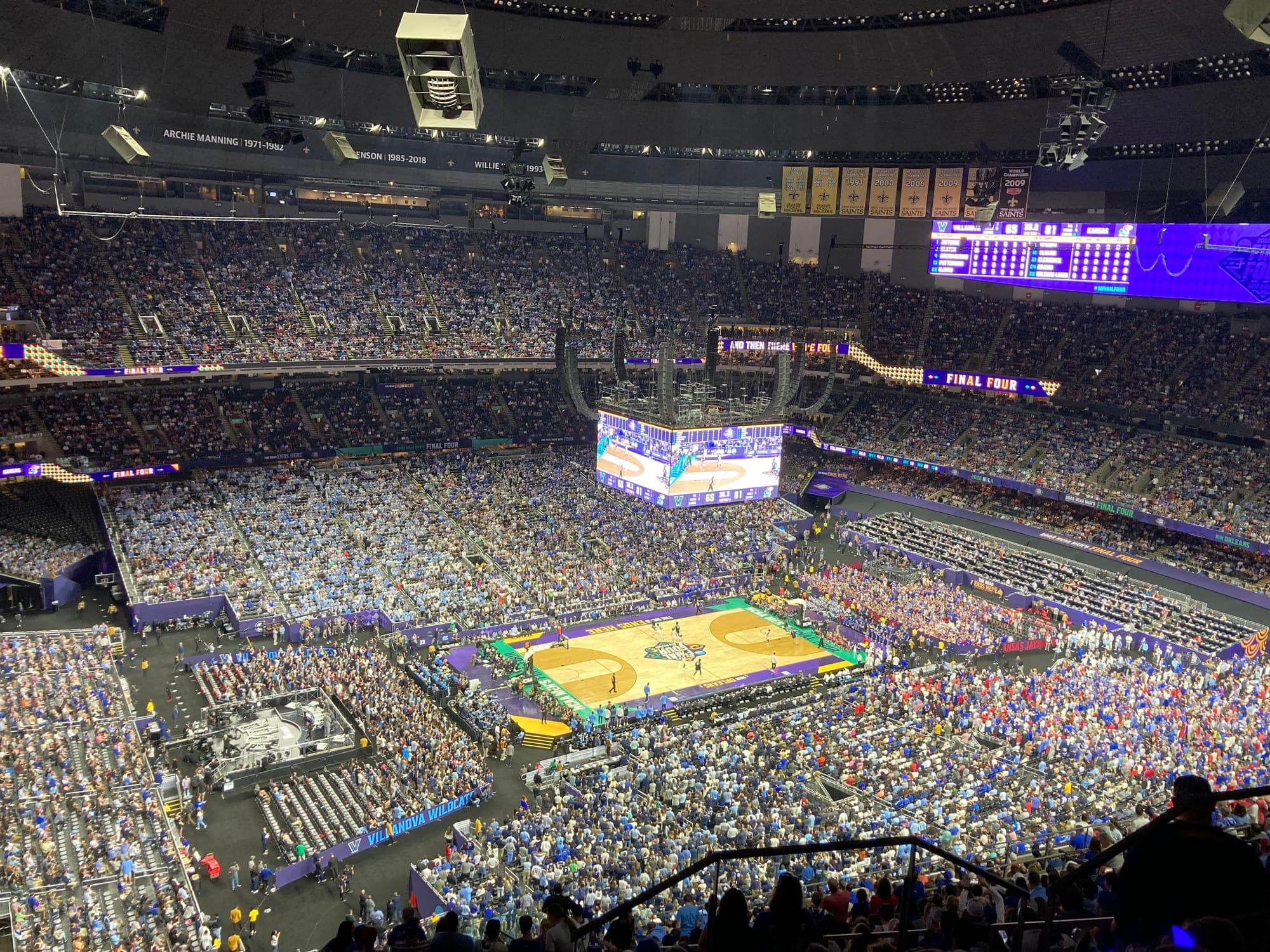
Kansas and Villanova in the 2022 Final Four at the Superdome — the stage seeding fights are built to reach.
Photo: Disc Wheel / CC BY-SA 4.0
Television shorthand tends to erase the first useful distinction: selection, seeding, and bracketing are separate jobs. The men’s and women’s committees first decide which at-large teams belong in the tournament, then rank the full field on an overall seed list, then place those teams into a workable bracket.
Selection: who gets in
Beginning in 2027, both Division I tournaments contain 76 teams: 32 automatic qualifiers and 44 at-large selections. An automatic qualifier earns its conference’s bid, normally by winning the conference tournament. Everyone else needs an at-large invitation.
There is no conference cap and no published formula that turns a record into a bid; twelve committee members compare complete résumés and vote by secret ballot.
The team sheet and NET
The committee’s working document is the team sheet. It puts every result in context and places several models side by side. NET is the primary sorting tool, not an answer key.
- Results-based measures — KPI, Strength of Record, Wins Above Bubble — ask what a team accomplished against its schedule.
- Predictive systems — KenPom, BPI, Torvik — estimate underlying quality.
- The point of showing several models is that no single outlier gets to decide a season.
NET itself combines a results component, the Team Value Index, with adjusted net efficiency. It rewards beating strong teams, gives additional value to road and neutral performance, and adjusts efficiency for opponent and location. The committee also sees head-to-head results, common opponents, overall and nonconference strength of schedule, road record, imbalanced league schedules, and player or coach availability. A ranking is the start of the conversation, not the end.
Quadrants and Wins Above Bubble
Quadrants make that conversation easier to read. The wider road bands recognize how difficult it is to win away from home. But a win over No. 2 and a win over No. 29 can share the same Q1 label, so counting quadrant wins without reading the opponents underneath them loses important information.
| Quadrant | Home | Neutral | Road |
|---|---|---|---|
| Q1 | NET 1–30 | NET 1–50 | NET 1–75 |
| Q2 | NET 1–75 | NET 1–100 | NET 1–135 |
Wins Above Bubble helps restore some of that missing resolution. WAB estimates how many more or fewer wins a team earned than a typical bubble team would expect against the same schedule. For the expanded men’s field, the NCAA moved that reference point from No. 45 to No. 55 in NET.
That makes November scheduling matter twice: strong opponents create opportunities, and road or neutral wins over them carry more value than an identical home result.
Inside the room
The field is built through repeated ballots rather than one grand ranking exercise. Teams move from an under-consideration board into the field, then the committee ranks groups to build the overall seed list. Members can later “scrub” that list — directly comparing neighboring teams and moving one by majority vote.
That is why the last team selected is not automatically the lowest at-large seed; selection order and final seed order are different.
Seed lines and bracket placement
Once the seed list is final, it becomes the committee’s 1-through-76 judgment of the field. The familiar seed lines group those rankings in fours: overall Nos. 1–4 become the four No. 1 seeds, Nos. 5–8 the No. 2 seeds, and so on. The overall No. 1 receives first choice of region and first-weekend site.
The committee then checks that the strongest teams are distributed reasonably across the four regions rather than loading one path to the Final Four.
Bracket placement adds constraints that have little to do with résumé quality. Teams should stay near their natural geographic area when possible. Conference opponents are separated according to how often they already played, early nonconference rematches are avoided when practical, and top seeds should not be placed at a major home-crowd disadvantage. Those rules can move a team one seed line — and in unusual cases two — without changing where it sat on the true seed list.
The 2027 Opening Round
The 12 lowest-seeded automatic qualifiers play six games against one another, and the 12 lowest-seeded at-large teams play six more. On the men’s side, Dayton and Wichita host tripleheaders on the Tuesday and Wednesday after Selection Sunday; the women’s games are played at campus sites. The twelve winners complete the traditional 64-team bracket, which then proceeds on the familiar schedule.
Men’s vs women’s brackets
The men’s and women’s committees use the same broad three-step logic, but their brackets are not operationally identical. In the women’s tournament, the top 16 seeds that submit qualifying bids generally host the first two rounds, so seeding can determine home-court access as well as opponent strength. That makes the line between a No. 4 and No. 5 seed especially consequential.