
The China Open returns—and China’s new snooker generation is ready for the spotlight
After a pandemic-era disappearance, snooker’s old Beijing flagship opens in Taiyuan with a world champion from Lanzhou, another from China’s first Crucible wave, and a record home draw.
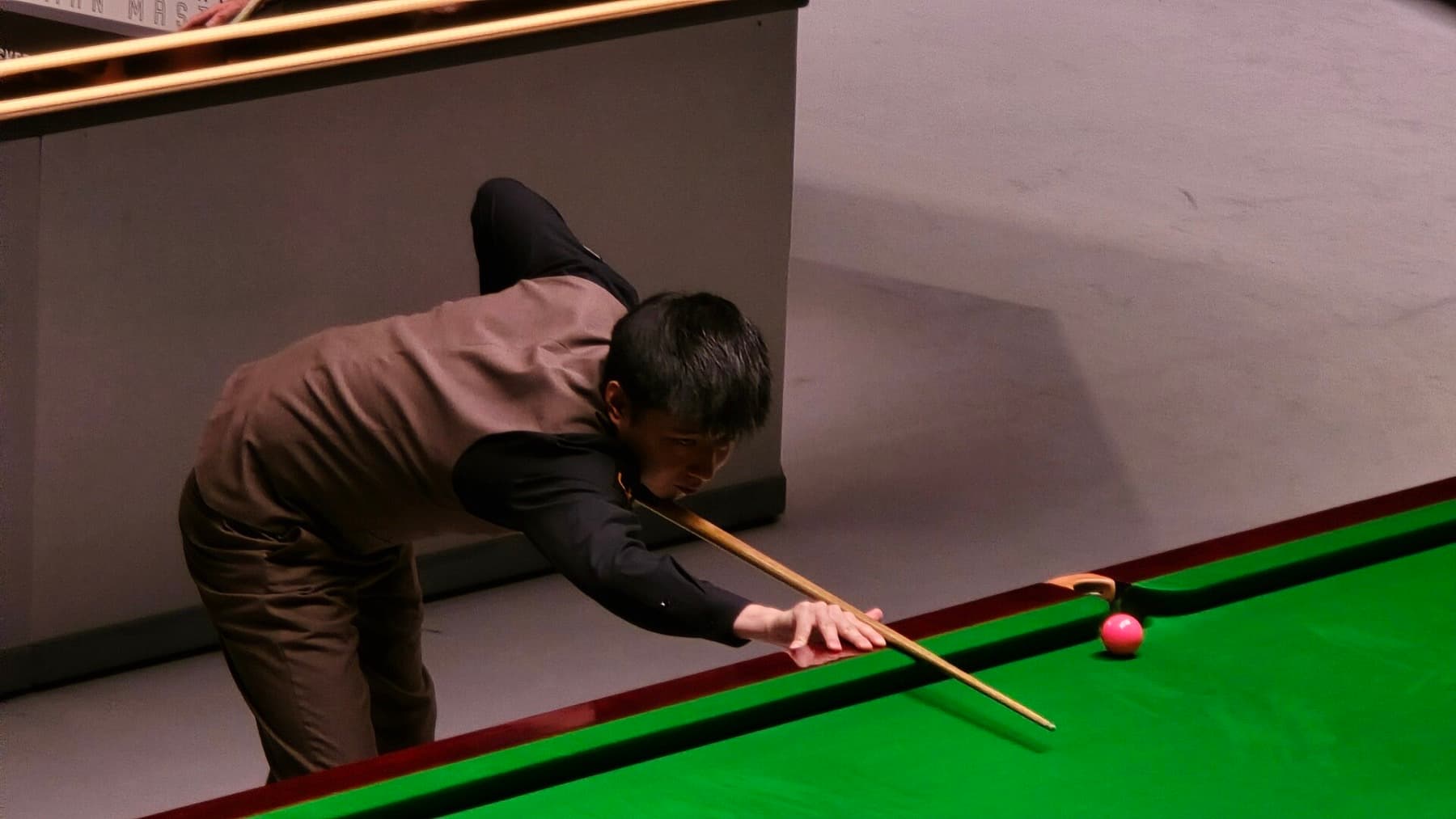
Zhao Xintong lines up a shot under arena lights at the German Masters in Berlin in 2026 — China’s first Crucible champion, now world No. 3, as the China Open returns with a deep home field.
Photo: Andrej146 / CC0
The China Open is back on the World Snooker Tour calendar for the first time since 2019. Main-stage play runs August 8–16 at the Riverside Sports Centre in Taiyuan, Shanxi — a new city for an old flagship that spent its modern life in Beijing. Neil Robertson is still the defending champion because the pandemic cancelled 2020 and the event never got restored until now. The visiting names will sell overseas tickets. The story that matters this week is who else is in the building.
This tournament once remade the sport. In 2005, an 18-year-old Ding Junhui beat Stephen Hendry in the Beijing final on his birthday, with an estimated 110 million viewers in China watching a local teenager topple the game’s great. Shanghai Masters and a thick China swing followed. When Covid took the Open off the board, Wuhan, Xi’an, and other ranking stops filled the gap. The return does not restore Beijing. It restores the name that still means the home season’s prestige event — now with a £1.205 million prize fund and a £250,000 winner’s cheque that matches UK Championship money.
Wu Yize arrives as world champion. In May at the Crucible, the 22-year-old from Lanzhou beat Shaun Murphy 18–17 in the first world final to go the distance since 2002, becoming the second-youngest champion after Stephen Hendry and China’s second straight world winner after Zhao Xintong in 2025. He opens in Taiyuan against Yao Pengcheng as the No. 2 seed. A first-round win is expected. A deep run would tell home crowds the Crucible was a beginning, not a one-week story.
Zhao sits third in the world rankings behind Judd Trump and Robertson, with almost no ranking points to defend until next year’s Worlds. He faces Zhang Anda in an all-Chinese last-32 match — the kind of draw that used to be rare and is now ordinary. Zhao has said Ding’s 2005 Beijing win, watched on his own eighth birthday, lit the fuse. Ding himself is still here, opening against David Gilbert, still the bridge generation even as younger Chinese players fill the top half of the sport.
The international field is as deep as the Open always demanded. Trump, O’Sullivan, Selby, Williams, Higgins, Murphy, and Wilson are all entered. Twelve Chinese players reached the main draw, a record for the event. Roughly thirty Chinese professionals are on the tour this season, and about half the players under 30 are from China. Visiting stars still fill the posters. They do not own the plot alone.
What the return signals is straightforward. China’s snooker boom outgrew the need for a single Beijing showcase, then missed the brand that started it. Putting the China Open back — in Taiyuan, with Crucible champions in the home half and UK-level prize money — says the tour wants that flagship again, not only satellite ranking weeks. No Chinese player has reached this final since Ding in 2014. That drought is the other number on the board.
Wu and Zhao are the first names to watch. A Chinese winner would be the first in twelve years and the cleanest proof that the Open’s old job — inventing a star — has flipped. The new job is whether the stars China already has can lift the trophy where the revolution began, even if the table now sits a few hundred kilometers west of Beijing.