
What is virtual taekwondo—and is it really a sport?
Motion sensors turn real kicks into a digital bout. The Asian Games just made that format a medal event — and the answer to the sport question is more sweaty than it sounds.
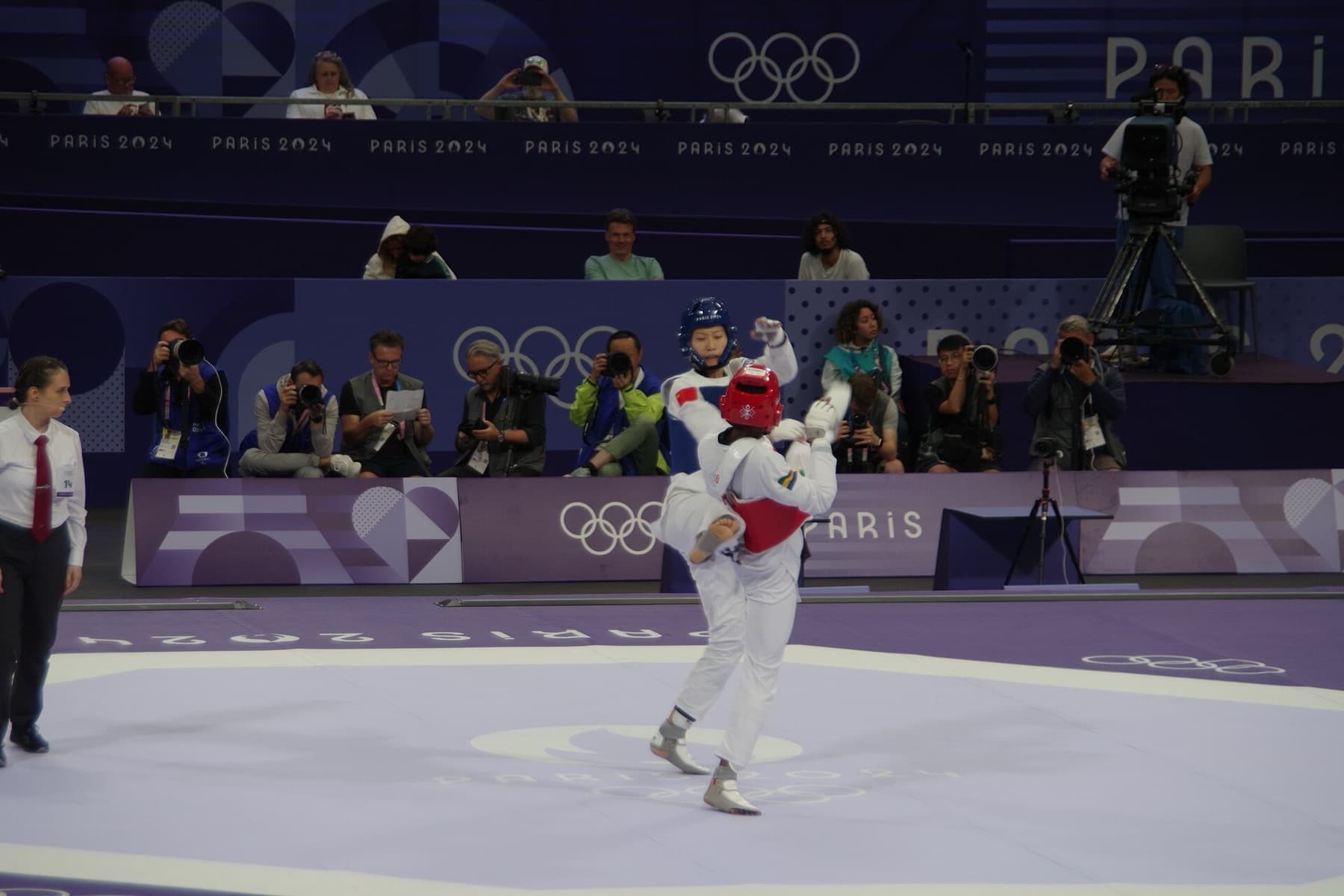
Women’s 57 kg taekwondo at the Paris 2024 Olympics in the Grand Palais — white dobok, electronic chest and head protectors, and the high kicks Virtual Taekwondo now tracks with motion sensors instead of impact scoring.
Photo: AlSepPhoenix / CC BY 4.0
On October 2 in Toyohashi, sixteen athletes will put on VR headsets, strap motion sensors to their bodies, and fight for an Asian Games medal without ever landing a kick on each other. World Taekwondo and the Olympic Council of Asia made Virtual Taekwondo an official medal event for Aichi–Nagoya 2026. The useful question is not whether the gear looks like a game. It is what the body still has to do.
Here is how a bout works. Each competitor stands in a four-by-four-meter square wearing a headset and five AXIS motion-tracking nodes — typically one on the upper body and pairs on the knees and lower legs — while holding controllers used for blocking. Singapore’s Refract Technologies built the system with World Taekwondo. When you throw a front kick, turning kick, or punch, the sensors map speed and position onto an avatar in a digital arena. A screen behind the fighters shows what spectators need: two figures trading strikes and a health bar that drops when a clean hit registers.
Scoring is closer to a fighting game than to Olympic kyorugi. Rounds last sixty seconds. Win the round by emptying the opponent’s bar or holding more of yours when the horn sounds. Matches are best of three. There are no weight classes and no gender split in the Asian Games individual event — anyone aged 17 to 35 can land in the same bracket — because the safety logic that separates those groups in contact sparring does not apply the same way when strikes never land.
That does not make it easy. Coaches who have put athletes through the format say three rounds leave people spent. Without a physical opponent to respect, fighters kick from the opening second instead of waiting for an opening. Speed becomes the power. Stamina, hip flexibility, and the ability to judge distance you cannot see with your own eyes matter as much as a flashy technique. Vietnamese champion Nguyen Thanh Hien Linh has said her first virtual outing felt like kicking into air. Two years later she was winning regional golds after learning to guess where the other avatar would be before it moved.
The safety pitch is the clearest difference from traditional sparring. Knee and joint injuries are the sport’s familiar tax. Virtual bouts remove impact. They do not remove overuse, falls in the headset, or the chance two people bump into each other in a shared square. Comparative injury studies are still thin. What athletes and parents already report is simpler: you can compete hard without absorbing a spinning head kick.
People reach for the esports label because of the headset. The work is still martial. Couch gaming asks for thumbs and game sense. Virtual taekwondo asks for the same technique library as club kyorugi, then wraps it in health bars and digital avatars. World Taekwondo showed the format at the IOC’s Olympic Esports Series in Singapore in 2023, staged a first World Championships there in 2024 with more than 120 athletes from 23 countries, and is building operator certifications and a training hub at Taekwondowon in Korea. That is federation infrastructure, not a pickup online tournament.
The Asian Games are a natural proving ground. A one-day, sixteen-player bracket at Toyohashi City General Gymnasium is small enough to run with calibrated gear and certified operators, and big enough that national programs will care who medals. Malaysia is already lobbying to put the discipline on the 2027 SEA Games programme. Talk of Olympic Esports Games continues; a Los Angeles 2028 medal in traditional Olympic taekwondo’s sense is not on the books. What Nagoya can decide is whether the format holds up under continental lights.
Is it really a sport? If sport means contested physical skill under rules, with winners, losers, and a governing body willing to stand behind the result, yes. If it only counts when bodies collide, that bar already excludes plenty of Olympic events. Nagoya will not settle every argument. It will put sweaty athletes and a health bar on the same broadcast — and let viewers decide which one they are watching.