
Julie Chu won four Olympic medals. In Sochi she carried the U.S. flag.
Teammates voted her Team USA’s closing-ceremony flag bearer after a fourth Olympic medal. The road there ran through Harvard, the Patty Kazmaier Award, and the 2002 roster that made her the first Asian American woman on the U.S. Olympic hockey team.
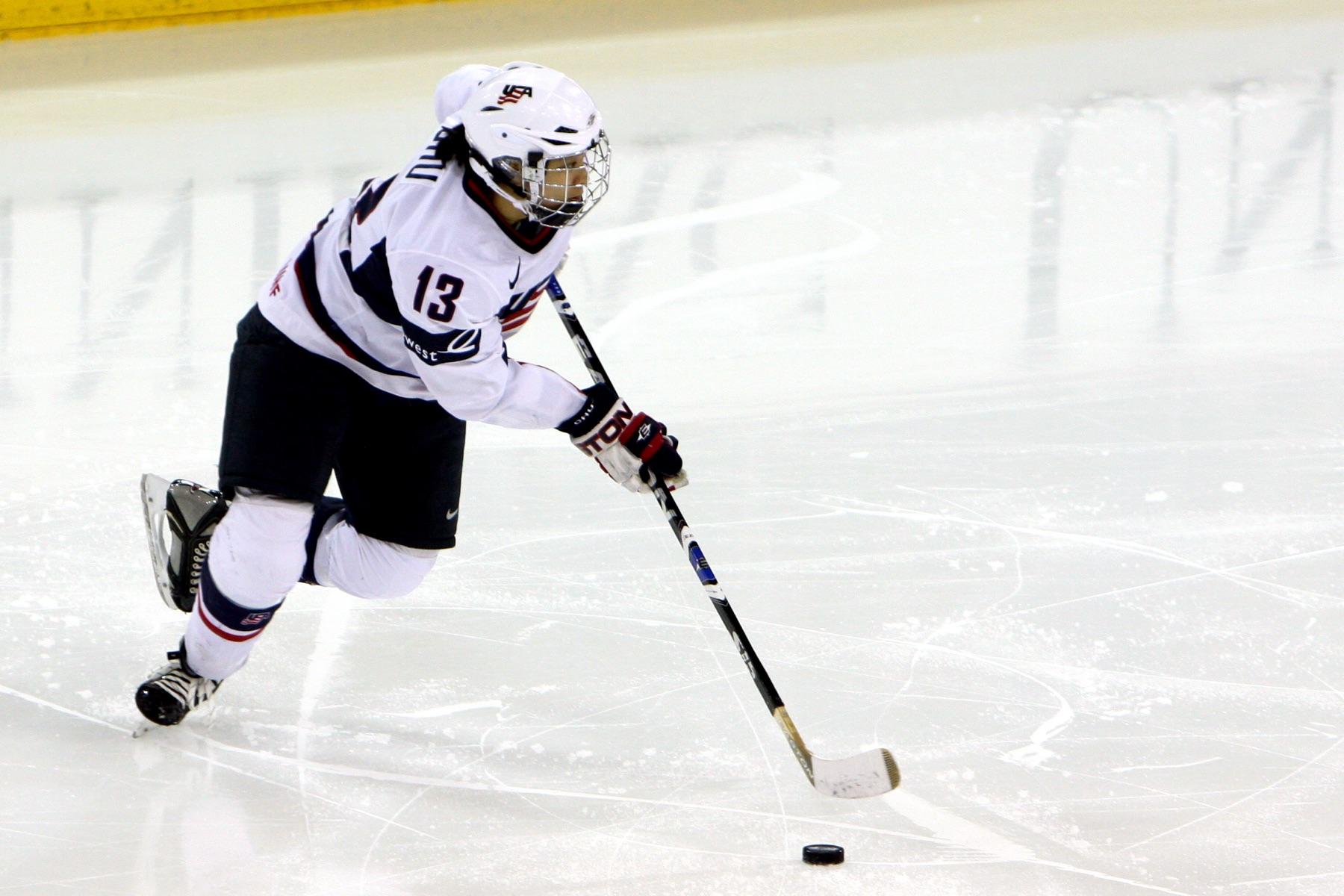
Julie Chu, No. 13 for the United States, handles the puck in a white USA jersey in January 2010 — four years before she carried the flag at Sochi’s closing ceremony.
Photo: Sara Melik
On Feb. 23, 2014, Julie Chu walked into Fisht Stadium in Sochi with the American flag. Three nights earlier, Canada had beaten the United States 3–2 in overtime in the women’s hockey final — Marie-Philip Poulin’s power-play winner for a fourth straight Canadian gold, Chu’s third Olympic silver. Teammates across Team USA had already voted her the closing-ceremony flag bearer. She was 31, a four-time Olympian, and the most veteran player on the women’s hockey roster. “I’m completely humbled and kind of in shock,” she said. “I never imagined that this would happen, especially knowing how strong the U.S. delegation is.”
A decade-plus of teammates already knew who they would pick. The vote only made it public. Chu was the second ice hockey player to carry the U.S. flag at an Olympics, after Cammi Granato in 1998. Granato had walked out after gold in Nagano. Chu walked out after another silver against Canada, twelve years after she became the first Asian American woman to play for the U.S. Olympic hockey team.
That first roster spot started in Fairfield, Connecticut. Her father, Wah, was born in Guangzhou and emigrated from Hong Kong to New York as a teenager; her mother’s family is Chinese and Puerto Rican. Chu tried soccer and figure skating before youth hockey stuck. She played prep hockey, graduated from Northwood School in 2001, and deferred Harvard so she could skate Salt Lake City at 19. The family got matching Olympic-rings tattoos with her No. 13 after she made the team. She scored two goals and two assists in five Olympic games and took silver. Then she went to Cambridge.
At Harvard she became the program’s all-time scoring leader and, by the end of her career, the NCAA’s career points and assists leader with 284 points (88 goals, 196 assists). The points mark stood until 2011. She was a three-time All-American, a co-captain, and in March 2007 she won the Patty Kazmaier Memorial Award as the nation’s top collegiate women’s hockey player — Harvard’s fifth winner of the prize. She graduated that spring with a psychology concentration, already a two-time Olympian after taking another year for Turin 2006, where the U.S. won bronze.
Vancouver 2010 brought another silver. Sochi would add a third. Between Games she captained the U.S. to world gold in 2013, won five world titles in all, and led the 2009 worlds in scoring with ten points. She played for the Minnesota Whitecaps and then the Montreal Stars, winning the Clarkson Cup with both clubs. She also coached — assistant at Minnesota Duluth when the Bulldogs won the 2008 NCAA title, then at Union College — before stepping away to prepare for Sochi. On paper it is a long list. The flag vote was about how those years felt to the people who shared the bench with her.
In Sochi she was an assistant captain. Against Canada she killed penalties for most of a final the U.S. led 2–0 in the third before Jenner and Poulin forced overtime. Afterward she told reporters the group never stopped believing it could still win gold. A day later she learned the captains of Team USA’s sports had picked her to lead the march. Four Olympics, four medals, and a closing walk chosen by peers who had watched her through every Canada series and every college season in between.
In 2002 she was the first Asian American woman on the U.S. Olympic hockey team. In 2014 the people inside the program trusted her with the whole delegation. She later became head coach at Concordia in Montreal, where she still runs the Stingers, and where she shares a life with Caroline Ouellette, the Canadian rival she faced in three Olympic finals. The road from Fairfield to Fisht ran through Harvard scoring records and a Kazmaier Award. The closing ceremony just put the leadership part where everyone could see it.