
The night Midori Ito landed the Olympic triple Axel and Kristi Yamaguchi won gold
At Albertville in 1992, Ito fell on her first triple Axel, landed the second, and took silver. Yamaguchi won gold even after trouble on a triple loop. The ordinals explain why.
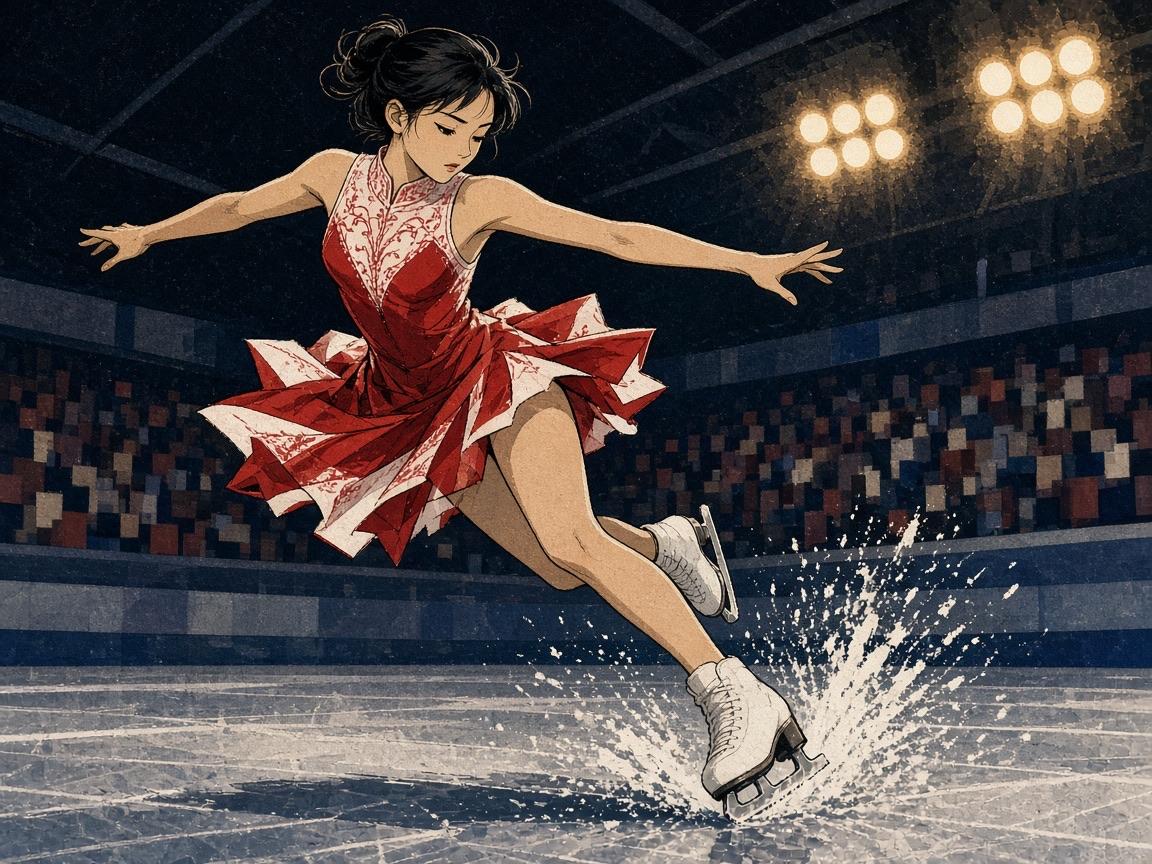
Illustration of a skater holding a landing edge under arena lights — for the Albertville night Midori Ito landed the first women’s Olympic triple Axel.
Illustration: The Medalist
On Feb. 21, 1992, at the Halle Olympique in Albertville, Midori Ito fell on a triple Axel early in her free skate, got up, and landed another one later in the same program. It was the first triple Axel a woman had ever completed in Olympic competition. By the end of the night Kristi Yamaguchi of the United States had the gold, Ito the silver, and Nancy Kerrigan the bronze. People still pull up the Axel. The medals make more sense once you see how the panel ranked the whole free skate.
The free skate was worth two-thirds of the title. Short-program placement was factored by 0.5; free-skate placement by 1.0. Yamaguchi had won the original program — the short — unanimously on Wednesday. Kerrigan sat second, France’s Surya Bonaly third. Ito was fourth after falling on her triple Lutz combination. She had planned a triple Axel in that short, then swapped it for the Lutz after a rough practice day that included a near-miss when Bonaly threw a backflip close to her. From fourth, she needed to win the free and hope the leaders stumbled hard enough that their factored totals still let her through. Yamaguchi only had to stay within two places of Ito.
Yamaguchi skated first among the leaders, to “Malagueña,” after Dorothy Hamill found her backstage to wish her luck. She opened with a triple Lutz–triple toe and held the program together until midway, when her triple loop, one of her strongest jumps, went wrong. Contemporary reports call it a fall or a hand-down; either way she was on the ice and surprised. She cut the next triple Salchow to a double, then closed on a clean triple Lutz. Five clean triples in all. The nine judges gave her technical marks in the 5.7–5.8 range and eight 5.9s (with one 5.8) for artistic impression. Seven of nine ranked her first in the free. The Japanese and Czechoslovak judges had Ito first. By the time Ito stepped on the ice, Yamaguchi’s marks had already set a free-skate standard most of the panel would not move past.
Ito skated after Kerrigan and Bonaly, to Rachmaninoff. She opened lighter than planned: a double Lutz–triple toe instead of a bigger combination. Then she went for a triple Axel–triple toe, the same jump she had landed in warmup, and crashed. The fall put her behind early. She answered with a triple flip and a triple loop, then threw the Axel again about three minutes into the program and landed it clean. A triple Salchow and a double Axel closed the skate. Skating Magazine wrote that she caught more air than most ski jumpers. She had become the first woman to land a triple Axel at the Olympics. Most of the panel still had her second to Yamaguchi.
Under the 6.0 system, judges ranked whole programs, not isolated base values the way today’s GOE sheet does. Ito’s fall, the lighter opening combination, and the short-program fourth all sat next to the landed Axel. Yamaguchi’s trouble on the loop sat next to cleaner choreography and those artistic 5.9s. Free-skate points on Olympedia’s sheet read 104.7 for Yamaguchi and 104.1 for Ito: close in the old total, a clear majority in placement. Factored, Yamaguchi finished on 1.5. Ito finished on 4.0. Kerrigan, who had her own free-skate wobbles, held bronze on the same 4.0 total by winning the short-program tiebreaker.
Ito had already apologized to Japan after the short. After the free she said she thought her people would excuse her now. The silver was Japan’s first Olympic figure skating medal, and the first Olympic figure skating medal for a skater from outside Europe or North America. Yamaguchi, 20, Japanese American from Fremont, California, became the first Asian American woman to win Olympic figure skating gold, and the first U.S. woman since Hamill in 1976. The press had spent the week calling one the athlete and the other the artist. Both made mistakes that night. Both landed hard jumps. The panel still preferred Yamaguchi’s full program.
Ami Nakai’s modern score sheet makes a useful companion. Her Skate America triple Axel carries an 8.00 base value and published GOE; every tenth is public. Ito’s Olympic Axel lived inside ordinals and 5.8s. The jump was the same ambition, but the night was decided differently. Yamaguchi’s gold and Ito’s first Olympic women’s triple Axel still share one free skate — and a sheet that ranked the whole program, not just the landing.