
Kinue Hitomi’s Amsterdam silver was Asia’s first Olympic medal for a woman
A last-minute 800 metres in 1928, a media myth that erased the race until 1960, and a career that ended on the anniversary of the final.
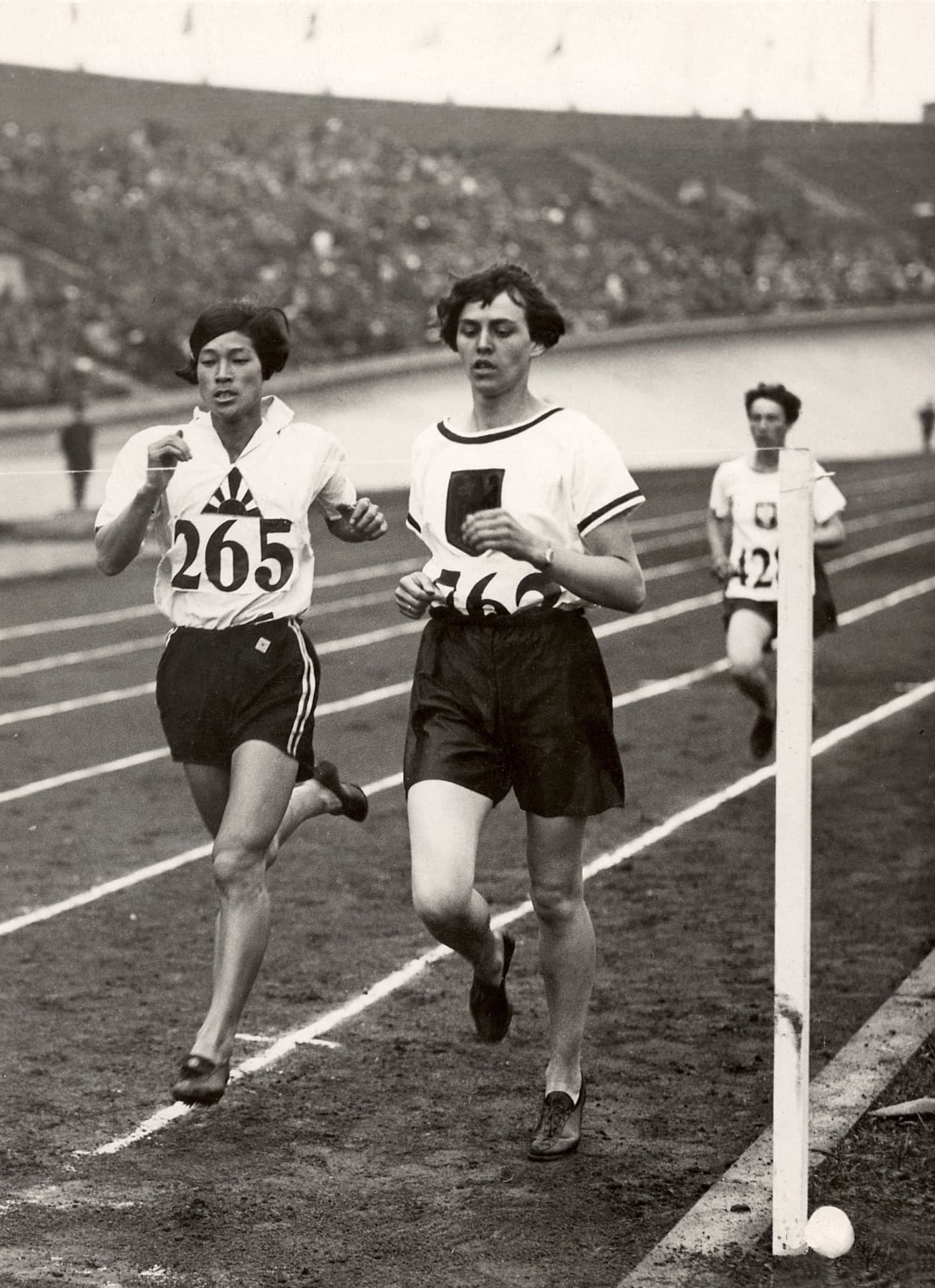
Kinue Hitomi (bib 265) runs the women's 800 metres at the Amsterdam Olympics in 1928 — silver behind Germany's Lina Radke, and the first Olympic medal won by an Asian woman.
Photo: Spaarnestad Photo / Public Domain
On August 2, 1928, in Amsterdam, a 21-year-old from Okayama named Kinue Hitomi finished second in the first Olympic women's 800 metres. Germany's Lina Radke won in a world record 2:16.8; Hitomi crossed in 2:17.6; Sweden's Inga Gentzel took bronze. Nine women started and all nine finished. Hitomi's silver was the first Olympic medal won by a woman from Asia — and the first for any Japanese woman.
She was not supposed to be in that final. Hitomi had come to Amsterdam as Japan's only woman athlete, built for the 100 metres and for jumps the Olympics did not yet stage for women. She cleared the 100 heats and went out in the semifinals, fourth in her race. Last-minute entries were still allowed. She had never run an official 800. She entered anyway, ran 2:26.4 in the heat behind Radke, then chased gold on legs she had not trained for the distance.
The first lap went out in 64.2 seconds with Hitomi fifth. With a little more than 200 metres left she remembered what her coach kept telling her when her legs went dead — use the arms — and the film shows her pumping them hard enough to change the race. She passed Gentzel, hunted Radke down the straight, and missed gold by eight-tenths. The same afternoon, Mikio Oda won Japan's first Olympic gold in the men's triple jump. Hitomi's silver put a woman's name on the board beside his.
Western newspapers rewrote the finish into a cautionary tale: mass collapse, women carried off the track, proof that 800 metres was beyond feminine strength. Film and results say otherwise. The top three all broke the previous world record, and the field completed the lap. Within a few years the IOC and IAAF stripped the women's 800 from the Olympic program. It did not return until Rome 1960. Hitomi's silver sat inside that argument whether she wanted it or not — a race she finished, used to justify a 32-year erasure.
Those editors flattened an athlete who already traveled farther than most men on her federation's budget. In 1926 she rode the Trans-Siberian alone toward Gothenburg for the Women's World Games, funded in part by the Osaka Mainichi Shimbun sports desk that had hired her as a journalist so she could train in the afternoons. As Japan's lone entrant she won the long jump in a world record 5.50 metres and the standing long jump, took silver in the discus and bronze in the 100 yards, and collected the women's federation honor for most individual points. By the Olympic year she had pushed the long jump to 5.98 metres in Osaka. Amsterdam offered her a short sprint and a sudden middle distance instead — and she still left with silver.
She had grown up in Fukuhama, Okayama, the daughter of rice farmers who could afford girls' schooling that led to Tokuyo Nikaido's gymnastics academy in Tokyo — a school built for teachers and grace, not yet for medal chasing. Hitomi made competitive sport her job anyway: teaching posts, then Mainichi, then the lecture circuit that followed every medal. Japanese papers celebrated Amsterdam and then interrogated her body. Interviewers weighed her, asked if sport was making her unwomanly, and floated rumors that she was not a woman at all. The first Japanese woman on an Olympic podium came home to a gossip beat about her gender.
She kept racing. In 1929 she set a world-record 24.7 in the 200 and stacked more Japanese marks across sprints and jumps. In September 1930 she captained a small Japanese team to the Women's World Games in Prague, won the long jump again, added triathlon silver and bronzes in the 60 metres and javelin, and scored enough points to finish near the top of the individual standings — while running a fever through the European meets that followed. The tour piled race on race. Letters and papers waiting at home were colder than the first Amsterdam headlines. She went back to work almost immediately.
On March 25, 1931, after coughing blood, she entered Osaka Imperial University Hospital under a false name to keep the crowds out. The diagnosis was pleurisy; pneumonia followed. She died at 12:25 p.m. on August 2, 1931 — exactly three years after the Amsterdam final — at 24. Her teacher Nikaido later wrote in a women's magazine that sport had not killed Hitomi; Hitomi had died for sport. What remains without the epigram is simpler: an overworked young athlete, a hospital alias, and a calendar that closed on the anniversary of the race that still defines her.
Eight years later, Hideko Maehata became Japan's first woman Olympic champion in the Berlin pool. Hitomi's Amsterdam file does not borrow that gold. She was a sprinter who entered an 800 she had never raced, finished second to a world record, and put an Asian woman's name on an Olympic medal stand for the first time — while nine women finished a race the papers pretended no woman could survive.