
How to watch MLB’s ABS challenge system
Two challenges, a height-scaled rectangle, and a hat tap — the first full season of automated ball-strike challenges, explained for viewers who want the strategy, not the marketing.
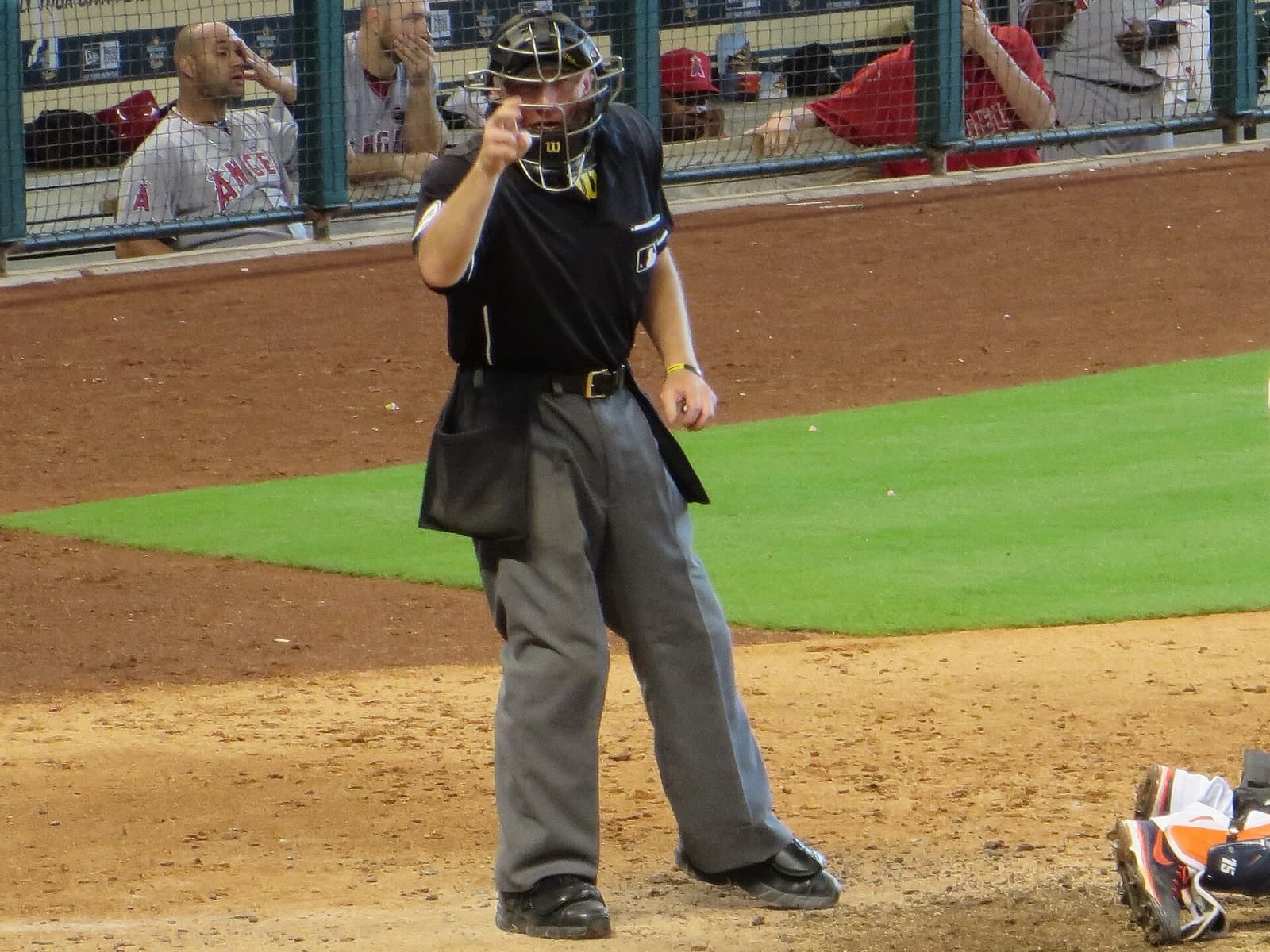
Umpire Lance Barksdale signals a strike on June 29, 2013 — the human call ABS challenges can now reverse in about 15 seconds when a batter, pitcher, or catcher taps for a review.
Photo: EricEnfermero / CC BY-SA 3.0
MLB did not hand the strike zone to robots. It handed a limited appeal to the three people standing closest to the pitch: the batter, the pitcher, and the catcher. Since Opening Day 2026, every Spring Training, regular-season, and postseason game has used the Automated Ball-Strike Challenge System — Hawk-Eye cameras, a T-Mobile private network, and a scoreboard graphic that lands in about 15 seconds. The home-plate umpire still calls every pitch first. The computer only enters when someone taps a hat or helmet and says so out loud, immediately, without dugout help. That constraint is the whole strategy. You are not reviewing baseball like an NFL coach with a tablet. You are spending a scarce resource in real time.
The bank account is simple and easy to misread. Each team starts with two challenges. Win one and you keep it; lose two and you are done for the nine innings. Enter an extra inning with none left and you get one fresh challenge for that inning — they do not stack. Position players pitching cannot be challenged. The zone itself is a two-dimensional rectangle measured at the midpoint of the plate: 17 inches wide, top at 53.5% of the batter’s certified standing height (no cleats), bottom at 27%. Independent testers measure players in spring; MLB certifies the number before anyone appears in a big-league game. That rectangle is a touch tighter than the old human-enforced envelope, especially at the top — which is why April walk rates spiked and why pitchers spent the first half negotiating a new edge.
Half a season of data makes the skill gap visible. Through late July, Baseball Savant shows roughly 6,700 challenges with about a 53% overturn rate overall — close to the ~50% success MLB saw in 2025 spring testing. Catchers dominate the volume and the accuracy: fielders (almost always catchers) sit near 58–59% overturns, batters near 48%, pitchers in the mid-30s on a tiny sample. Midsummer Sports Business Journal figures told the same story at the break. Cincinnati’s Tyler Stephenson has been a poster case for catcher craft; Rangers catchers/pitchers led early team success rates on that side. The strategic read is not “always challenge.” It is that the person who just received the pitch usually has a better geometric read than the batter who just watched it go by — and that wasting a challenge on a pitcher’s ego from the mound is a poor trade.
You can see the resource game on big nights. When Yoshinobu Yamamoto closed the sixth at Citi Field on July 25 — the start that pushed him to 100 combined NPB–MLB wins — an ABS challenge flipped a ball into a strike and finished Brett Baty’s at-bat. Japanese coverage keyed on catcher Dalton Rushing’s role in that sequence; MLB’s highlight simply labeled the overturn that ended the inning. Either way, the clip is the viewer’s lesson: late counts, high leverage, and a catcher’s confidence that the machine will agree. Teams that tap too early in 0–0 counts burn inventory they will want on 3–2 with the bullpen phone ringing. Teams that never tap leave free runs on the table when the edge call is wrong.
How to watch, then: ignore the sponsor name on the graphic and read the bank. Does the team still have both challenges? Who is tapping — batter or catcher — and is the count worth the spend? Remember the zone is fixed to height, not crouch, and measured mid-plate, so the “back-door” breaker that used to kiss the back of a human zone can lose the challenge even when it looked close on the broadcast camera at the front. FanGraphs’ midseason walk research argued that the challenges themselves slightly cut walks (more balls flipping to strikes than the reverse), while the tighter baseline zone and more accurate calling pushed league walk rates up — an indirect ABS effect, not a simple “robots love free passes” story. The shift ban removed one spreadsheet cheat code. ABS challenges added a different one: know your height, know your catcher’s eye, and spend the hat tap like a timeout you cannot call from the dugout.