
Kati Tabin Played for World Championship Gold. What Did Canada Ask of Her?
Canada’s silver put the Montréal defender on gold-medal ice. The IIHF sheets listed her with Sophie Jaques. In the final she played 6:22 — a long way from the 21 minutes Montréal usually wants.
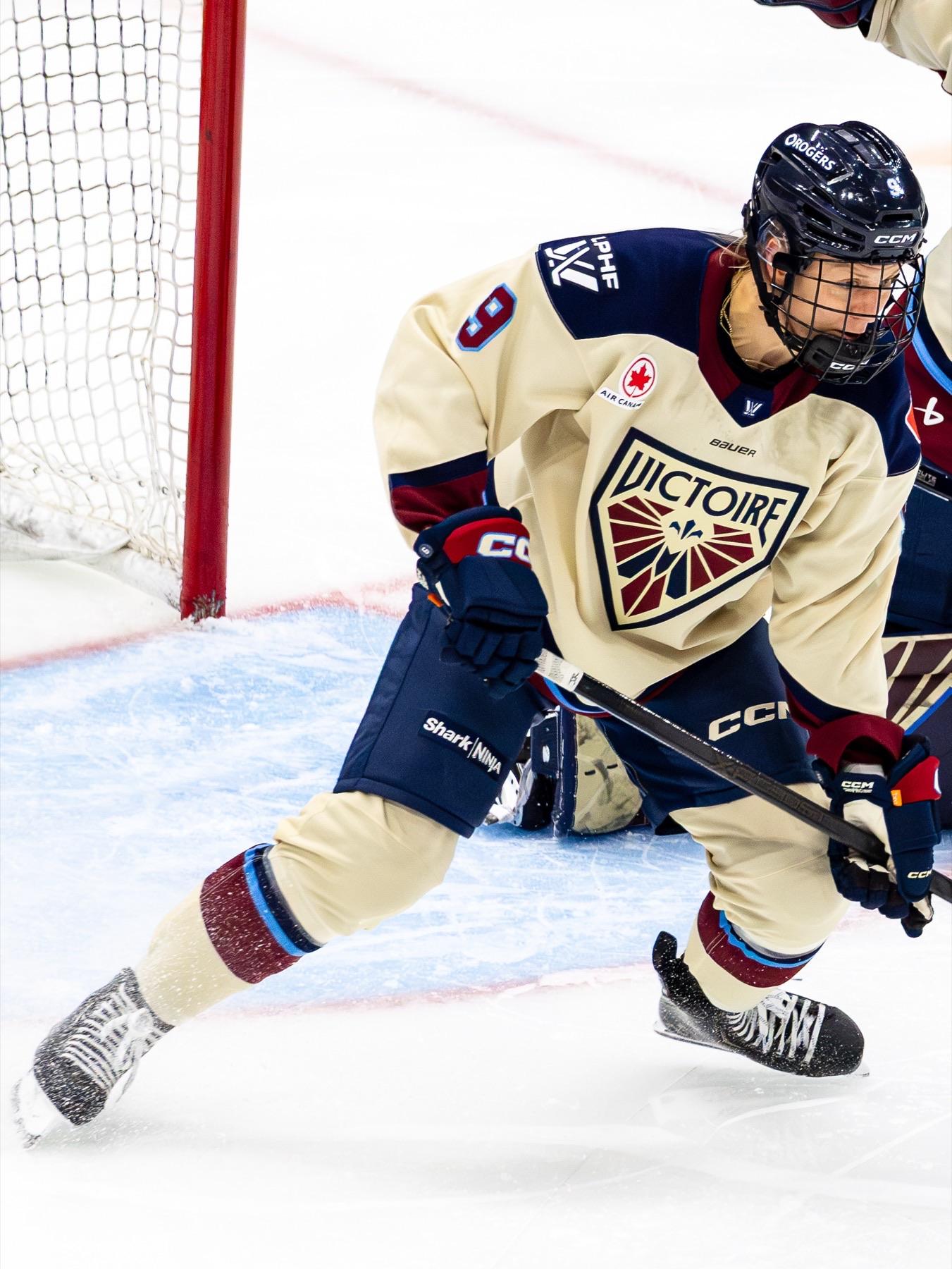
Kati Tabin for the Montréal Victoire against Seattle on Dec. 23, 2025. On Monday in Herning she took silver with Canada after a 6–2 gold-medal loss to the United States.
Photo: Jenn G / CC BY-SA 4.0
On Canada’s gold-medal lineup sheet in Herning, the fourth defence pair was Sophie Jaques and Kati Tabin — Nos. 2 and 4. The same names had been listed together against Denmark a week earlier. That is the first thing Canada asked of the Montréal Victoire defender at the 2026 IIHF Women’s World Championship: a fixed spot on the last pair, with minutes that still had to be earned shift by shift.
The ice time makes the ask concrete. In Monday’s gold medal game, a 6–2 loss to the United States, Tabin played 6:22 across 10 shifts — 3:48 in the first period, then 1:21 and 1:13 after the intermissions. Jaques, her listed partner, took 14:15 on 24 shifts. Canada dressed eight defenders and kept every one of them under 20 minutes. Renata Fast and Nicole Gosling, the top pair on the sheet, still led the blue line. Tabin’s night was the lightest among Canadian defenders.
Across the full tournament she finished with 87:42 of ice time in seven games — 12:31 a night, 129 shifts, about 40 seconds a shift. She scored no goals, added one assist, and finished plus-3. The assist came early against Finland, on Caitlin Kraemer’s opener. Hockey Canada’s silver medal release framed the week the usual way: United States 6, Canada 2, Sarah Fillier’s two goals, an 11th Worlds silver for the program. Tabin’s name was not in the scoring summary. Her work showed up in the minutes and the shift count.
Montréal asks for something else. In the 2025–26 PWHL regular season she averaged 20:54 a night over 30 games — 2 goals, 10 assists, plus-10 — second among Victoire defenders in ice time behind Nicole Gosling’s 21:18. Le Devoir’s early-season notes listed Maggie Flaherty as her new partner on the blue line; when Erin Ambrose later went on long-term injured reserve, the club put Tabin and Flaherty out as the top pair. That is roughly nine more minutes a night than Canada gave her in Denmark, on a pairing trusted to start games rather than wait for the last call.
Read the Canadian sheets in order and the pattern holds. Against Denmark, a 10–0 preliminary win, Tabin still sat with Jaques on the lineup card and took a fuller share — 14:33 on 22 shifts. Blowouts spread the minutes. The gold game compressed them. Fast and Gosling stayed in the heavy work. Chloe Primerano and Ambrose took the first pair slot on the gold sheet. Kendall Cooper and Ella Shelton filled the next. Jaques and Tabin remained the last defence pair listed, and Tabin’s actual shifts shrank to six minutes when the United States pulled away.
Canada’s coaching staff in Herning was led by Kori Cheverie, who also coaches Tabin with the Victoire. The national team rolled eight defenders through the week. The club blue line is thinner, and her minutes there are not optional. Cheverie knows both jobs. At Worlds the job was depth, matchups, and short shifts. In Montréal it is closer to 21 minutes and a partner who stays out there with her.
Tabin is 29, from Oakbank, Manitoba, by way of Quinnipiac. She made Canada’s Olympic silver team in Milano Cortina earlier this year after a late climb onto the senior roster, then kept the national sweater for Worlds. The Victoire re-signed her through the next two seasons. Silver in Herning does not change the club math waiting at home. It clarifies the international one: when Canada writes Jaques–Tabin on the card, it is naming a pair. When the gold-medal clock runs, it is still choosing how often that pair leaves the bench.
About 21 minutes a night at Place Bell. Twelve and a half across Worlds. Six and change when the gold was on the line. Canada asked Tabin to be available, paired, and limited by shift. Montréal asks her to eat the clock. The Worlds silver goes on the résumé either way. The minutes she gets back home are the ones that look like her ordinary job.