
India didn’t find a prodigy. The IPL finished one.
After an Orange Cap season that already crowned him, a 15-year-old’s record T20I fifty in Harare wasn’t a coming-out party — it was the national team matching a market that moved first.
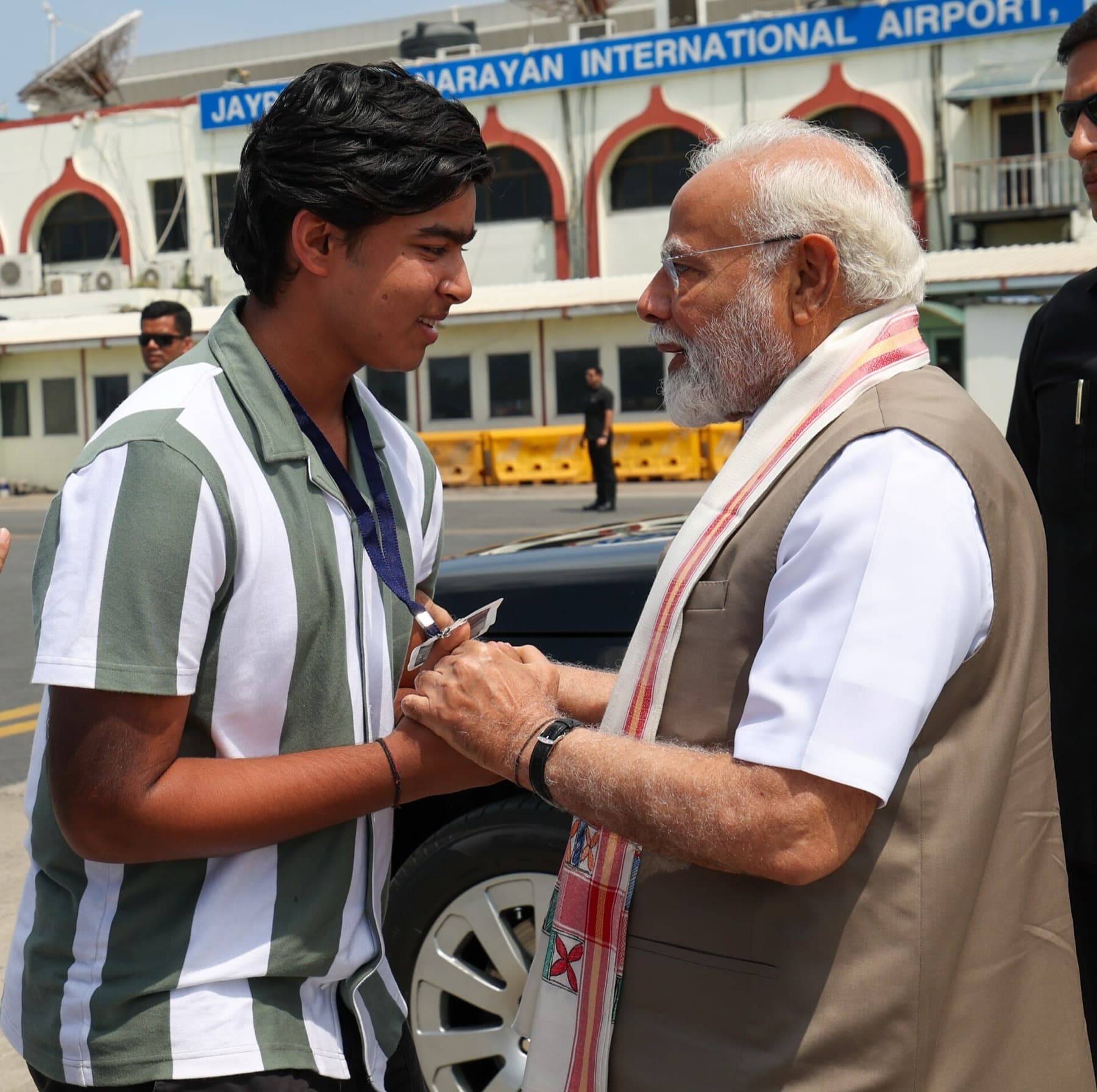
Vaibhav Sooryavanshi with Prime Minister Narendra Modi at Jay Prakash Narayan International Airport in Patna on May 30, 2025 — national attention arriving after his first IPL season, well before the Orange Cap and India cap that followed.
Photo: Prime Minister's Office (India) / GODL-India
Harare Sports Club has seen Vaibhav Sooryavanshi before. In February he smashed 175 off 80 balls there in the Under-19 World Cup final, a record score that helped India lift a sixth title. On Thursday night he walked out again as a senior India opener, took an 18-ball half-century, and finished on 50 from 19 against Zimbabwe. India chased 126 with forty balls to spare. Shreyas Iyer got a first win as T20I captain. The teenager, at 15 years and 118 days, became the youngest player to score a men’s T20I fifty.
Most coverage will treat that as another prodigy bulletin. A clearer read is quieter: India did not discover Sooryavanshi in Harare. The Indian Premier League had already finished the audition. His national fifty was the BCCI catching up to a franchise season that had already crowned him.
That season is the proof. Opening for Rajasthan Royals in IPL 2026, Sooryavanshi made 776 runs in 16 innings at a strike rate of 237.30 — Orange Cap, Most Valuable Player, Emerging Player, Super Striker, Super Sixes. Seventy-two sixes broke Chris Gayle’s long single-season mark. At 15 years and 65 days he was the youngest Orange Cap winner the league has had. More than five hundred of those runs came in the powerplay, against bowlers who already own international caps. Packed stands and match-up pressure did the job Ranji cricket used to do over years: prove that a kid can keep swinging when the field is set and the money is loud.
The timeline underneath that season is the point. Rajasthan Royals paid ₹1.1 crore for him at the 2025 mega auction when he was 13 — youngest IPL contract on record — after trials at their high-performance setup. He debuted at 14, sixed the first ball he faced, and scored an IPL hundred nine days later. Bihar had already given him a Ranji debut at 12. India A later watched him reach a List A fifty in eleven balls. By the time selectors named him for Ireland and England this summer, the market had already priced the skill. His India debut at Old Trafford — 15 years and 99 days, past Sachin Tendulkar’s age record — replaced Sanju Samson after a lean run. Iyer said he deserved the squad on recent months of evidence. That is selection language for a player whose case was built in Royals pink.
Tendulkar’s age still gets invoked because it is the nearest Indian measuring stick. The comparison mostly shows how the on-ramp changed. Tendulkar walked into Test cricket as a teenager in a board-first world. Sooryavanshi walked into a T20 economy where a franchise season can finish a white-ball case before the national team needs faith. The MVP car he cannot legally drive until he is 18 is the same story in one line: commercial adulthood arrived before the license. Yashasvi Jaiswal’s longer wait for a settled white-ball India role, even after strong Royals seasons, underlines the new queue. The league no longer only rewards promise. It can mint a finished T20 product and force the BCCI to respond.
Sooryavanshi will have harder nights than Zimbabwe’s 125 for seven. England already saw him for fourteen balls on debut. What Harare clarified is not that India found a future star — the IPL had already done that work in public. The national team is now deciding how to use a player the auction finished first.