
LA’s World Cup proved one stadium can run on transit. The Olympics need fifty.
Eight SoFi nights got Angelenos onto Metro. LA28 still has to move people to many venues at once — for more than two weeks, with almost nowhere to park.
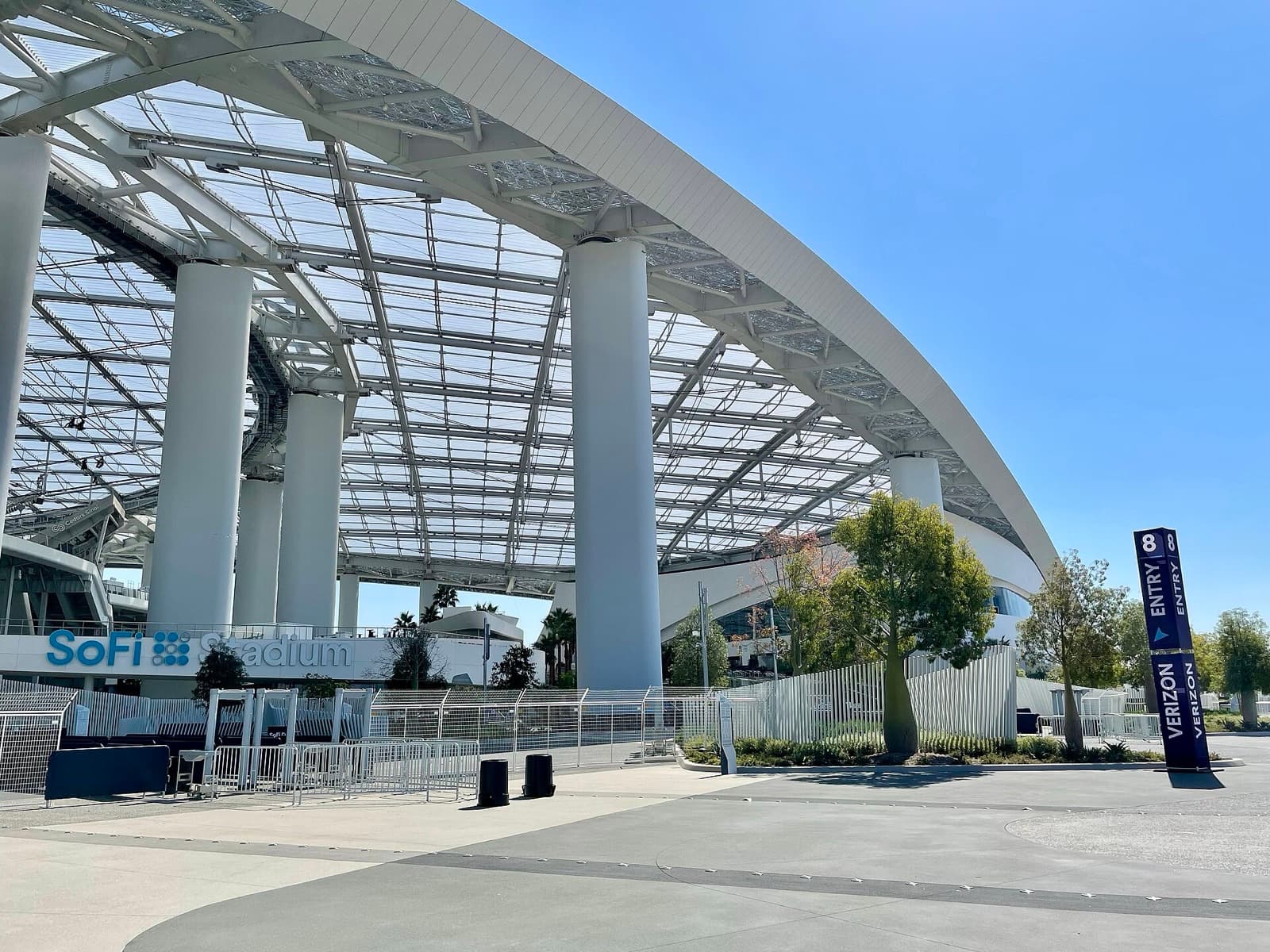
SoFi Stadium’s entrance in Inglewood — eight FIFA World Cup 2026 match nights, and in 2028 the bowl that flips to Olympic swimming.
Photo: Redspork02 / CC BY-SA 4.0
For a month this summer, Los Angeles Stadium — SoFi Stadium under FIFA’s nameplate — ran like a transit experiment with a soccer ball attached. Eight World Cup matches, more than 560,000 tickets through the gates, and Metro’s dedicated shuttle network logging 212,865 rides to and from Inglewood. On the Spain–Austria knockout alone, nearly 50,000 rail rides and more than 30,000 shuttle rides moved people who could not simply drive to the curb. Local officials are already calling it a dress rehearsal for 2028. The clearer takeaway is smaller: the Cup proved Angelenos will leave the car when the path to a sold-out bowl is obvious.
That habit change is the win worth keeping. There is still no train that stops at SoFi. Metro stood up fifteen shuttle routes from rail hubs and park-and-rides, borrowed roughly two hundred buses for the tournament, and treated match days as a regional system rather than a parking-lot scramble. LA28 chief operating officer John Harper put it plainly: the Cup showed the city can change travel behavior, and the Olympics will ask for the same behavior on a much larger scale. Ticket holders in 2028 are being told to expect a transit-first Games — little or no spectator parking at venues once security perimeters go up. June and July were the soft open for that message.
Scale is where the rehearsal stops. World Cup Los Angeles was one building, eight nights, one crowd pattern repeating. LA28 is aiming at roughly fifty competition venues, about 15,000 Olympic and Paralympic athletes, and more than 800 events. CEO Reynold Hoover told Reuters before kickoff that organizers would study how FIFA moved fans, then “size up and scale” what worked — because the Cup’s model is smaller by design. Harper’s picture is easier to hold: the Olympics feel like running seven World Cup matches, or seven Super Bowls, every day for two and a half weeks. A clean exit from Inglewood after Spain–Belgium is proof of craft. Simultaneous sessions from Long Beach to Carson to the Coliseum are a different machine, and Metro’s Games planning already talks about nearly two thousand supplemental buses once everyday riders and Games crowds share the same network.
Most people in Southern California will still never sit inside an Olympic session. During the Cup, the host committee and city partners staged more than three hundred community activations alongside official fan zones — the part of the month that lived in parks and plazas rather than behind turnstiles. Kathryn Schloessman of the Los Angeles host committee has argued that neighborhood memory is the real Games product for residents: whether the event showed up on their block, or only as someone else’s party on television. That is the human side of the same scale problem. If transit only works for people with tickets, and the street layer feels closed, the region will experience 2028 as something that happened to it rather than with it.
After the final whistle in Inglewood, the scorecard is fairly simple. Los Angeles showed it can fill a football bowl without turning every approach road into a parking search, and it showed that fan life can spill into the city without a ticket. What a single-stadium tournament cannot prove is whether that same clarity holds when dozens of venues ask for buses, rail capacity, and goodwill on the same July afternoon. July 14, 2028 is when that test begins. The World Cup left LA28 a usable answer on habits. The multi-venue version still has to be built.