
Your daughter wants to wrestle. How does she get her first match?
NFHS counted 88,771 girls wrestling in 2025–26. A first-month map for middle- and high-school beginners: Illinois and California school vs club, gear costs, and girls-only questions.
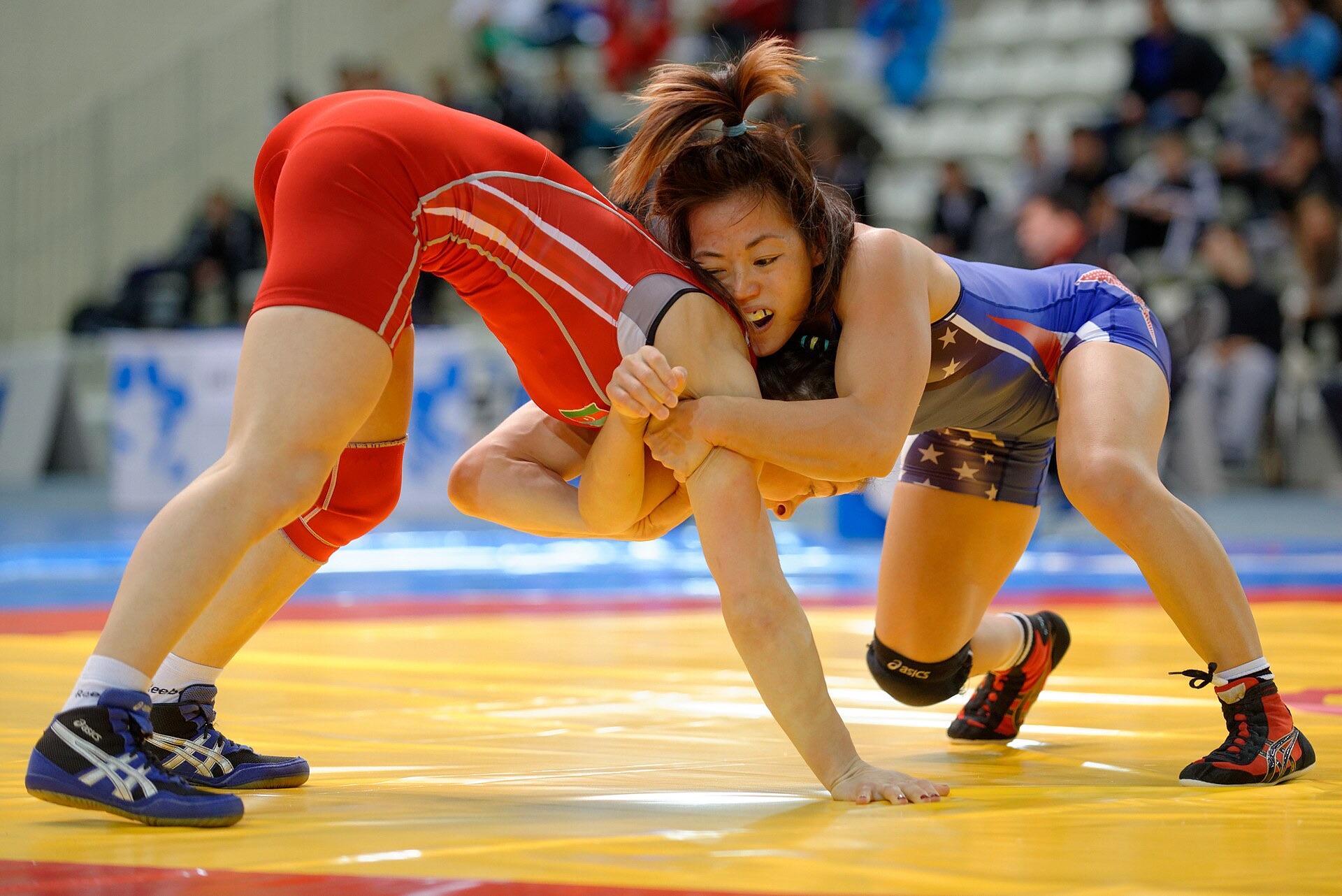
Clarissa Chun of the United States (blue) wrestles Azerbaijan’s Mariya Stadnik at the 2014 Golden Grand Prix of Paris. Chun started high school wrestling as a junior at Roosevelt in Honolulu.
Photo: Marie-Lan Nguyen / CC BY 3.0
The NFHS High School Athletics Participation Survey for 2025–26 counted 88,771 girls in wrestling — up about 20 percent from the year before — at 8,853 schools. Forty state associations now run girls state championships. The hallway ask is getting louder. What a parent still needs is the next month: how a middle- or high-school beginner gets onto a bout sheet.
Call the athletic director first. Find out whether the school fields a girls team, a boys team that will take girls, or nothing yet. Same day, pull the clearance packet: sports physical, concussion form, and the district’s online portal. She cannot practice for the school until the nurse clears the file. The only gear she needs before that first afternoon is wrestling shoes, usually $30 to $70. Shorts and a fitted shirt are enough for practice. Headgear ($20–$50) can wait unless the room requires it on day one. A singlet ($30–$70) can wait until someone names a weigh-in date.
Clarissa Chun’s first season still sounds familiar. She was a junior at Roosevelt High School in Honolulu, a judo kid who had stayed on the swim team until Hawaii sanctioned girls wrestling as a pilot. “I’ll try it,” she told PBS Hawaiʻi’s Long Story Short. The room was mostly boys — just Chun and one other girl — and some teammates hesitated. “We trained every day together; they get over it real fast,” she said. Chun, who is Japanese and Chinese and grew up in Hawaii, went on to a World title, an Olympic bronze, and a college coaching career. Outside the bigger girls-only programs, a lot of first practices still look like hers: a new sport in a co-ed room, learned one session at a time.
In the Chicago suburbs, the school route and the club route sit a few towns apart. Palatine High School, in District 211, lists no registration fee for sports. A current physical in Infinite Campus is the gate. Krista Semkiv, the girls coach and a school social worker, told NFHS the roster grew from one girl to nearly 30 headed into 2025–26 after the program became girls-only. “It’s a no-cut sport,” she said. “So any girl, no matter your size, can join the team.” Weight classes from about 90 or 100 pounds up to 235 are why that promise holds. For 2026–27, IHSA girls wrestling can open practice on Monday of Week 17 (Oct. 26, 2026), with the first contest allowed Monday of Week 19 (Nov. 9). A freshman who clears paperwork in late October can often see a dual or tournament inside that first month.
West Suburban Girls Wrestling Club, in the Naperville–Aurora corridor, runs a different kind of month. The room is all girls, with women on the coaching staff. The 2025–26 winter folkstyle season for second through eighth grade listed $395 at Metea Valley High School, plus a USA Wrestling membership the club put at $60 before the first practice. High-school girls are pointed back to their school teams during the IHSA winter and can return for spring freestyle. School wrestling is cheap and tied to one building. The club fee covers a girls-only week and a USA Wrestling card for weekend brackets when the school season is dark.
California runs the school path through CIF. In the Southern Section, she has to represent a school that has paid the girls wrestling sports dues — $150 for the school, separate from the boys fee — and she needs an annual physical before any authorized practice. Girls may work out with their school’s boys team, but CIF-SS Rule 3408 keeps workouts inside the same school until after the league season. If there is no girls dual team, she may wrestle boys for the school until league finals, then move into girls individual brackets for the section championships. California led the NFHS sheet in 2025–26 with 10,204 girls at 861 schools. When a school has no girls program, ask the athletic director in writing, then CIF; a USA Wrestling club covers training and open tournaments while that answer comes, and it is also how many California girls keep wrestling after CIF ends.
Price the first month as gear and fees. Durable gear — shoes, then headgear, then a singlet once a competition is set — often lands between $80 and $190 new, less if the club keeps a loaner bin. School participation is often free or a small district fee. A club season like West Suburban’s sits closer to a few hundred dollars, plus USA Wrestling membership in the $30–$65 range depending on the state card. Tournament entries usually run $20 to $50 once she competes. Gas and a Saturday hotel are the costs that never make the flyer.
Before she commits, ask how practice is paired — girls only, co-ed, or both — and who she will wrestle live in week one. Ask whether women are on the coaching staff, and whether duals and tournaments put her in a girls bracket, a boys bracket, or whichever has a partner at her weight. Semkiv’s point about weight classes is useful here: a room that needs both 100-pounders and 235-pounders already expects different bodies. Find out when the first competition is, what “ready” means for a beginner, and whether a JV or novice bracket exists so her first bout is not against a state qualifier. Ask, too, how the room handles skin checks, weight certification, and who talks to parents after a hard first pin.
A realistic first month is shorter than it sounds. Clear the physical, buy the shoes, and watch a practice before she jumps in. The next two weeks are stance, motion, and enough live wrestling to know if she wants the next one. By week three or four, headgear and borrowed team gear are enough for a JV dual, a league tournament, or a USA Wrestling girls bracket — as long as someone has walked her through weigh-ins. Chun’s early path was showing up every day in a room that was still inventing girls wrestling. Getting her first match now is less mysterious than it was then. It still starts with a nurse’s clearance, a pair of shoes, and a coach willing to put her name on the bout sheet.