
Want to fence in college? A guide for Asian American high school girls
Varsity or club, how coaches actually find you, what a recruiting email is worth, and what the season costs before you double the tournament calendar.
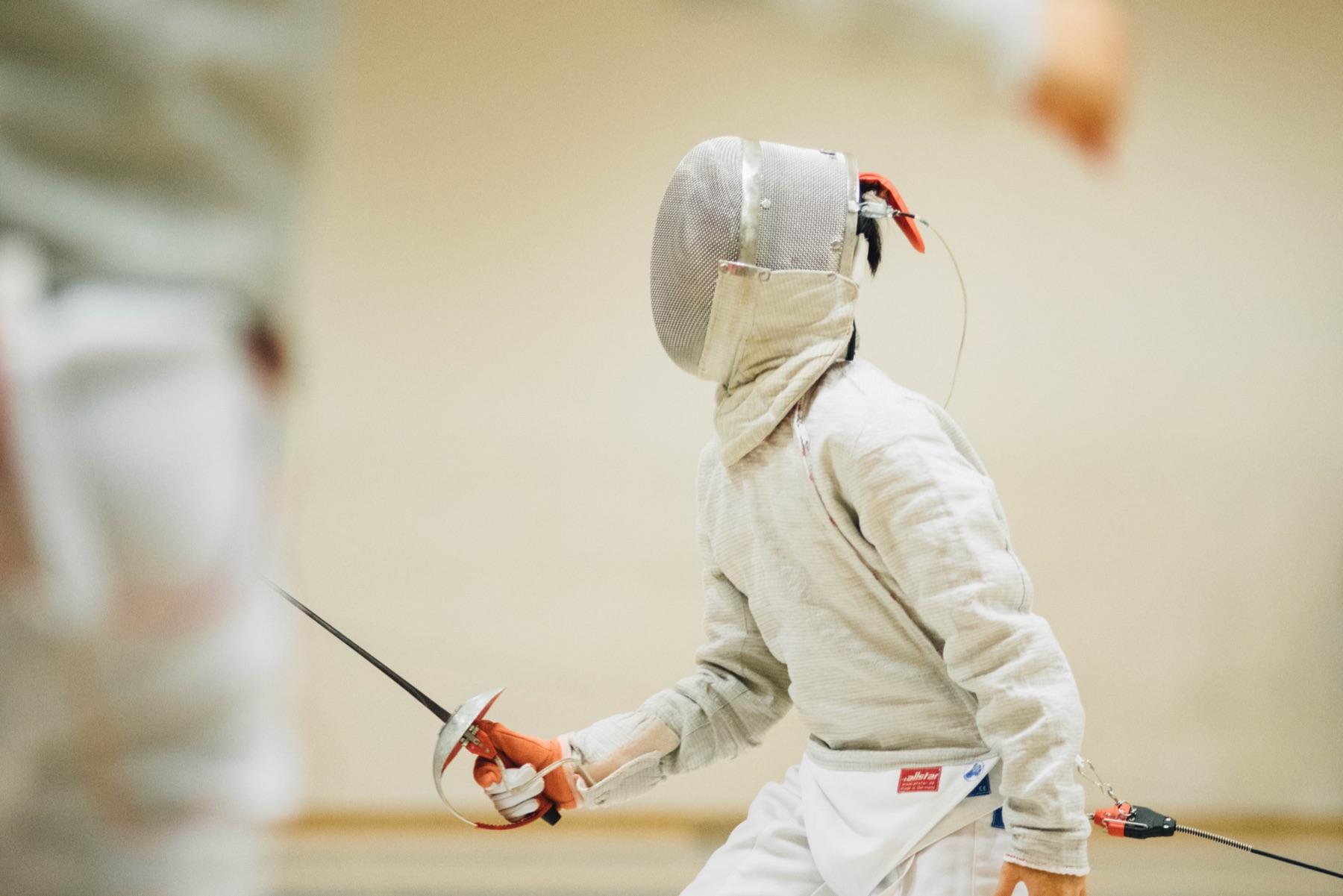
A school-age fencer on strip in a competition bout, mask and body cord on.
Photo: chuttersnap / CC0
Most girls who fence in college started the same way: a borrowed jacket at a local club, one weapon, and a few seasons learning what a real touch sounds like. Somewhere in high school the question shows up — from a parent, a teammate, or the girl herself. Can she keep fencing after graduation? Yes. Sometimes that means an NCAA roster. Sometimes it means a college club at a school that never sponsored varsity fencing. USA Fencing already publishes the directories and the recruiting hub that make either path workable.
The varsity map is small. As of August 2024, USA Fencing counted about 45 NCAA schools with fencing, across Divisions I, II, and III, in 16 states. Check the federation’s current program list for names, athletics sites, and whether a school fields women only or both genders. Soccer and swimming run far bigger. Fencing does not. On the women’s side, Asian American and Pacific Islander athletes are already a big share of that small pool: the NCAA’s 2024–25 demographics sheet puts AANHPI women at 28 percent of collegiate fencing participants — 213 athletes. The percentage looks large because the sport is tiny. The headcount is what a recruit is actually competing with.
In high school, varsity and club are different afternoons. A school team — when one exists — usually means free or low-cost practice, league dual meets, and a coach inside the athletic department. In a few cities with public-school fencing, that can carry her for four years. Club fencing is the USA Fencing member club: group classes, optional private lessons, regional and national tournaments, and a rating coaches across the country can read. Serious recruits often do both when the school offers the sport. Most American high schools do not, so the club is the whole pathway. Ask the athletic director once. Search USA Fencing’s Find a Club tool for the nearest strip. Ratings, NAC points, and the results sheet coaches skim usually come from there.
College splits the same way. An NCAA varsity team trains on an athletic-department calendar, travels to dual meets and invitationals, and can send fencers to NCAA regionals and the national championship. Some Division I and II programs award athletic aid, but fencing is an equivalency sport: a women’s Division I coach historically works with a small scholarship pool split across the roster. Partial awards are common. Full rides are rare. Ivy League programs give no athletic scholarships at all — need-based aid only — so recruiting there is often about admissions support instead of a monthly check.
College club fencing covers more campuses. USA Fencing lists collegiate clubs nationwide, and the United States Association of Collegiate Fencing Clubs runs championships for teams outside the NCAA varsity system. If she wants to keep fencing while she studies engineering at a school without a varsity strip, that is still a real team with its own calendar and travel budget.
Coaches find athletes through results first: regional opens, national events, and the rating next to her name. A short recruiting video helps — a few clean phrases with weapon, graduation year, and contact info up front. Skip the ten-minute montage. Email still works when NCAA rules allow it. Keep the note short: who she is, where she fences, recent results, GPA or a transcript summary, and a link to video.
USA Fencing’s College Connect platform is built for that handoff. Every NCAA fencing coach and every USA Fencing member in grades 8 through 12 already has an account to claim. The profile can pull verified results from the federation database, hold GPA and test scores, host video, and let athletes message coaches inside the rules. College fairs at national events now register through the same hub. If a coach goes quiet, check the contact calendar before you take it personally. Division I coaches may start recruiting communication on June 15 after her sophomore year, and in-person contact on August 1 before junior year. Division II and III open earlier on some steps. Rising sophomores and younger generally cannot meet NCAA coaches at Summer Nationals. A lot of silence is the rulebook.
Coach interest still is not an acceptance letter. A coach who likes her foil can ask admissions for a transcript read, invite an unofficial visit, or later support an application. Admissions decides. At selective schools that sponsor fencing, that support can matter a lot. It does not erase GPA, coursework, or testing where the school still uses it. A verbal “we’d love to have you” before applications open is encouragement. Ask what happens next: a transcript review, a campus visit date, courses the coach wants to see, or a written note that admissions will treat her as a recruited athlete. Write the answers down. Families get burned when they treat a strip-side chat like a contract.
Price the path before you double the tournament calendar. The first months are usually the cheapest — clubs loan beginner gear, and intro classes are meant to feel tryable. Once she sticks, a basic personal set often lands in the low hundreds of dollars; electric competition kits cost more. USA Fencing membership sits on top: Access for local events, Competitive when she needs regional and national entry. Club dues and private lessons are the monthly line that swings hardest by city. Travel is the surprise. A local league season plus a few regional opens is one budget. A year built around North American Cups and Summer Nationals is another — flights, hotels, missed school days, and entry fees stacked together. Serious junior pipelines aimed at the most selective NCAA programs can run into the tens of thousands of dollars a year. The New York Times has reported six-figure stretches for families chasing that Ivy and Notre Dame corridor.
Before you commit, ask the club what a realistic competitive year costs at her level — lessons, gear replacement, which tournaments actually move a rating, and which ones she can skip. Ask how many private lessons the coach thinks she needs, and what happens when a semester gets heavy. If a school team exists, ask whether it can carry part of the week so the club bill does not have to buy every touch.
Confirm whether her high school fields fencing. Join a USA Fencing club if she has not already. Pick one weapon and get enough local results that a rating means something. Claim College Connect in high school, put real results on the profile, and write coaches when the contact rules allow it. Keep a parallel list of schools with club teams for campuses she already likes. Put the budget in the same conversation as the dream school, so a coach’s email is not the first time anyone adds up airfare. She does not need to sit at No. 1 on a national points list to keep fencing after graduation. She needs a strip that fits her academics, a clear read on what a coach can promise, and adults who will not confuse a borrowed jacket in ninth grade with a scholarship in April.