
The greatest individual performances in sports history
Not records alone — moments when one athlete bent probability.
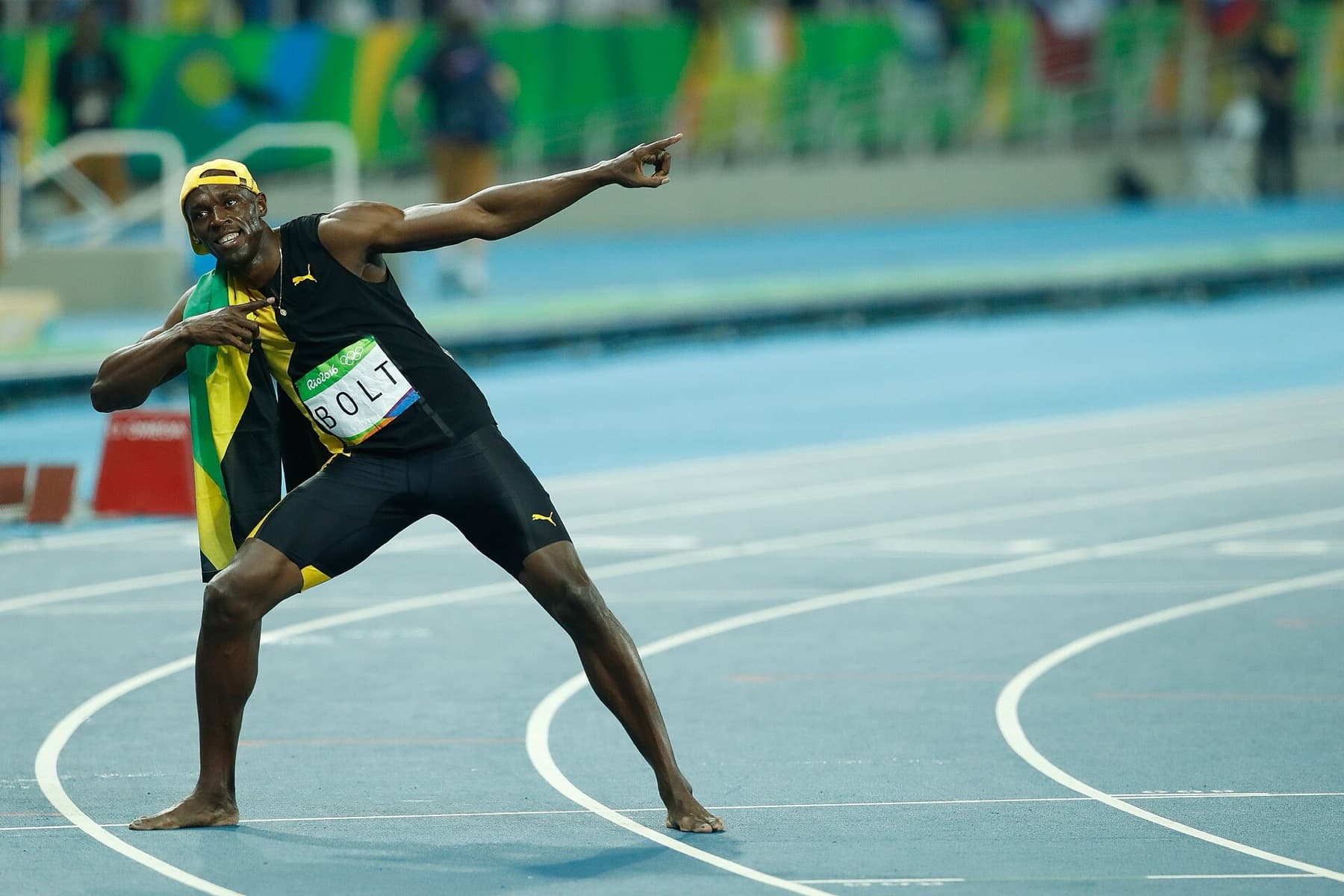
Usain Bolt winning the 100m final at Rio 2016 — a singular Olympic performance still used as a benchmark.
Photo: Fernando Frazão / Agência Brasil / CC BY 3.0 BR
Usain Bolt’s Rio 100 metres final was not his fastest night. He ran 9.81 seconds — slower than Beijing’s world record, slower than London’s Olympic record — and still became the first man to win three straight Olympic titles at the distance. Justin Gatlin had the season’s buzz; the field knew exactly where Bolt would be. The performance that lands in the museum is often the one that arrives after the world has adjusted for you.
Greatest individual performances are not the same as career greatness, and they are not simply personal bests. A career is a portfolio. A record is a number. The nights that stick are the ones that moved the distribution — when one athlete’s output sat so far from what the moment allowed that everyone watching had to rewrite the range of possible.
One useful filter is margin against the field and against expectation. Bob Beamon’s long jump of 8.90 metres at Mexico City in 1968 beat the world record by 55 centimetres; the adjective “Beamonesque” entered sports jargon because the gap was not incremental. Secretariat’s 1973 Belmont — 31 lengths, 2:24 for a mile and a half on dirt — is the same idea in a different language: a winner so far ahead that the race became a solo time trial with company still on the track. Wilt Chamberlain’s 100 points for the Philadelphia Warriors against the Knicks in Hershey on March 2, 1962, belongs here as a counting outlier, with the honest caveat that 1960s pace, defense, and scheduling make raw points a different currency than today’s box score.
Another filter is rescue under collapse. Kapil Dev’s unbeaten 175 off 138 balls against Zimbabwe at Tunbridge Wells in the 1983 World Cup came after India had fallen to 17 for 5. No other batter in the innings passed 25; India posted 266 for 8 and won by 31 runs, keeping a tournament alive that ended with a title at Lord’s. The BBC was elsewhere that day — no video of the knock exists — which is part of why it lives as oral history: a captain inventing a total from rubble. Michael Jordan’s 1997 Finals “flu game” (later described by Jordan as food poisoning) sits on a related shelf: 35 points in 44 minutes when the body looked finished, in a series that still needed winning. Adversity is not automatic greatness, but it changes the probability table the athlete is solving.
Some performances rewrite the scoring language itself. At Montreal in 1976, 14-year-old Nadia Comăneci earned the first perfect 10.0 in Olympic gymnastics on uneven bars; the scoreboard, not built for a 10, flashed 1.00. She collected more perfect marks across the Games and left with three golds. The number mattered less as trivia than as proof that the old ceiling had been a software limit. Michael Phelps’s Beijing 2008 haul — eight golds across a nine-day slate of individual races and relays, each in world or Olympic record time — is probability bent by volume: not one impossible race, but a session no program had survived at that density since Mark Spitz, and then beyond it.
Context still matters, and mythology can overclaim. Kerri Strug’s injured second vault in Atlanta 1996 locked a U.S. team gold in public memory; later reporting noted the Americans would likely have won the team title even without that attempt, and modern gymnastics culture has re-read the night as a warning about what athletes were asked to risk. A durable list of “greatest performances” should separate feats that expanded what skill can do from moments that mainly expanded what pain culture demanded.
How should a reader use a greatest-performances list, then? Ask four questions: Was the margin absurd relative to peers that day? Did the athlete solve a broken game state, not just pad a lead? Did the number change how the sport keeps score or talks about the event? And does the story still hold after the era’s rules, equipment, and incentives are named? Bolt at Rio passes a quieter version of the test — not the farthest leap past a record, but the rarest kind of repeat under full scouting. The highlight reel loves the first shock. The lasting category is the night when shock had already been priced in, and the athlete cleared it anyway.