
Yuka Saso won the same major under two flags
The 2021 U.S. Women’s Open lists her under the Philippines. The 2024 edition lists her under Japan. The two trophies make that choice concrete — without guessing what either flag meant to her.
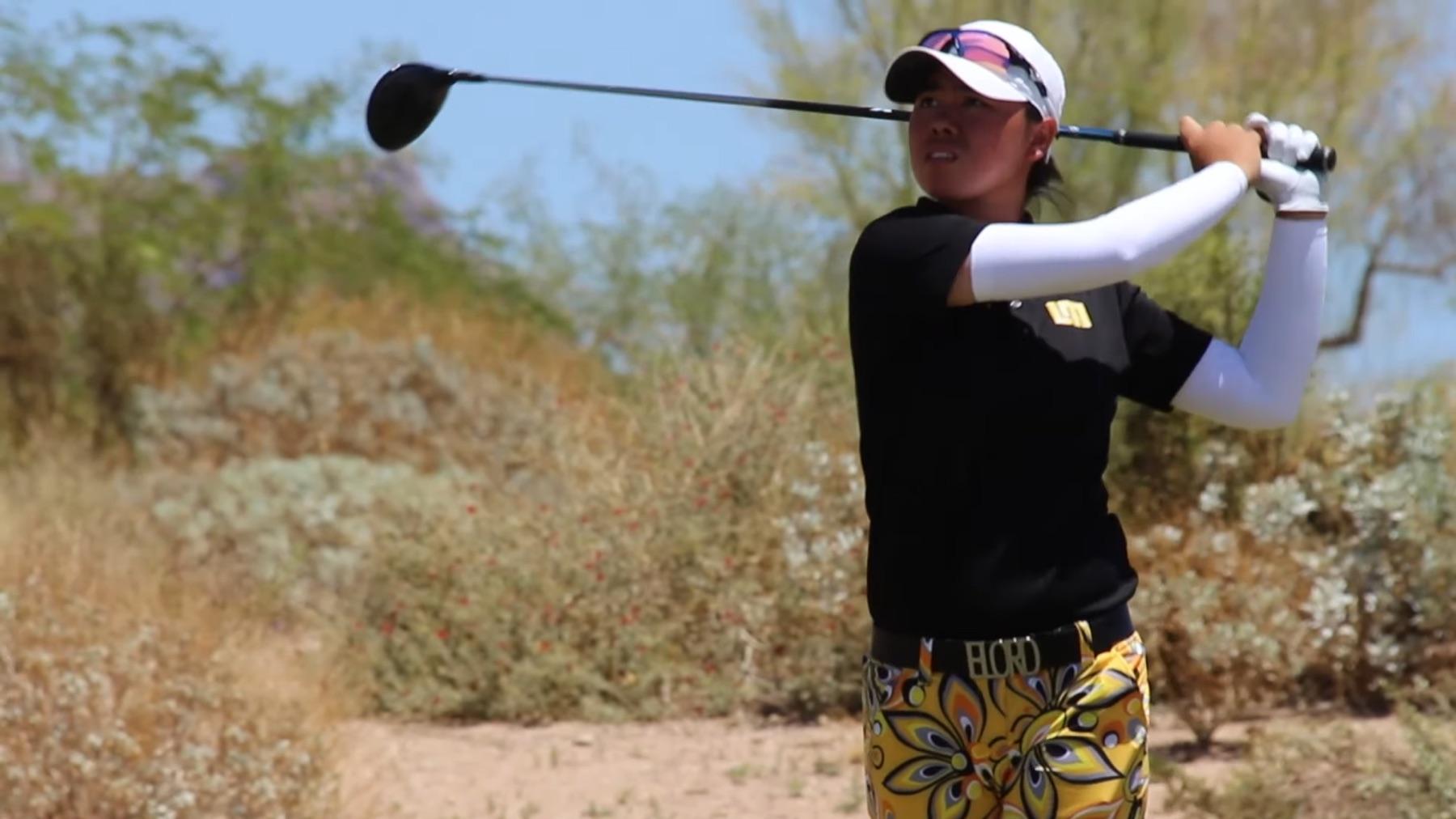
Yuka Saso in the follow-through at the 2018 Thunderbird International Junior — three years before she won the U.S. Women’s Open for the Philippines, and six before she won it again for Japan.
Photo: AJGAGolf / CC BY 3.0
On the U.S. Women’s Open champions’ list, the same name appears twice under different countries. In 2021 at The Olympic Club, the USGA sheet says Philippines. In 2024 at Lancaster Country Club, it says Japan. Yuka Saso is the first player in championship history to win the Harton S. Semple Trophy for two nations. Passport law, Olympic eligibility, and how she talks about her parents all sit around those two Sundays.
June 6, 2021, Lake Course, San Francisco. Saso closed in 73 for 4-under 280, tied Japan’s Nasa Hataoka after Lexi Thompson bogeyed the last two holes and fell one stroke short of the playoff. Saso birdied the first sudden-death hole after a two-hole aggregate finished even. She was 19 years, 11 months, and 17 days old — matching Inbee Park as the youngest champion to the day — and the first golfer from the Philippines to win a women’s major. The Philippine flag sat next to her name on the board.
Her mother, Fritzie, is Filipina. Her father, Masakazu, is Japanese. She was born June 20, 2001, in San Ildefonso, Bulacan. The family story was already there before any Tour paperwork.
June 2, 2024, Lancaster, Pennsylvania. Same major, same trophy, different country code. Saso shot 68-71-69-68 for 4-under 276 and won by three over Hinako Shibuno, another Japanese player. At 22 years, 11 months, and 13 days, she became the youngest multiple U.S. Women’s Open winner. It was also her first LPGA victory since Olympic Club. The USGA wrote the history in one line: first champion to hoist the trophy representing two countries. Saso put it in family terms. “Winning in 2021 I represented the Philippines. I feel like I was able to give back to my mom,” she told NBC. “This year I was able to represent Japan, and I think I was able to give back to my dad.”
Japan’s nationality law required her to choose one citizenship by early adulthood. Dual nationals cannot keep both indefinitely. In late 2021 she elected Japanese citizenship, and the LPGA listed her under Japan starting with the 2022 season. The National Golf Association of the Philippines had expected the move. Secretary general Bones Floro called it a “business decision” by Saso and her family — sad for the federation, understandable on a Tour calendar. Philippine Olympic Committee president Bambol Tolentino said the same: a Japanese passport means fewer visas, easier travel, and commercial doors that open more easily at home in Japan.
Saso has been blunt about the practical reason. “The main reason in choosing Japanese citizenship is the passport I will use to travel,” she told Philippine media in February 2022. Time management on a Tour that hops continents, she said, gets easier when most stops do not require a visa scramble. She has also kept saying what the paperwork did not erase. “I’ll be forever Filipino and Japanese. That will never change.” After Lancaster she put it another way: if she could put two flags beside her name, she would. Representing the Philippines never made her less Japanese, she said, and representing Japan never made her less Filipino.
What did change was who she could play for. Under the Philippine flag she won Asian Games individual and team gold in 2018 and finished tied for ninth at the Tokyo Olympics in 2021. Once she elected Japan, those national-team lanes closed. Qualifying for Paris became a Japanese fight — four players chasing two Olympic spots — and her second U.S. Open title helped lock her in beside Miyu Yamashita. At Le Golf National she said Tokyo had been her mother’s country on the sheet and Paris was her father’s. “Not a lot of people can experience this,” she said. “So I’m really grateful.”
The three years between Opens brought no LPGA wins and a lot of ordinary Tour weeks. She finished second at the 2023 Women’s PGA Championship and tied for third at the Evian. When Lancaster finally ended the drought, she cried on the green and talked about the wait, not the flag swap. “Since 2021 I haven’t won… after a long wait, I wasn’t expecting to win the U.S. Women’s Open.” The sweeter part, she said later, was doing her dream tournament twice.
Line the Sundays up once more. 2021: Saso, PHI, Olympic Club, 280, playoff. 2024: Saso, JPN, Lancaster, 276, three clear. Same player, same major, two country codes the USGA will not revise. She has asked people not to treat the second flag as abandonment. “Hopefully people will not think that I abandoned the Philippines, because I love the Philippines. I also love Japan,” she told AFP when the switch was still new. “It’s still the same me, it’s just the flag.” Both countries already have a U.S. Women’s Open champion named Yuka Saso. She has said, in public, what she wants each of those Sundays to mean for her parents.