
Why a World Cup winner left Chicago to play five games for a men’s club in Japan
In fall 2020 she left the Chicago Red Stars for Hayabusa Eleven — her brother’s amateur side in Kanagawa Prefecture League Division 2, about seven or eight levels below J1. In public she tied those five games to the equality fight she’d watched up close in the NWSL.
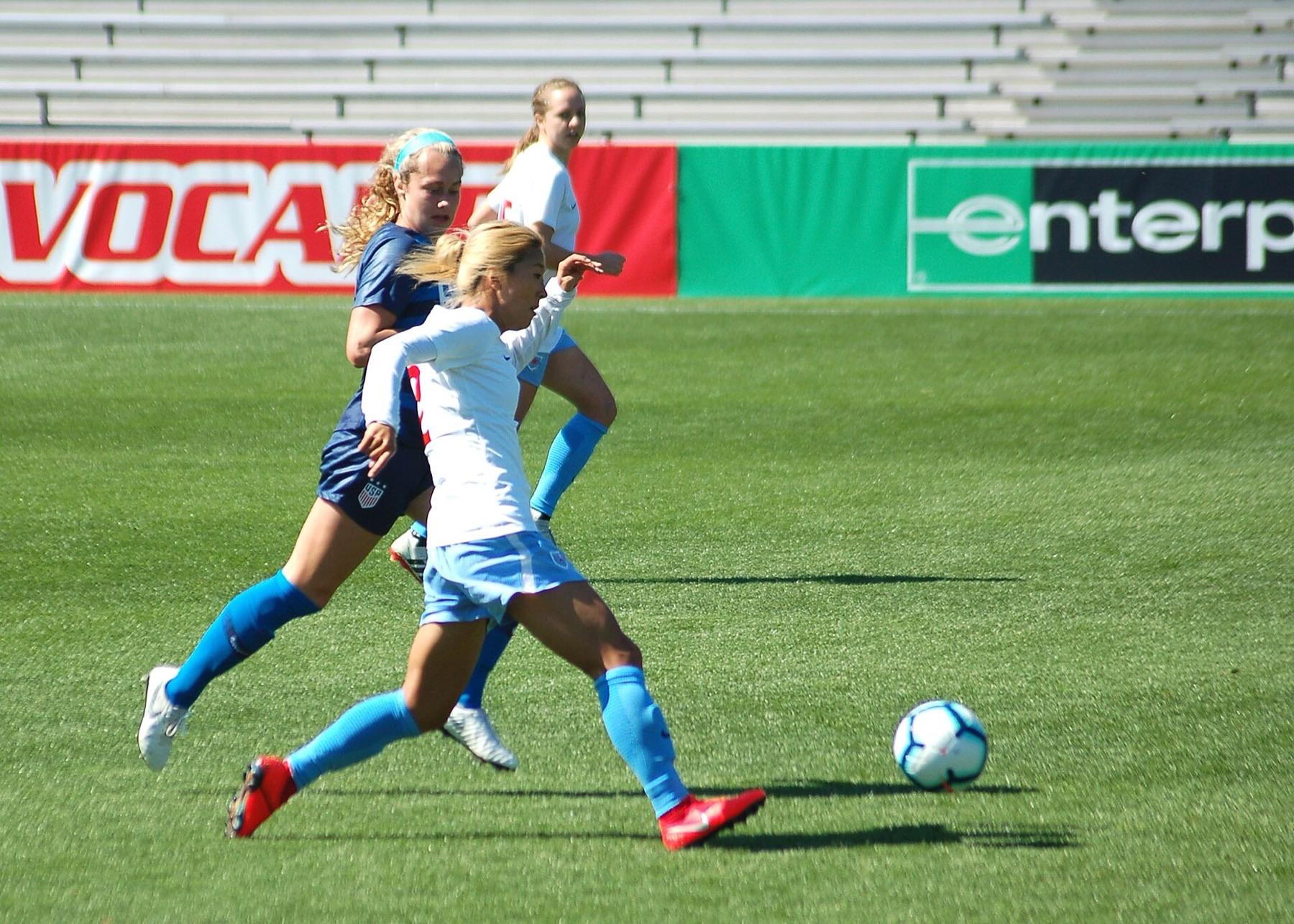
Yuki Nagasato in a Chicago Red Stars white kit in March 2019 — the NWSL club she left on loan the next fall for five games with her brother’s men’s amateur side in Atsugi.
Photo: Dana K. O. / CC BY-SA 2.0
In September 2020, Chicago Red Stars forward Yuki Nagasato flew home to Atsugi and joined a men’s club that most of the soccer world had never heard of. Hayabusa Eleven was her older brother Genki’s team. The loan covered the NWSL’s abbreviated Fall Series and the offseason. She made five appearances. That short run is the story — weekend prefectural soccer, not a J.League chapter.
Hayabusa Eleven played in Kanagawa Prefecture League Division 2, an amateur prefectural second division. Above it sit the Kantō regional leagues, then the semi-pro Japan Football League, then professional J3, J2, and J1. ESPN and BBC Sport both put Kanagawa’s second division roughly seven or eight rungs below the top flight. The Red Stars called the club amateur and still said Nagasato would play for it in a professional capacity. She was joining weekend men’s soccer in her hometown, several tiers below anything that shows up on a J.League broadcast.
She asked for the move. Genki, a former J.League forward and the club’s captain, had known for years that she wanted a men’s team. School friend Hayato Sato was on the roster; former Japan men’s international Yuichiro Nagai had signed that season too. The club itself was new — founded as Hayabusa Eleven in 2019 with a J.League ambition, starting in Kanagawa’s third division and promoted into the second for 2020. A pandemic-shortened schedule put 28 Division 2 sides into four seven-team blocks. Nagasato had started Chicago’s first two NWSL Challenge Cup games that summer, then sat with a left-leg injury. When the Fall Series offered only a handful of matches, several Red Stars took overseas loans. Hers went to Atsugi.
What she said at the unveiling was not about fitness alone. She had watched Megan Rapinoe turn the 2019 Women’s World Cup into a running argument about equal pay and who counts. Nagasato had been living that fight from the NWSL side — in the same league that shared a calendar and a set of arguments with the U.S. women’s national team’s equal-pay case. “I was really inspired by messages on gender gap by Rapinoe at the World Cup and I was wondering if I could also send a message to the society,” she told reporters. “I thought I could show that women can also play in a men’s team. I want to help create a community where there is no boundary regarding gender or race.”
Later she put it even more plainly. “I don’t want people to see just gender, I want people to see a human,” she told BBC Sport. The decision felt casual to her — joining a men’s side the way she’d join any side — and she was surprised when the cameras treated it as seismic. She had played boys’ soccer as a kid before switching to girls’ football at 12. A World Cup winner’s résumé made the ask possible: 2011 gold, 2015 silver, 2012 Olympic silver, a Champions League title with Turbine Potsdam, 58 goals in 132 caps. After years around the U.S. equal-pay fight, she wanted the loan to mean more than keeping fit until spring.
The debut, in October, was a closed-doors 3–1 win over Sanno FC. Television crews still lined the hedge. “It was low key, but a lot of TV came to have interviews with me — it was crazy,” she said. “They made me feel strange. I was, ‘oh, this is not a big thing for me, don’t give me pressure like that.’ But I played as I can and I played for the team, not myself.” She finished with five appearances as Hayabusa topped its block. Still nursing the Challenge Cup injury, she started only the last of those games and completed 70 minutes in a 2–1 win over Verdrero Kohoku. That result set up a promotion semi-final she was not registered to play. Kanagawa University edged it 1–0 without her.
On the pitch she was almost matter-of-fact about the gap. The men were quicker; her answer was faster decisions. “I can beat men’s players with my quick decision making,” she told FIFA.com. To BBC Sport she put it in plainer terms: everything is faster than a women’s team, “but it’s not a big, big, difference.” The boys were welcoming, and chemistry with Genki felt normal. “I felt there was no barrier there and it was easy.” Afterward she said the stint raised her ceiling — women’s matches no longer felt like the fastest football she had to handle.
Midway through the loan, Chicago traded her and Savannah McCaskill to expansion Racing Louisville for full roster protection in the November expansion draft. The Red Stars had said she would return for 2021 preseason; the paperwork changed while she was still in yellow and green. She finished the five games, then carried the same argument into Kentucky. Kids should be able to dream about a men’s team, she said, not only a women’s one. “I wish it would have been more normal, what I did. I hope more women’s players can apply to their men’s team.”
Five prefectural appearances will not redraw Japan’s men’s ladder. They do show what a World Cup winner chose to do with an empty NWSL fall: walk into her brother’s amateur Division 2 side and try the equality argument on grass, in Atsugi, for five games.