
Event Guide
Global Football Guide
The world's game, in context
The first 48-team World Cup — format, final weekend, and the business of a three-country tournament.
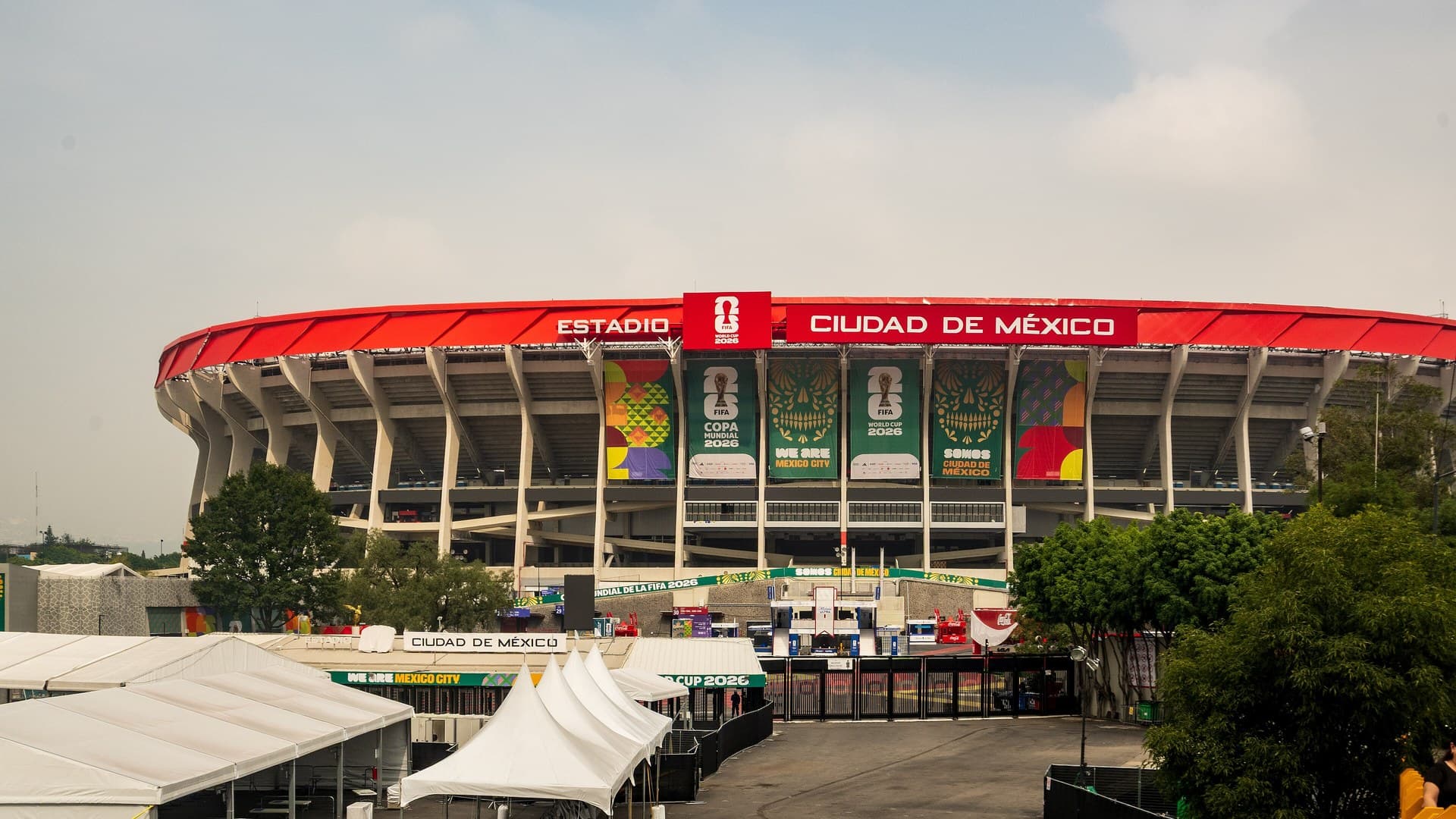
Estadio Ciudad de México (Azteca) dressed for the 2026 World Cup — the venue that opened the tournament on June 11.
Photo: ProtoplasmaKid / CC BY 4.0
Overview
This guide is built around the first 48-team FIFA World Cup — 104 matches across Canada, Mexico, and the United States from June 11 to July 19, 2026. It is not a live scores board. It is the context layer: how the expanded format remapped the month, what the final tested, and why the commercial story of this Cup may matter as much as the trophy.
Spain beat Argentina 1–0 after extra time at New York New Jersey Stadium on July 19 — Ferran Torres in the 106th minute — to claim a second world title and complete a Euro 2024–World Cup 2026 double. Argentina finished with ten men after Enzo Fernández’s late red card; Lionel Messi’s sixth World Cup ended in tears and without a final goal. France took fourth after England won the bronze match in Miami.
North America’s hosting plotline closed early. Canada, Mexico, and the United States all exited in the Round of 16 — Morocco 3–0, England 3–2, Belgium 4–1 — leaving a three-country Cup without a host in the last eight. Asia’s story was sharper than the scorelines suggest: Japan led Brazil in Houston before Gabriel Martinelli’s stoppage-time winner ended another first-knockout exit; Australia fell to Egypt on penalties after reaching the Round of 32. No AFC side reached the Round of 16.
Key Dates
Tournament opens
Mexico City Stadium hosts the first of 104 matches in the expanded field.
Group stage ends
12 groups of four; top two plus eight best thirds advance to a new Round of 32.
Round of 16 begins
Host nations begin exiting; Morocco, Norway, and Belgium deliver defining nights.
Spain reach the final
Oyarzabal and Porro beat France 2–0 in Dallas; La Roja’s second World Cup final.
Argentina join them
Fernández and Lautaro Martínez overturn England after Gordon’s opener in Atlanta.
Bronze final
France vs England at Miami Stadium — Mbappé, Kane, and Bellingham still in the Golden Boot race.
World Cup final
Spain 1–0 Argentina after extra time — Ferran Torres 106’ — at New York New Jersey Stadium.
What Happened
Opening Round story
48 teams, then a new Round of 32
Twelve groups sent 32 sides into the first World Cup Round of 32. Expansion favorites and debutants mixed; the format’s real test arrived when eight best thirds filled the bracket.
Round of 32
Cape Verde nearly topples Argentina; Japan leads Brazil until stoppage time
Messi’s holders needed extra time and an own goal to survive Cabo Verde 3–2 in Miami. Japan led Brazil in Houston before Martinelli’s 90+5 winner (2–1). Australia fell to Egypt on penalties after 1–1.
Round of 16
All three hosts exit in four days
Morocco 3–0 Canada, England 3–2 Mexico, Belgium 4–1 USA. Norway’s Haaland brace beat Brazil 2–1; Switzerland edged Colombia on penalties; Spain beat Portugal 1–0.
Quarter-finals
Europe’s top four plus the holders
France 2–0 Morocco, Spain 2–1 Belgium, England 2–1 Norway (a.e.t.), Argentina 3–1 Switzerland (a.e.t.). FIFA’s pre-tournament top four occupied the last four.
Semi-finals
Spain 2–0 France; Argentina 2–1 England
Oyarzabal (pen) and Porro beat Les Bleus in Dallas. Gordon put England ahead in Atlanta before Fernández and Lautaro Martínez flipped the holders into a seventh World Cup final.
Final
Spain 1–0 Argentina (a.e.t.) — Torres 106’
Ferran Torres’ extra-time winner delivered Spain’s second World Cup and a Euro–World Cup double. Enzo Fernández was sent off late in regulation; Messi finished scoreless in the final. England beat France 6–4 for bronze; Mbappé took the Golden Boot with 10 goals.
How This Tournament Works
48 teams, 12 groups
Each side plays three group games. The top two in every group advance automatically. Eight of the twelve third-placed teams join them — filling a 32-team knockout bracket that did not exist in the old 32-team Cup.
One extra knockout round
Champions now need eight wins from group stage through the final, not seven. That Round of 32 is where Japan, Australia, and several expansion stories ended — and where Norway’s Haaland run against Brazil began.
Three countries, four time zones
Sixteen host cities stretch nearly 2,800 miles. Cluster scheduling helped some squads; others lived on flights. Travel fatigue became a competitive subplot once the knockout map scattered teams across borders.
Athletes & Teams to Watch
Lionel Messi
Football · Argentina
39; six World Cups, eight goals this summer, tears after a scoreless final that may close his international career.
Lamine Yamal
Football · Spain
Youngest player to win both a European Championship and a World Cup; led the final in shots and dribbles at 19.
Kylian Mbappé
Football · France
First player to win consecutive Golden Boots (10 goals); now the men’s World Cup all-time scoring leader with 22.
Erling Haaland
Football · Norway
Two against Brazil sent Norway to a first-ever World Cup quarter-final; the month’s clearest proof that the expanded bracket still produces shocks.
Japan
Football · Japan
Eighth straight finals, led Brazil deep into Houston, still waiting on a first knockout win — the APAC measuring stick this Cup.
Strategy & Rules
History & Context
Expansion from 32 to 48 was sold as access and drama. On the pitch it also diluted group-stage jeopardy: with eight third-placed sides advancing, draws often served both teams, and several matchday-three fixtures arrived already decided. Critics called the third-place race luck-of-the-draw; FIFA kept the structure that guaranteed every side three games.
Sunday’s final was the first World Cup decider between the reigning European and South American champions, and the first meeting of FIFA’s top two ranked teams in a final since rankings began. Spain claimed a second title sixteen years after 2010; Argentina fell short of becoming the first back-to-back champions since Brazil in 1958–62. Their only previous World Cup meeting was a 1966 group game Argentina won 2–1.
Asia’s pathway into this Cup was already a story before the first whistle — Japan and Australia through a brutal AFC third-round group, South Korea and Jordan from another. The finals confirmed the familiar ceiling: Japan competitive against Brazil until the last kick, Australia competitive until a shootout. Closing that gap is still the region’s next-cycle project.
Business & Media
FIFA has framed 2026 as a record commercial cycle — tournament revenue projections in the high single-digit billions, with media rights alone cited around $3.8 billion and sponsorship near $2.4 billion in analyst estimates. More matches mean more inventory; a U.S. summer kickoff means primetime windows Fox and Telemundo already paid to own.
Fox’s English-language U.S. rights (~$485 million) and Telemundo’s Spanish package are widely treated as below open-market value — a hangover from FIFA’s 2022 calendar shift compensation — which is why 2030/2034 talks already float combined English–Spanish bids in the $1.5–2 billion range per Cup. Host exits hurt narrative, but group-stage volume and retransmission fees still make the month a balance-sheet win.
Dynamic ticketing and resale fees turned the final weekend into a pricing story as much as a football story. The next rights cycle will price whether North American hosting was a one-off windfall or the new floor for football’s biggest product.
Related Guides
Update Log
- Added What Happened knockout highlights through final weekend; Spain–Argentina final package live.
- Full live package: Spain–Argentina final weekend, 48-team format cards, hosts/APAC wrap, Azteca hero.
- Pre-tournament APAC qualification tracker and evergreen scaffold.
The Medalist Briefing
Weekly intelligence on global sport, pathways, and the stories behind the scores. No noise. No betting picks.